
ปัจจัยที่มีอิทธิพลต่อความรุนแรงของผู้ป่วยโรคไข้เลือดออก อำเภอจุฬาภรณ์ จังหวัดนครศรีธรรมราช
Article Sidebar
Main Article Content
บทคัดย่อ
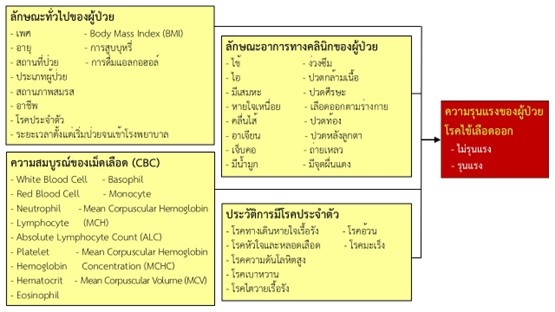
โรคไข้เลือดออกเป็นปัญหาสาธารณสุขที่สำคัญของประเทศไทยโดยเฉพาะในเขตพื้นที่เมือง การแพร่ระบาดและอัตราป่วยตายมีแนวโน้มเพิ่มสูงขึ้นอย่างต่อเนื่องแม้จะมีนวัตกรรมการป้องกันโรค การวิจัยแบบผลมาหาเหตุครั้งนี้มีวัตถุประสงค์เพื่อ 1) ศึกษาลักษณะทั่วไปของผู้ป่วยโรคไข้เลือดออก 2) เพื่อวิเคราะห์ลักษณะทางคลินิกของผู้ป่วยโรคไข้เลือดออก 3) เพื่อวิเคราะห์ปัจจัยที่มีอิทธิพลต่อการเกิดความรุนแรงของผู้ป่วยโรคไข้เลือดออก ดำเนินการศึกษาในผู้ป่วยยืนยันโรคไข้เลือดออก (รหัส 506) จำนวน 438 ราย ในช่วงปี พ.ศ. 2556–2568 วิเคราะห์ข้อมูลด้วยสถิติเชิงพรรณนาและสถิติถดถอยโลจิสติก (Binary และ Multiple Logistic Regression) เพื่อหาค่า Odds Ratio (OR) ที่ระดับนัยสำคัญ 0.05
ผลการวิจัยพบว่ากลุ่มตัวอย่างส่วนใหญ่เป็นเพศชาย (ร้อยละ 53.9) กลุ่มอายุ 10–19 ปี (ร้อยละ 35.6) และส่วนใหญ่เป็นนักเรียน (ร้อยละ 62.8) อาการทางคลินิกที่พบมากที่สุดคือ ไข้ (ร้อยละ 95.9) รองลงมาคือ ไอ และปวดกล้ามเนื้อ ผลการวิเคราะห์ปัจจัยที่มีอิทธิพลต่อความรุนแรงของโรค พบว่าปัจจัยที่มีนัยสำคัญทางสถิติ ได้แก่ ภาวะเกล็ดเลือดต่ำกว่า 100,000 cells/mm3 (OR=194.63) ระยะเวลาเริ่มป่วยจนถึงโรงพยาบาลที่ล่าช้า (OR=118.39) การมีโรคประจำตัว (OR = 10.72), อาการปวดท้อง (OR = 4.62), เลือดออกตามร่างกาย (OR = 4.19) และภาวะโภชนาการเกินหรือ BMI ≥ 25 (OR = 1.70)
ข้อสรุปที่สำคัญจากการวิจัยครั้งนี้คือ ความล่าช้าในการเข้าถึงบริการทางการแพทย์และภาวะเกล็ดเลือดต่ำเป็นตัวพยากรณ์ความรุนแรงที่สำคัญที่สุด รวมถึงกลุ่มผู้ป่วยที่มีโรคประจำตัวและภาวะอ้วนมีความเสี่ยงสูงต่อการเกิดโรคขั้นรุนแรง ข้อเสนอแนะเชิงนโยบายคือควรนำปัจจัยเสี่ยงเหล่านี้ไปพัฒนาระบบคัดกรองผู้ป่วย (Triage System) ในสถานพยาบาลระดับปฐมภูมิเพื่อลดอัตราความรุนแรงและการเสียชีวิตในอนาคต
Article Details

อนุญาตภายใต้เงื่อนไข Creative Commons Attribution-NonCommercial-NoDerivatives 4.0 International License.
บทความที่ได้รับการตีพิมพ์เป็นลิขสิทธิ์ของสำนักงานป้องกันควบคุมโรคที่ 11 จังหวัดนครศรีธรรมราช (Office of Disease Prevention and Control Region 11 Nakhon Sri Thammarat)
ข้อความที่ปรากฏในบทความแต่ละเรื่องในวารสารวิชาการเล่มนี้เป็นความคิดเห็นส่วนตัวของผู้เขียนแต่ละท่านไม่เกี่ยวข้องกับสำนักงานป้องกันควบคุมโรคที่ 11 จังหวัดนครศรีธรรมราช และ บุคคลากรท่านอื่น ๆในสำนักงานฯ แต่อย่างใด ความรับผิดชอบองค์ประกอบทั้งหมดของบทความแต่ละเรื่องเป็นของผู้เขียนแต่ละท่าน หากมีความผิดพลาดใดๆ ผู้เขียนแต่ละท่านจะรับผิดชอบบทความของตนเองแต่ผู้เดียว
ห้ามนำข้อความทั้งหมด หรือบางส่วนไปพิมพ์ซ้ำ เว้นแต่จะได้รับอนุญาตจากกองบรรณาธิการวารสาร
เอกสารอ้างอิง
World Health Organization. Dengue: guidelines for diagnosis, treatment, prevention and control [อินเทอร์เน็ต]. [สืบค้นเมื่อ 19 ตุลาคม 2567]. แหล่งข้อมูล: https://www.who.int/publications/i/item/9789241547871
Parveen S, Riaz Z, Saeed S, Ishaque U, Sultana M, Faiz Z, et al. Dengue hemorrhagic fever: a growing global menace. J Water Health 2023 Nov;21(11):1632-50. doi: 10.2166/wh.2023.114
Simmons CP, Farrar JJ, Nguyen v V, Wills B. Dengue. N Engl J Med 2012;366(15):1423–32. doi: 10.1056/NEJMra1110265
Endy TP, Chunsuttiwat S, Nisalak A, Libraty DH, Green S, Rothman AL, et al. Epidemiology of inapparent and symptomatic acute dengue virus infection: a prospective study of primary school children in Kamphaeng Phet, Thailand. Am J Epidemiol 2002;156(1):40-51. doi: 10.1093/aje/kwf005
World Health Organization. Dengue and severe dengue [อินเทอร์เน็ต]. [สืบค้นเมื่อ 5 กันยายน 2568]. แหล่งข้อมูล: https://www.who.int/news-room/fact-sheets/detail/dengue-and-severe-dengue
Flasche S, Jit M, Rodríguez-Barraquer I, Coudeville L, Recker M, Koelle K, et al. The long-term safety, public health impact, and cost-effectiveness of routine vaccination with a recombinant, live-attenuated dengue vaccine (Dengvaxia): a model comparison study. PLoS Med 2016;13(11):e1002181. doi: 10.1371/journal.pmed.1002181
Sridhar S, Luedtke A, Langevin E, Zhu M, Bonaparte M, Machabert T, et al. Effect of dengue serostatus on dengue vaccine safety and efficacy. N Engl J Med 2018;379(4):327-40. doi: 10.1056/NEJMoa1800820
Yeh CY, Chen PL, Chuang KT, Shu YC, Chien YW, Perng GC, et al. Symptoms associated with adverse dengue fever prognoses at the time of reporting in the 2015 dengue outbreak in Taiwan. PLoS Negl Trop Dis 2017;11(12):e0006091. doi: 10.1371/journal.pntd.0006091
Gibson G, Souza-Santos R, Pedro AS, Honório NA, Carvalho MS. Occurrence of severe dengue in Rio de Janeiro: an ecological study. Rev Soc Bras Med Trop. 2014 Nov-Dec;47(6):684-91. doi: 0.1590/0037-8682-0223-2014
Kapuria D, Takyar VK, Etzion O, Surana P, O'Keefe JH, Koh C. Association of hepatic steatosis with Subclinical atherosclerosis: systematic review and meta-analysis. Hepatol Commun 2018;2(8):873-83. doi: 10.1002/hep4.1199
Anders KL, Nguyet NM, Chau NV, Hung NT, Thuy TT, Lien le B, et al. Epidemiological factors associated with dengue shock syndrome and mortality in hospitalized dengue patients in Ho Chi Minh City, Vietnam. Am J Trop Med Hyg 2011;84(1):127-34. doi: 10.4269/ajtmh.2011.10-0476
กรมควบคุมโรค กระทรวงสาธารณสุข. โรคไข้เลือดออกเด็งกี [อินเทอร์เน็ต]. [สืบค้นเมื่อ 16 ตุลาคม 2568]. แหล่งข้อมูล: https://www.ddc.moph.go.th/disease_detail.php?d=6
สุรชาติ โกยดุลย์, อดิศักดิ์ ภูมิรัตน์. นิเวศระบาดวิทยาและพลวัตการแพร่ไวรัสเด็งกี่. วารสารสาธารณสุขมหาวิทยาลัยบูรพา 2565;17(1);44-57.
Rahman MS, Ekalaksananan T, Zafar S, Poolphol P, Shipin O, Haque U, et al. Ecological, social, and other environmental determinants of dengue vector abundance in urban and rural areas of Northeastern Thailand. Int J Environ Res Public Health 2021;18(11):5971. doi: 10.3390/ijerph18115971
Saifur RG, Dieng H, Hassan AA, Salmah MR, Satho T, Miake F, et al. Changing domesticity of Aedes aegypti in northern Peninsular Malaysia: reproductive consequences and potential epidemiological implications. PLoS One 2012;7(2):e30919. doi: 10.1371/journal.pone.0030919
Meyer WB, Turner BL. Human population growth and global land-use/cover change. Annu Rev Ecol Syst 1992;23:93–61.
Pakaya R, Daniel D, Widayani P, Utarini A. Spatial model of Dengue Hemorrhagic Fever (DHF) risk: scoping review. BMC Public Health 2023;23(1):2448. doi: 10.1186/s12889-023-17185-3
Akter R, Hu W, Naish S, Banu S, Tong S. Joint effects of climate variability and socioecological factors on dengue transmission: epidemiological evidence. Trop Med Int Health 2017;22(6):656-69. doi: 10.1111/tmi.12868
Zellweger RM, Cano J, Mangeas M, Taglioni F, Mercier A, Despinoy M, et al. Socioeconomic and environmental determinants of dengue transmission in an urban setting: an ecological study in Nouméa, New Caledonia. PLoS Negl Trop Dis 2017;11(4):e0005471. doi: 10.1371/journal.pntd.0005471
กองโรคติดต่อนำโดยแมลง กรมควบคุมโรค กระทรวงสาธารณสุข. สถานการณ์โรคไข้เลือดออก [อินเทอร์เน็ต]. [สืบค้นเมื่อ 14 เมษายน 2568]. แหล่งข้อมูล: https://ddc.moph.go.th/dvb/pagecontent.php?page=1269&dept=dvb
Sangkaew S, Ming D, Boonyasiri A, Honeyford K, Kalayanarooj S, Yacoub S, et al. Risk predictors of progression to severe disease during the febrile phase of dengue: a systematic review and meta-analysis. Lancet Infect Dis 2021;21(7):1014–26. doi: 10.1016/S1473-3099(20)30601-0
Abualamah WA, Banni HS, Almasmoum HA, Allohibi YA, Samarin HM, Bafail MA. Determining risk factors for dengue fever severity in Jeddah City, a case-control study (2017). Pol J Microbiol 2020;69(3):331–7. doi: 10.33073/pjm-2020-036
Huy NT, Van Giang T, Thuy DH, Kikuchi M, Hien TT, Zamora J, et al. Factors associated with dengue shock syndrome: a systematic review and meta-analysis. PLoS Negl Trop Dis 2013;7(9):e2412. doi: 10.1371/journal.pntd.0002412
Paraná VC, Feitosa CA, da Silva GCS, Gois LL, Santos LA. Risk factors associated with severe dengue in Latin America: a systematic review and meta-analysis. Trop Med Int Health 2024;29(3):173–91. doi: 10.1111/tmi.13968
Carras M, Maillard O, Cousty J, Gérardin P, Boukerrou M, Raffray L, et al. Associated risk factors of severe dengue in Reunion Island: a prospective cohort study. PLoS Negl Trop Dis 2023;17(4):e0011260. doi: 10.1371/journal.pntd.0011260
Copaja-Corzo C, Flores-Cohaila J, Tapia-Sequeiros G, Vilchez-Cornejo J, Hueda-Zavaleta M, Vilcarromero S, et al. Risk factors associated with dengue complications and death: a cohort study in Peru. PLoS One 2024;19(6):e0305689. doi: 10.1371/journal.pone.0305689
Chagas GCL, Rangel AR, Noronha LM, Veloso FCS, Kassar SB, Oliveira MJC, et al. Risk factors for mortality in patients with dengue: a systematic review and meta-analysis. Trop Med Int Health 2022;27(8):656–68. doi: 10.1111/tmi.13797
วัชรี แก้วนอกเขา, เสาวพักตร์ ฮิ้นจ้อย, ดารินทร์ อารีย์โชคชัย. การศึกษาปัจจัยเสี่ยงต่อการเสียชีวิตของผู้ป่วยโรคไข้เลือดออกช็อก ปี พ.ศ. 2546 - 2556 ประเทศไทย. รายงานการเฝ้าระวังทางระบาดวิทยาประจำสัปดาห์ 2558;46:129-36.
ยุทธ ไกยวรรณ์. หลักการและการใช้การวิเคราะห์การถดถอยโลจิสติกสำหรับการวิจัย. วารสารวิจัยมหาวิทยาลัยเทคโนโลยีราชมงคลศรีวิชัย 2555;4(1):1-12.
อรทัย เจริญสิทธิ์. การวิเคราะห์การถดถอยโลจิสติกแบบไบนารีสำหรับการวิจัยทางสังคมศาสตร์. SAU Journal of Social Sciences and Humanities 2017;1(2):1-9.
Tsheten T, Clements ACA, Gray DJ, Adhikary RK, Furuya-Kanamori L, Wangdi K. Clinical predictors of severe dengue: a systematic review and meta-analysis. Infect Dis Poverty 2021;10(1):123. doi: 10.1186/s40249-021-00908-2
Yuan K, Chen Y, Zhong M, Lin Y, Liu L. Risk and predictive factors for severe dengue infection: a systematic review and meta-analysis. PLoS One 2022;17(4):e0267186. doi: 10.1371/journal.pone.0267186
Zulkipli MS, Rampal S, Bulgiba A, Peramalah D, Jamil N, See LLC, et al. Is there any association between body mass index and severity of dengue infection? Trans R Soc Trop Med Hyg 2021;115(7):764–71. doi: 10.1093/trstmh/trab021
Thach TQ, Eisa HG, Hmeda AB, Faraj H, Thuan TM, Abdelrahman MM, et al. Predictive markers for the early prognosis of dengue severity: a systematic review and meta-analysis. PLoS Negl Trop Dis 2021;15(10):e0009808. doi: 10.1371/journal.pntd.0009808
Htun TP, Xiong Z, Pang J. Clinical signs and symptoms associated with WHO severe dengue classification: a systematic review and meta-analysis. Emerg Microbes Infect 2021;10(1):1116–28. doi: 10.1080/22221751.2021.1935327
