
Efficacy of CPAP 5 cmH2O during cardiopulmonary bypass on partial pressure of oxygen in elderly patients undergoing cardiac surgery
Article Sidebar
Main Article Content
บทคัดย่อ
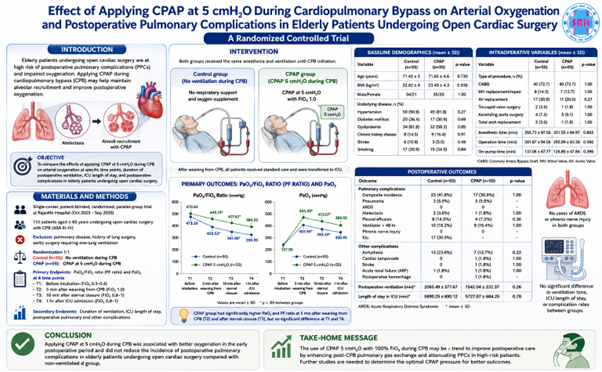
The number of elderly patients undergoing open-heart surgery is rising due to increase in life expectancy. Despite advances in surgical techniques and perioperative care, postoperative pulmonary complications (PPCs) remain common, often indicated by reduced arterial oxygen levels influencing ventilator weaning. Oxygenation decline may result from pulmonary collapse during Cardiopulmonary Bypass (CPB), ischemia-reperfusion injury, inflammation, and impaired alveolar-capillary function. Continuous Positive Airway Pressure (CPAP) 5 cm during CPB on arterial oxygenation and postoperative pulmonary complications (PPCs) in elderly patients. This single-center randomized controlled study included 110 elderly patients undergoing open-heart surgery with CPB. Patients were assigned to one of two intraoperative ventilation strategies: (1) no mechanical ventilation and no oxygen supplied during CPB (control group) or (2) CPAP at 5 cm
during CPB (CPAP group). Arterial blood gas samples were collected at multiple consecutive stages throughout the surgery. Postoperative outcomes included mechanical ventilation duration, intensive care unit (ICU) stay, and PPCs incidence.
The CPAP group showed significantly higher Pa/Fi
ratios and PaO2 at 5 minutes post-CPB (403.53±104.43 mmHg and 403.5±104.42 mmHg in control group vs. 445.20±85.31 mmHg and 445.19±85.30 mmHg in CPAP group, p = .024) and after sternal closure (361.90±139.48 mmHg and 353.33±149.30 mmHg in control group vs. 417.42±117.90 mmHg and 413.07±125.87 mmHg in CPAP group, P=0.026 and P=0.025 respectively), but not after ICU admission. No differences were found in PPCs incidence (42% control versus 31% CPAP), ICU stay (p = .78) and extubating time (p = .26).
Appling CPAP 5 cm during CPB was associated with better oxygenation in early stage and did not reduce the incidence of PPCs in elderly patients undergoing cardiac surgery
Article Details

อนุญาตภายใต้เงื่อนไข Creative Commons Attribution-NonCommercial-NoDerivatives 4.0 International License.
เอกสารอ้างอิง
Alavi M, Pakrooh B, Mirmesdagh Y, Bakhshandeh H, Babaee T, Hosseini S, et al.(2013) The effects of positive airway pressure ventilation during cardiopulmonary bypass on pulmonary function following open heart surgery. Res Cardiovasc Med;2(2):79-84. https://doi.org/10.5812/cardiovascmed.9090
Apostolakis E, Filos KS, Koletsis E, Dougenis D.(2010) Lung dysfunction following cardiopulmonary bypass. J Card Surg;25(1):47-55. https://doi.org/10.1111/j.1540-8191.2009.00936.x
Ball L, Costantino F, Pelosi P. (2016)Postoperative complications of patients undergoing cardiac surgery. Current Opinion Crit Care;22(4):386-92. https://doi.org/10.1097/MCC.0000000000000323
Berry CB, Butler PJ, Myles PS.(1993) Lung management during cardiopulmonary bypass: is continuous positive airways pressure beneficial? Br J Anaesth;71(6):864-8. https://doi.org/10.1093/bja/71.6.864
Chi D, Chen C, Shi Y, Wang W, Ma Y, Zhou R, et al.(2017) Ventilation during cardiopulmonary bypass for prevention of respiratory insufficiency: a meta-analysis of randomized controlled trials. Medicine (Baltimore);96(12): e6454. https://doi.org/10.1097/MD.0000000000006454
Curiel-Balsera E, Mora-Ordoñez JM, Castillo-Lorente E, Benitez-Parejo J, Herruzo-Avilés A, Ravina-Sanz JJ, et al.(2013) Mortality and complications in elderly patients undergoing cardiac surgery. J Crit Care;28(4):397-404. https://doi.org/10.1016/j.jcrc.2012.10.018
Elhaddad AM, Youssef MF, Ebad AA, Abdelsalam MS, Kamel MM.(2022) Effect of ventilation strategy during cardiopulmonary bypass on arterial oxygenation and postoperative pulmonary complications after pediatric cardiac surgery: a randomized controlled study. J Cardiothorac Vasc Anesth;36(12):4357-63. https://doi.org/10.1053/j.jvca.2022.06.027
Ferreyra GP, Baussano I, Squadrone V, Richiardi L, Marchiaro G, Del Sorbo L, et al.(2008) Continuous positive airway pressure for treatment of respiratory complications after Ferreyra GP abdominal surgery: a systematic review and meta-analysis. Ann Surg;247(4):617-26. https://doi.org/10.1097/SLA.0b013e318167ae3e
Gado AA, Hefnawy SM, Abdelrahim AM, Alberry MA WAA, Madkour MAEF.( 2022)
A randomized controlled comparison of three modes of ventilation during cardiopulmonary bypass on oxygenation in pediatric patients with pulmonary hypertension undergoing congenital heart surgeries. Egyptian Journal of Anaesthesia;38(1):193-200. https://doi.org/10.1080/11101849.2022.2045074
Griffith KA, Sherrill DL, Siegel EM, Manolio TA, Bonekat HW, Enright PL.(2001) Predictors of loss of lung function in the elderly: the cardiovascular health study. Am J Respir Crit Care Med;163(1):61-8. https://doi.org/10.1164/ajrccm.163.1.9907058
Janssens JP, Pache JC, Nicod LP.( 1999) Physiological changes in respiratory function associated with ageing. Eur Respir J;13(1):197-205. https://doi.org/10.1034/j.1399-3003.1999.13a36.x
Liu J, Li X, Xie W, Wang Y, Xu Z, Bai YX, et al.(2024) Risk factors and short-term outcomes of postoperative pulmonary complications in elderly patients after cardiopulmonary bypass. Clin Interv Aging; 19:31-9. https://doi.org/10.2147/CIA.S441671
Magnusson L, Zemgulis V, Wicky S, Tydén H, Hedenstierna G.(1998) Effect of CPAP during cardiopulmonary bypass on postoperative lung function. An experimental study. Acta Anaesthesiol Scand;42(10):1133-8. https://doi.org/10.1111/j.1399-6576.1998.tb05186.x
Noguchi S, Saito J, Hashiba E, Kushikata T, Hirota K.(2016) Lactate level during cardiopulmonary bypass as a predictor of postoperative outcomes in adult patients undergoing cardiac surgery. JA Clin Rep;2(1):39 . https://doi.org/10.1186/s40981-016-0066-5
Schreiber JU, Lancé MD, de Korte M, Artmann T, Aleksic I, Kranke P.(2012) The effect of different lung-protective strategies in patients during cardiopulmonary bypass: a meta-analysis and semiquantitative review of randomized trials. J Cardiothorac Vasc Anesth;26(3):448-54. https://doi.org/10.1053/j.jvca.2011.08.008
Seese L, Sultan I, Gleason TG, Navid F, Wang Y, Thoma F, et al.(2020) The impact of major postoperative complications on long-term survival after cardiac surgery. Ann Thorac Surg;110(1):128-35. https://doi.org/10.1016/j.athoracsur.2019.09.084
Skloot GS.(2017) The effects of aging on lung structure and function. Clin Geriatr Med;33(4):447-57. https://doi.org/10.1016/j.cger.2017.06.001
Suraseranivong R.(2022) Physiologic changes in the elderly. GMSMJ;2(2):129-40.
Tanner TG, Colvin MO.(2020) Pulmonary complications of cardiac surgery. Lung;198(6):889-96. https://doi.org/10.1007/s00408-020-00394-8
Yang HH, Chang JC, Jhan JY, Cheng YT, Huang YT, Chang BS, et al.(2020) Prognostic value of peak lactate during cardiopulmonary bypass in adult cardiac surgeries: A retrospective cohort study. Tzu Chi Med J;32(4):386-91. https://doi.org/10.4103/tcmj.tcmj_174_19
