
ความชุกและปัจจัยที่สัมพันธ์กับการกลายพันธุ์ของยีน EGFR ในผู้ป่วยมะเร็งปอดชนิด NSCLC ที่เข้ารับการรักษาในโรงพยาบาลมหาราชนครศรีธรรมราช
Article Sidebar
Main Article Content
บทคัดย่อ
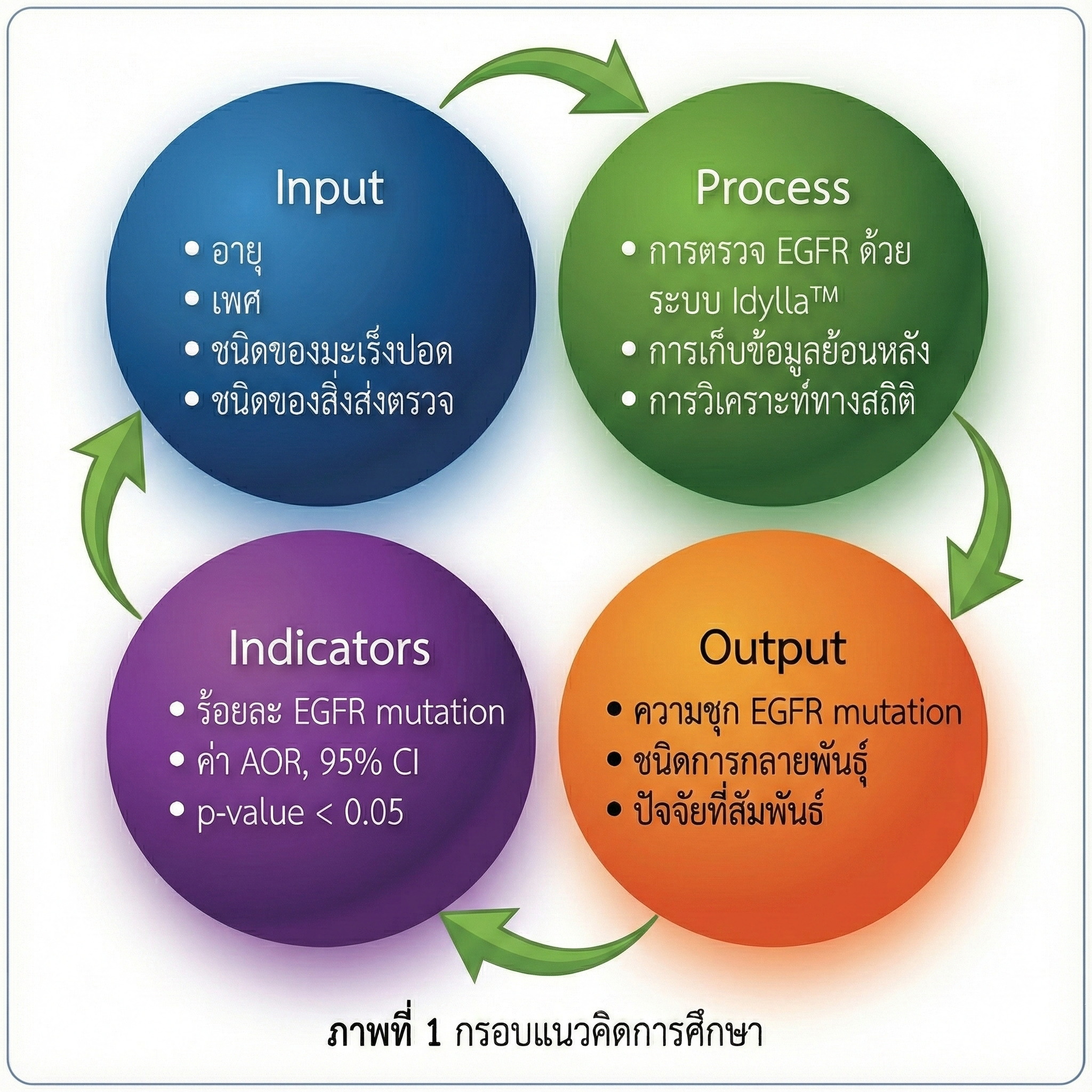
มะเร็งปอดชนิดไม่ใช่เซลล์เล็ก (NSCLC) เป็นมะเร็งที่มีอัตราการเสียชีวิตสูงที่สุดทั่วโลก การกลายพันธุ์ยีน EGFR ได้ปฏิวัติการรักษาด้วย precision medicine ที่ช่วยปรับปรุงอายุขัยและคุณภาพชีวิตผู้ป่วยอย่างมีนัยสำคัญ โดยมีวัตถุประสงค์เพื่อประเมินความชุกของการกลายพันธุ์ยีน EGFR จากการศึกษาเชิงวิเคราะห์ย้อนหลัง ในผู้ป่วย NSCLC ณ โรงพยาบาลมหาราชนครศรีธรรมราช และวิเคราะห์ปัจจัยทางคลินิกที่เกี่ยวข้อง การศึกษาเป็นแบบวิเคราะห์ย้อนหลังในผู้ป่วย NSCLC จำนวน 359 ราย ที่ได้รับการตรวจวิเคราะห์ยีน EGFR ด้วยระบบ Idylla ระหว่าง พ.ศ. 2565-2567 วิเคราะห์ความสัมพันธ์ระหว่างการกลายพันธุ์กับอายุ เพศ ชนิดทางพยาธิวิทยา และประเภทสิ่งส่งตรวจ ใช้สถิติ chi-square test, t-test และ binary logistic regression
ผลการศึกษาพบว่า ความชุกการกลายพันธุ์ของยีน EGFR จำนวน 132 ราย (36.77%) ส่วนใหญ่เป็นชนิด Exon 19 deletion (55.30%) และ L858R point mutation (30.30%) ปัจจัยที่สัมพันธ์กับการกลายพันธุ์ EGFR พบว่า เพศหญิงมีโอกาสเกิดการกลายพันธุ์มากกว่าเพศชาpประมาณ 3.18 เท่า (AOR = 3.182, 95% CI: 1.970–5.139) ผู้ป่วย adenocarcinoma มีอัตราการพบการกลายพันธุ์สูงกว่า squamous cell carcinoma อย่างมีนัยสำคัญ (p < 0.001) ขณะที่อายุและประเภทสิ่งส่งตรวจไม่มีความสัมพันธ์กับการกลายพันธุ์ ข้อค้นพบนี้สนับสนุนความสำคัญของการตรวจคัดกรองยีน EGFR อย่างเป็นระบบในผู้ป่วย NSCLC ทุกราย เพื่อให้ผู้ป่วยเข้าถึงการรักษาด้วย EGFR-TKI ที่มีประสิทธิภาพสูงและผลข้างเคียงน้อยกว่าเคมีบำบัดแบบดั้งเดิม
Article Details

อนุญาตภายใต้เงื่อนไข Creative Commons Attribution-NonCommercial-NoDerivatives 4.0 International License.
บทความที่ได้รับการตีพิมพ์เป็นลิขสิทธิ์ของสำนักงานป้องกันควบคุมโรคที่ 11 จังหวัดนครศรีธรรมราช (Office of Disease Prevention and Control Region 11 Nakhon Sri Thammarat)
ข้อความที่ปรากฏในบทความแต่ละเรื่องในวารสารวิชาการเล่มนี้เป็นความคิดเห็นส่วนตัวของผู้เขียนแต่ละท่านไม่เกี่ยวข้องกับสำนักงานป้องกันควบคุมโรคที่ 11 จังหวัดนครศรีธรรมราช และ บุคคลากรท่านอื่น ๆในสำนักงานฯ แต่อย่างใด ความรับผิดชอบองค์ประกอบทั้งหมดของบทความแต่ละเรื่องเป็นของผู้เขียนแต่ละท่าน หากมีความผิดพลาดใดๆ ผู้เขียนแต่ละท่านจะรับผิดชอบบทความของตนเองแต่ผู้เดียว
ห้ามนำข้อความทั้งหมด หรือบางส่วนไปพิมพ์ซ้ำ เว้นแต่จะได้รับอนุญาตจากกองบรรณาธิการวารสาร
เอกสารอ้างอิง
Borgeaud M, Parikh K, Banna GL, Kim F, Olivier T, Le X, et al. Unveiling the landscape of uncommon EGFR mutations in NSCLC-a systematic review. J Thorac Oncol 2024;19(7):973–83. doi: 10.1016/j.jtho.2024.03.016
Thamrongjirapat T, Akewanlop C, Khiewngam K, Tantraworasin A, Danchaivijitr P, Reungwetwattana T, et al. EP.07E.05 Prevalence of EGFR mutations (EGFRm)in patients with early-stage NSCLC - results from EARLY-EGFR Thailand study. J Thorac Oncol 2024;19(10):S554–S5. doi: 10.1016/j.jtho.2024.09.1027
Zhou C, Wu YL, Chen G, Feng J, Liu XQ, Wang C, et al. Erlotinib versus chemotherapy as first-line treatment for patients with advanced EGFR mutation-positive non-small-cell lung cancer (OPTIMAL, CTONG-0802): a multicentre, open-label, randomised, phase 3 study. Lancet Oncol 2011;12(8):735–42. doi:10.1016/S1470-2045(11)70184-X
Jung HA, Kim M, Kim HS, Kim JH, Choi YH, Cho J, et al. A phase 2 study of palbociclib for recurrent or refractory advanced thymic epithelial tumors (KCSG LU17-21). J Thorac Oncol 2023;18(2):223–31. doi:10.1016/j.jtho.2022.10.008
Lindeman NI, Cagle PT, Aisner DL, Arcila ME, Beasley MB, Bernicker EH, et al. Updated molecular testing guideline for the selection of lung cancer patients for treatment with targeted tyrosine kinase inhibitors: guideline from the college of american pathologists, the international association for the study of lung cancer, and the association for molecular pathology. Arch Pathol Lab Med 2018;142(3):321-46. doi: 10.5858/arpa.2017-0388-CP
Zhang YL, Yuan JQ, Wang KF, Fu XH, Han XR, Threapleton D, et al. The prevalence of EGFR mutation in patients with non-small cell lung cancer: a systematic review and meta-analysis. Oncotarget 2016;7(48):78985–93. doi: 10.18632/oncotarget.12587
Soo RA, Reungwetwattana T, Perroud HA, Batra U, Kilickap S, Tejado Gallegos LF, et al. Prevalence of EGFR mutations in patients with resected stages I to III NSCLC: results from the EARLY-EGFR study. J Thorac Oncol 2024;19(10):1449–59. doi:10.1016/j.jtho.2024.06.008.
De Luca C, Gragnano G, Pisapia P, Vigliar E, Malapelle U, Bellevicine C, et al. EGFR mutation detection on lung cancer cytological specimens by the novel fully automated PCR-based Idylla EGFR mutation assay. J Clin Pathol 2017;70(4):295–300. doi: 10.1136/jclinpath-2016-203989
Rodriguez-Lara V, Avila-Costa MR. An overview of lung cancer in women and the impact of estrogen in lung carcinogenesis and lung cancer treatment. Front Med (Lausanne) 2021;8:600121. doi:10.3389/fmed.2021.600121
The jamovi project. jamovi [computer software]. Version 2.5. 2024 [cited 2025 Dec 23]. Available from: https://www.jamovi.org
Sukauichai S, Maneenil K, Supavavej A, Paul V, Benjawongsathien D, Chantharakhit C, et al. EGFR mutation-positive lung cancer in real-world treatment outcomes: a multicenter study from Thailand. Asian Pac J Cancer Care 2022;7(4):643-50. doi: 10.31557/APJCC2022.7.4.643
Nadal E, Oré-Arce M, Remon J, Bernabé-Caro R, Covela-Rúa M, de Castro-Carpeño J, et al. Expert consensus to optimize the management of older adult patients with advanced EGFR-mutated non-small cell lung cancer. Clin Transl Oncol 2023;25(11):3139-51. doi:10.1007/s12094-023-03286-3
He CH, Shih JF, Lai SL, Chen YM. Non-small cell lung cancer in the very young: higher EGFR/ALK mutation proportion than the elder. J Chin Med Assoc 2020;83(5):461-5. doi:10.1097/JCMA.0000000000000311
Kumari N, Singh S, Haloi D, Mishra SK, Krishnani N, Nath A, et al. Epidermal growth factor receptor mutation frequency in squamous cell carcinoma and its diagnostic performance in cytological samples: a molecular and immunohistochemical study. World J Oncol 2019;10(3):142-50. doi:10.14740/wjon1204
Jin R, Peng L, Shou J, Wang J, Jin Y, Liang F, et al. EGFR-mutated squamous cell lung cancer and its association with outcomes. Front Oncol 2021;11:680804. doi: 10.3389/fonc.2021.680804
