
ปัจจัยที่สัมพันธ์กับความวิตกกังวลของมารดาครรภ์แรกในระยะรอคลอด: การศึกษาแบบภาคตัดขวาง
Article Sidebar
Main Article Content
บทคัดย่อ
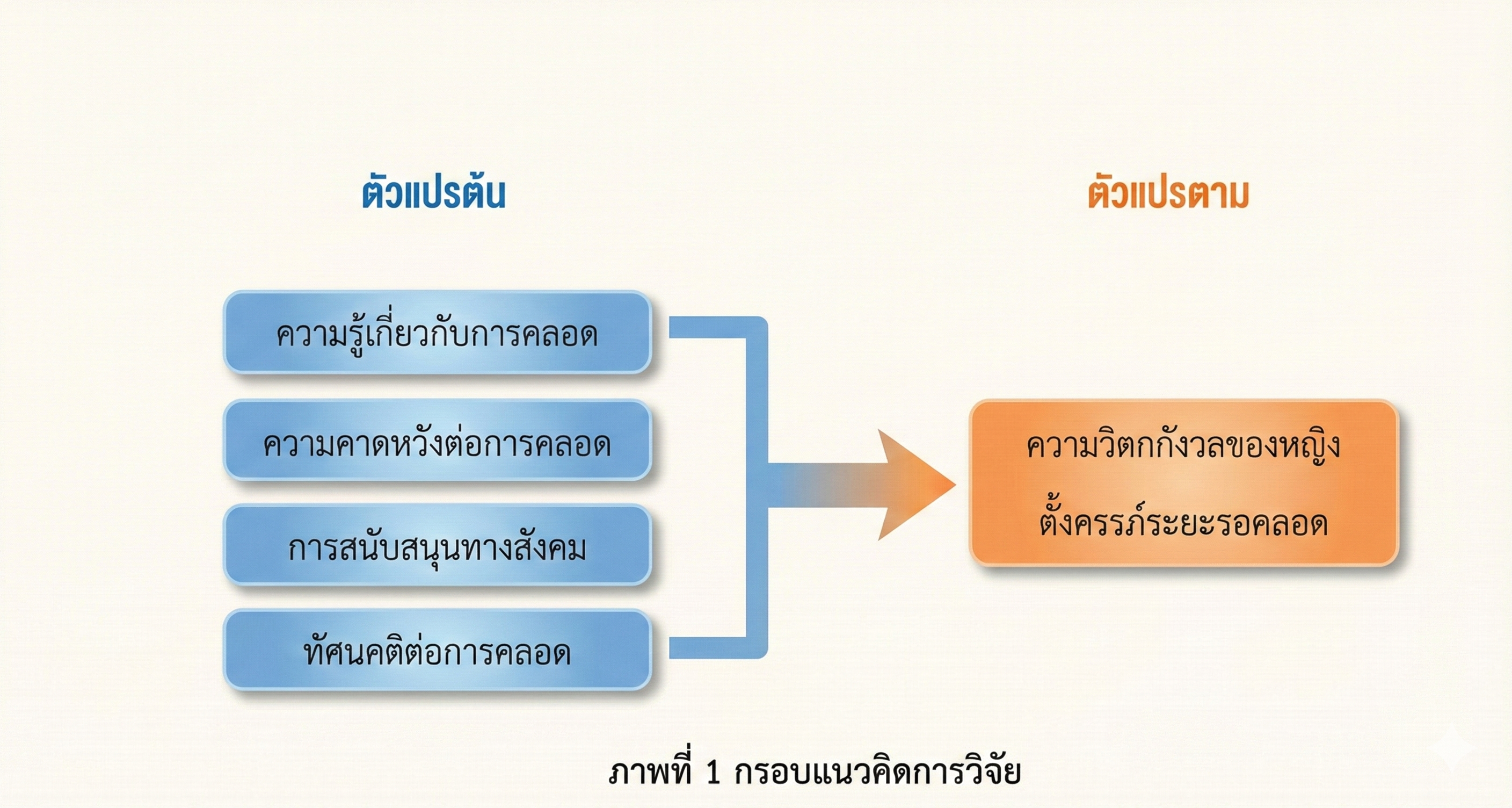
การวิจัยนี้มีวัตถุประสงค์เพื่อศึกษาระดับความวิตกกังวลและปัจจัยที่สัมพันธ์ต่อความวิตกกังวลของมารดาครรภ์แรกในระยะรอคลอด กลุ่มตัวอย่างคือหญิงตั้งครรภ์ครรภ์แรก จำนวน 138 ราย ที่เข้ารับบริการในห้องรอคลอด ณ โรงพยาบาลหลังสวน จังหวัดชุมพร เครื่องมือที่ใช้ในการวิจัยประกอบด้วย แบบสอบถามข้อมูลส่วนบุคคล แบบประเมินความวิตกกังวล แบบวัดความรู้เกี่ยวกับการคลอด แบบวัดทัศนคติต่อการคลอด แบบวัดความคาดหวังต่อการคลอด และแบบวัดการสนับสนุนทางสังคม วิเคราะห์ข้อมูลโดยใช้สถิติเชิงพรรณนา และ Pearson’s product correlation coefficient
ผลการศึกษาพบว่า กลุ่มตัวอย่างมีคะแนนเฉลี่ยความวิตกกังวลอยู่ที่ 42.75 (SD = 8.60) ซึ่งอยู่ในระดับปานกลาง ร้อยละ 53.60 และพบว่าปัจจัยที่มีความสัมพันธ์กับระดับความวิตกกังวลอย่างมีนัยสำคัญทางสถิติ ได้แก่ ความรู้เกี่ยวกับการคลอด (r = –0.343, p-value < 0.001) ทัศนคติต่อการคลอด (r = –0.318, p-value < 0.001) การสนับสนุนทางสังคม (r = –0.447, p-value < 0.001) และความคาดหวังต่อการคลอด (r = –0.421, p-value < 0.001)
ผลการศึกษานี้แสดงให้เห็นว่า มารดาครรภ์แรกมีความวิตกกังวลในระดับปานกลางถึงสูง และปัจจัยด้านความรู้เกี่ยวการคลอด ทัศนคติต่อการคลอด การสนับสนุนทางสังคม และความคาดหวังเกี่ยวกับการคลอดเป็นปัจจัยสำคัญที่สัมพันธ์กับระดับความวิตกกังวลอย่างมีนัยสำคัญ ดังนั้นจึงมี ความจำเป็นต้องศึกษาปัจจัยเหล่านี้อย่างเป็นระบบ เพื่อเป็นข้อมูลพื้นฐานในการพัฒนาแนวทางส่งเสริม สุขภาวะทางจิตใจของมารดาครรภ์แรกในระยะรอคลอด รวมทั้งควรจัดทำคู่มือให้ความรู้เพื่อลดความ วิตกกังวลของมารดาอย่างเหมาะสมและมีประสิทธิภาพ
Article Details

อนุญาตภายใต้เงื่อนไข Creative Commons Attribution-NonCommercial-NoDerivatives 4.0 International License.
บทความที่ได้รับการตีพิมพ์เป็นลิขสิทธิ์ของสำนักงานป้องกันควบคุมโรคที่ 11 จังหวัดนครศรีธรรมราช (Office of Disease Prevention and Control Region 11 Nakhon Sri Thammarat)
ข้อความที่ปรากฏในบทความแต่ละเรื่องในวารสารวิชาการเล่มนี้เป็นความคิดเห็นส่วนตัวของผู้เขียนแต่ละท่านไม่เกี่ยวข้องกับสำนักงานป้องกันควบคุมโรคที่ 11 จังหวัดนครศรีธรรมราช และ บุคคลากรท่านอื่น ๆในสำนักงานฯ แต่อย่างใด ความรับผิดชอบองค์ประกอบทั้งหมดของบทความแต่ละเรื่องเป็นของผู้เขียนแต่ละท่าน หากมีความผิดพลาดใดๆ ผู้เขียนแต่ละท่านจะรับผิดชอบบทความของตนเองแต่ผู้เดียว
ห้ามนำข้อความทั้งหมด หรือบางส่วนไปพิมพ์ซ้ำ เว้นแต่จะได้รับอนุญาตจากกองบรรณาธิการวารสาร
เอกสารอ้างอิง
Lowe NK. Self-efficacy for labor and childbirth fears in nulliparous pregnant women. J Psychosom Obstet Gynaecol 2000;21(4):219–24. doi: 10.3109/01674820009085591
Räisänen S, Lehto SM, Nielsen HS, Gissler M, Kramer MR, Heinonen S. Fear of childbirth in nulliparous and multiparous women: a population-based analysis of all singleton births in Finland in 1997-2010. Bjog 2014;121(8):965–70. doi: 10.1111/1471-0528.12599
World Health Organization. Mental health of women during pregnancy and postpartum. Geneva: WHO; 2022.
Gausia K, Fisher C, Ali M, Oosthuizen J. Antenatal depression and suicidal ideation among rural Bangladeshi women: a community-based study. Arch Womens Ment Health 2009;12(5):351–8. doi: 10.1007/s00737-009-0080-7
United Nations. World population prospects 2022: summary of results. New York: UN DESA; 2022.
Littleton HL, Bye K, Buck K, Amacker A. Psychosocial stress during pregnancy and perinatal outcomes: a meta-analytic review. J Psychosom Obstet Gynaecol 2010;31(4):219–28. doi: 10.3109/0167482X.2010.518776
Mueller CG, Webb PJ, Morgan S. The effects of childbirth education on maternity outcomes and maternal satisfaction. J Perinat Educ 2020;29(1):16–22. doi: 10.1891/1058-1243.29.1.16
Ip WY, Chung TK, Tang CS. The Chinese childbirth self-efficacy inventory: the development of a short form. J Clin Nurs 2008;17(3):333–40. doi: 10.1111/j.1365-2702.2006.01919.x
Conrad MS, Trachtenberg E. Personality traits, childbirth expectations, and childbirth experiences: a prospective study. J Reprod Infant Psychol 2023;41(4):403–16. doi: 10.1080/02646838.2021.2009451
Bedaso A, Adams J, Peng W, Sibbritt D. The relationship between social support and mental health problems during pregnancy: a systematic review and meta-analysis. Reprod Health 2021;18(1):162. doi: 10.1186/s12978-021-01209-5
Alhusen JL, Bower KM, Epstein E, Sharps P. Racial discrimination and adverse birth outcomes: an integrative review. J Midwifery Womens Health 2016;61(6):707–20. doi: 10.1111/jmwh.12490
Lazarus RS, Folkman S. Stress, appraisal, and coping. New York: Springer Publishing Company; 1984.
Faul F, Erdfelder E, Lang AG, Buchner A. G*Power 3: a flexible statistical power analysis program for the social, behavioral, and biomedical sciences. Behav Res Methods 2007;39(2):175–91. doi: 10.3758/bf03193146
Cohen J. Statistical power analysis for the behavioral sciences. 2nd ed. New York: Lawrence Erlbaum Associates; 1988.
House JS. Work stress and social support. Englewood Cliffs: Addison-Wesley Publishing Company; 1981.
กิ่งดาว แสงจินดา, สุพิศ ศิริอรุณรัตน์, ตติรัตน์ เตชะศักดิ์ศรี. ปัจจัยที่มีความสัมพันธ์กับพัฒนกิจการเป็นมารดาของหญิงตั้งครรภ์ที่ตั้งครรภ์โดยไม่ตั้งใจ. วารสารพยาบาลศาสตร์ มหาวิทยาลัยสยาม 2560;18(34):6–20.
นิจสากร นังคลา. ผลการเตรียมเพื่อการคลอดต่อประสบการณ์เกี่ยวกับการคลอดของสตรีครรภ์แรกและผู้ช่วยเหลือ [วิทยานิพนธ์ปริญญาโทพยาบาลศาสตรมหาบัณฑิตสาขาการพยาบาลสตรี] เชียงใหม่: มหาวิทยาลัยเชียงใหม่; 2546.
Spielberger CD, Gorsuch RL, Lushene R, Vagg PR, Jacobs GA. Manual for the state-trait anxiety inventory (Form Y1-Y2). Palo Alto: Consulting Psychologists Press; 1983.
Julian LJ. Measures of anxiety: State-Trait Anxiety Inventory (STAI), Beck Anxiety Inventory (BAI), and Hospital Anxiety and Depression Scale-Anxiety (HADS-A). Arthritis Care & Research 2011;63(S11):S467–S72. https://doi.org/10.1002/acr.20561
บุญใจ ศรีสถิตนรากูล. ระเบียบวิธีวิจัยทางพยาบาลศาสตร์. พิมพ์ครั้งที่ 5. กรุงเทพฯ: เมืองอักษร; 2553.
Stoll K, Hall WA. Attitudes and preferences of young women with low and high fear of childbirth. Qual Health Res 2013;23(11):1495–505. doi: 10.1177/1049732313507501
Fenwick J, Gamble J, Nathan E, Bayes S, Hauck Y. Pre- and postpartum levels of childbirth fear and the relationship to birth outcomes in a cohort of Australian women. J Clin Nurs 2009;18(5):667–77. doi: 10.1111/j.1365-2702.2008.02568.x
Razurel C, Kaiser B, Sellenet C, Epiney M. Relation between perceived stress, social support, and coping strategies and maternal well-being: a review of the literature. Women Health 2013;53(1):74-99. doi: 10.1080/03630242.2012.732681
Slade P, Balling K, Sheen K, Houghton G. Establishing a valid construct of fear of childbirth: findings from in-depth interviews with women and midwives. BMC Pregnancy Childbirth 2019;19(1):96 doi: 10.1186/s12884-019-2241-7
