
Factors Associated with Anxiety Among Primigravid Mothers During the Latent Phase of Labour: A Cross-Sectional Study
Article Sidebar
Main Article Content
Abstract
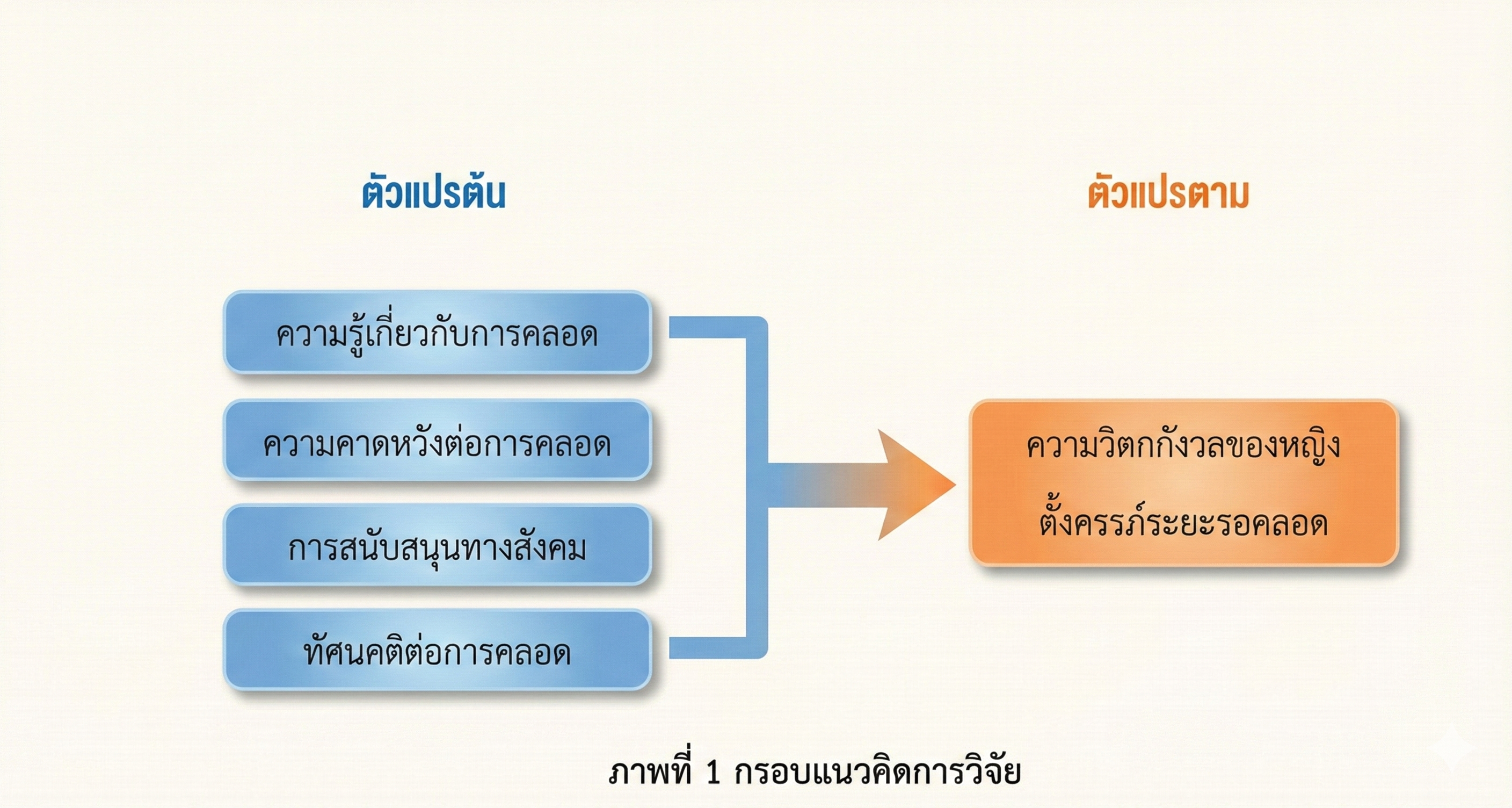
This study aimed to examine the level of anxiety and factors associated with anxiety among primigravid women during the latent phase of labor. The sample consisted of 138 first-time pregnant women attending the Delivery waiting room at Lang Suan Hospital, Chumphon Province. The Research instruments included a demographic questionnaire, the State-Trait Anxiety Inventory (STAI), a knowledge about childbirth questionnaire, an attitude toward childbirth scale, a childbirth expectation scale, and
a social support scale. Data were analyzed using descriptive statistics and Pearson’s product-moment correlation coefficient.
The results revealed that the sample had a mean anxiety score of 42.75 (SD = 8.60), indicating a moderate level of anxiety in 53.60%. Factors significantly associated with anxiety levels included knowledge about birth (r = –0.343, p-value < 0.001), attitude toward birth (r = –0.318, p-value < 0.001), social support (r = –0.447, p-value < 0.001), and birth expectancy (r = –0.421, p-value < 0.001).
The findings of this study indicate that primigravid women experience moderate to high levels of anxiety, and that factors such as childbirth knowledge, attitudes toward childbirth, social support, and childbirth expectations are significantly associated with their anxiety levels. These results highlight the necessity of systematically examining these factors to establish an evidence-based foundation for developing mental health promotion strategies for primigravid mothers during the latent phase of labor. Furthermore, the development of an educational manual tailored to reducing maternal anxiety is recommended to enhance psychological well-being and support effective preparation for childbirth.
Article Details

This work is licensed under a Creative Commons Attribution-NonCommercial-NoDerivatives 4.0 International License.
The articles published in this academic journal are copyrighted by the Office of Disease Prevention and Control Region 11, Nakhon Si Thammarat.
The views and opinions expressed in each article are solely those of the respective authors and do not reflect the opinions or positions of the Office of Disease Prevention and Control Region 11, Nakhon Si Thammarat, or its personnel. The authors are fully responsible for the content of their respective articles. In the event of any errors, the authors alone assume full responsibility for their works.
Reproduction of all or part of any article is strictly prohibited unless prior permission has been obtained from the journal editorial board.
This statement is intended for publication on the official website of the academic journal of the Office of Disease Prevention and Control Region 11, Nakhon Si Thammarat.
References
Lowe NK. Self-efficacy for labor and childbirth fears in nulliparous pregnant women. J Psychosom Obstet Gynaecol 2000;21(4):219–24. doi: 10.3109/01674820009085591
Räisänen S, Lehto SM, Nielsen HS, Gissler M, Kramer MR, Heinonen S. Fear of childbirth in nulliparous and multiparous women: a population-based analysis of all singleton births in Finland in 1997-2010. Bjog 2014;121(8):965–70. doi: 10.1111/1471-0528.12599
World Health Organization. Mental health of women during pregnancy and postpartum. Geneva: WHO; 2022.
Gausia K, Fisher C, Ali M, Oosthuizen J. Antenatal depression and suicidal ideation among rural Bangladeshi women: a community-based study. Arch Womens Ment Health 2009;12(5):351–8. doi: 10.1007/s00737-009-0080-7
United Nations. World population prospects 2022: summary of results. New York: UN DESA; 2022.
Littleton HL, Bye K, Buck K, Amacker A. Psychosocial stress during pregnancy and perinatal outcomes: a meta-analytic review. J Psychosom Obstet Gynaecol 2010;31(4):219–28. doi: 10.3109/0167482X.2010.518776
Mueller CG, Webb PJ, Morgan S. The effects of childbirth education on maternity outcomes and maternal satisfaction. J Perinat Educ 2020;29(1):16–22. doi: 10.1891/1058-1243.29.1.16
Ip WY, Chung TK, Tang CS. The Chinese childbirth self-efficacy inventory: the development of a short form. J Clin Nurs 2008;17(3):333–40. doi: 10.1111/j.1365-2702.2006.01919.x
Conrad MS, Trachtenberg E. Personality traits, childbirth expectations, and childbirth experiences: a prospective study. J Reprod Infant Psychol 2023;41(4):403–16. doi: 10.1080/02646838.2021.2009451
Bedaso A, Adams J, Peng W, Sibbritt D. The relationship between social support and mental health problems during pregnancy: a systematic review and meta-analysis. Reprod Health 2021;18(1):162. doi: 10.1186/s12978-021-01209-5
Alhusen JL, Bower KM, Epstein E, Sharps P. Racial discrimination and adverse birth outcomes: an integrative review. J Midwifery Womens Health 2016;61(6):707–20. doi: 10.1111/jmwh.12490
Lazarus RS, Folkman S. Stress, appraisal, and coping. New York: Springer Publishing Company; 1984.
Faul F, Erdfelder E, Lang AG, Buchner A. G*Power 3: a flexible statistical power analysis program for the social, behavioral, and biomedical sciences. Behav Res Methods 2007;39(2):175–91. doi: 10.3758/bf03193146
Cohen J. Statistical power analysis for the behavioral sciences. 2nd ed. New York: Lawrence Erlbaum Associates; 1988.
House JS. Work stress and social support. Englewood Cliffs: Addison-Wesley Publishing Company; 1981.
กิ่งดาว แสงจินดา, สุพิศ ศิริอรุณรัตน์, ตติรัตน์ เตชะศักดิ์ศรี. ปัจจัยที่มีความสัมพันธ์กับพัฒนกิจการเป็นมารดาของหญิงตั้งครรภ์ที่ตั้งครรภ์โดยไม่ตั้งใจ. วารสารพยาบาลศาสตร์ มหาวิทยาลัยสยาม 2560;18(34):6–20.
นิจสากร นังคลา. ผลการเตรียมเพื่อการคลอดต่อประสบการณ์เกี่ยวกับการคลอดของสตรีครรภ์แรกและผู้ช่วยเหลือ [วิทยานิพนธ์ปริญญาโทพยาบาลศาสตรมหาบัณฑิตสาขาการพยาบาลสตรี] เชียงใหม่: มหาวิทยาลัยเชียงใหม่; 2546.
Spielberger CD, Gorsuch RL, Lushene R, Vagg PR, Jacobs GA. Manual for the state-trait anxiety inventory (Form Y1-Y2). Palo Alto: Consulting Psychologists Press; 1983.
Julian LJ. Measures of anxiety: State-Trait Anxiety Inventory (STAI), Beck Anxiety Inventory (BAI), and Hospital Anxiety and Depression Scale-Anxiety (HADS-A). Arthritis Care & Research 2011;63(S11):S467–S72. https://doi.org/10.1002/acr.20561
บุญใจ ศรีสถิตนรากูล. ระเบียบวิธีวิจัยทางพยาบาลศาสตร์. พิมพ์ครั้งที่ 5. กรุงเทพฯ: เมืองอักษร; 2553.
Stoll K, Hall WA. Attitudes and preferences of young women with low and high fear of childbirth. Qual Health Res 2013;23(11):1495–505. doi: 10.1177/1049732313507501
Fenwick J, Gamble J, Nathan E, Bayes S, Hauck Y. Pre- and postpartum levels of childbirth fear and the relationship to birth outcomes in a cohort of Australian women. J Clin Nurs 2009;18(5):667–77. doi: 10.1111/j.1365-2702.2008.02568.x
Razurel C, Kaiser B, Sellenet C, Epiney M. Relation between perceived stress, social support, and coping strategies and maternal well-being: a review of the literature. Women Health 2013;53(1):74-99. doi: 10.1080/03630242.2012.732681
Slade P, Balling K, Sheen K, Houghton G. Establishing a valid construct of fear of childbirth: findings from in-depth interviews with women and midwives. BMC Pregnancy Childbirth 2019;19(1):96 doi: 10.1186/s12884-019-2241-7
