
ปัจจัยที่มีความสัมพันธ์ต่อการรอดชีวิตของผู้ประสบอุบัติเหตุทางท้องถนนของโรงพยาบาลระดับตติยภูมิในจังหวัดนครศรีธรรมราช
Article Sidebar
Main Article Content
บทคัดย่อ
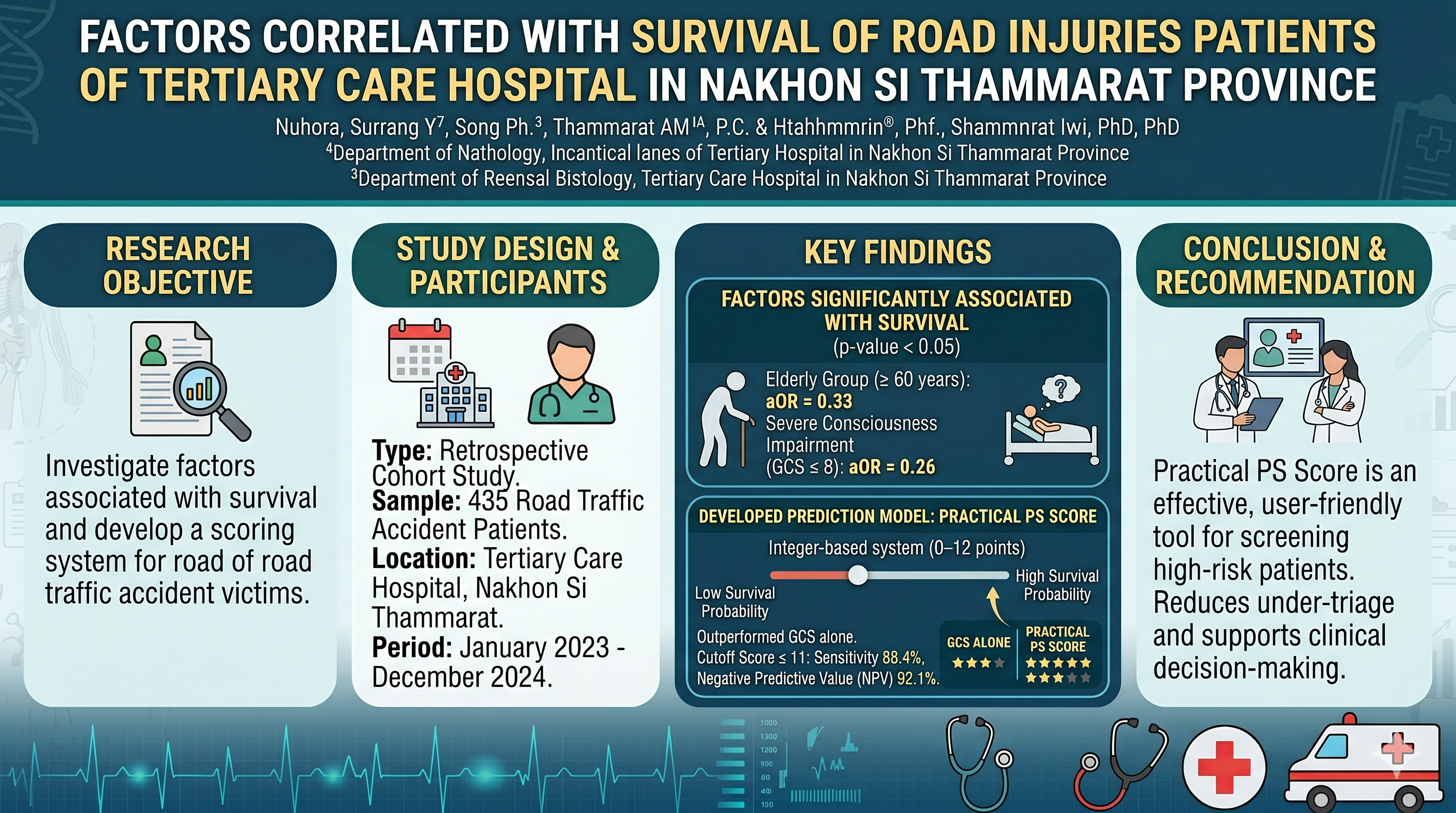
การประเมินความรุนแรงของผู้ป่วยอุบัติเหตุด้วยระดับความรู้สึกตัว (Glasgow Coma Scale; GCS) เพียงอย่างเดียวอาจมีข้อจำกัดในการระบุภาวะเปลี่ยนแปลงทางสรีรวิทยาที่สำคัญ การศึกษานี้มีวัตถุประสงค์เพื่อศึกษาปัจจัยที่มีความสัมพันธ์ต่อการรอดชีวิตและพัฒนาเกณฑ์คะแนนสำหรับการทำนายการรอดชีวิตของผู้ประสบอุบัติเหตุทางท้องถนน ในผู้ป่วยจำนวน 435 ราย ที่เข้ารับการรักษาในโรงพยาบาลระดับตติยภูมิ จังหวัดนครศรีธรรมราช ระหว่างเดือนมกราคม 2566 ถึง เดือนธันวาคม 2567 ผู้วิจัยได้พัฒนาเกณฑ์การให้คะแนนแบบจำนวนเต็ม (0-12 คะแนน) จากสัมประสิทธิ์ถดถอยโลจิสติกส์ และทดสอบประสิทธิภาพของ Practical PS Score สำหรับการทำนายการรอดชีวิตของผู้ประสบอุบัติเหตุทางท้องถนน
ผลการศึกษาพบว่า ปัจจัยที่มีความสัมพันธ์ต่อการรอดชีวิตอย่างมีนัยสำคัญทางสถิติ (p-value< 0.05) ได้แก่ ช่วงอายุ และระดับความรู้สึกตัว โดยพบว่ากลุ่มผู้สูงอายุ ≥ 60 ปี และผู้บาดเจ็บที่มีระดับความรู้สึกตัวรุนแรง (GCS ≤ 8) มีโอกาสรอดชีวิตลดลง (aOR = 0.33 และ 0.26 ตามลำดับ) อย่างมีนัยสำคัญเมื่อเทียบกับวัยทำงาน และผลการพัฒนาเกณฑ์คะแนนสำหรับการทำนายการรอดชีวิตด้วย Practical PS Score พบว่า มีความแม่นยำในการทำนายการรอดชีวิตสูงกว่าการใช้ GCS เพียงอย่างเดียว การกำหนดจุดตัดคะแนนที่ ≤ 11 ให้ค่าความไว และค่าทำนายผลลบ ร้อยละ 88.4 และ 92.1 ตามลำดับ
ดังนั้น Practical PS Score จึงเป็นเครื่องมือที่มีประสิทธิภาพและใช้งานง่าย เหมาะสำหรับการคัดกรองผู้ป่วยกลุ่มเสี่ยงสูง ช่วยลดอัตราการประเมินอาการต่ำกว่าความเป็นจริงและสนับสนุนการตัดสินใจทางคลินิกได้อย่างมีประสิทธิภาพ
Article Details

อนุญาตภายใต้เงื่อนไข Creative Commons Attribution-NonCommercial-NoDerivatives 4.0 International License.
บทความที่ได้รับการตีพิมพ์เป็นลิขสิทธิ์ของสำนักงานป้องกันควบคุมโรคที่ 11 จังหวัดนครศรีธรรมราช (Office of Disease Prevention and Control Region 11 Nakhon Sri Thammarat)
ข้อความที่ปรากฏในบทความแต่ละเรื่องในวารสารวิชาการเล่มนี้เป็นความคิดเห็นส่วนตัวของผู้เขียนแต่ละท่านไม่เกี่ยวข้องกับสำนักงานป้องกันควบคุมโรคที่ 11 จังหวัดนครศรีธรรมราช และ บุคคลากรท่านอื่น ๆในสำนักงานฯ แต่อย่างใด ความรับผิดชอบองค์ประกอบทั้งหมดของบทความแต่ละเรื่องเป็นของผู้เขียนแต่ละท่าน หากมีความผิดพลาดใดๆ ผู้เขียนแต่ละท่านจะรับผิดชอบบทความของตนเองแต่ผู้เดียว
ห้ามนำข้อความทั้งหมด หรือบางส่วนไปพิมพ์ซ้ำ เว้นแต่จะได้รับอนุญาตจากกองบรรณาธิการวารสาร
เอกสารอ้างอิง
World Health Organization. Road traffic injuries [Internet]. 2023 [cited 2024 Jan 15]. Available from: https://www.who.int/news-room/fact-sheets/detail/road-traffic-injuries
Wittachai C. Follow data of injuries and deaths towards the goal of safe Thai roads for everyone [Internet]. Bangkok: Thailand Development Research Institute (TDRI); 2024 Aug 26 [cited 2024 Sep 10]. Available from: https://tdri.or.th/2024/08/follow-data-of-injuries-and-deaths-towards-the-goal-of-safe-thai-roads-for-everyone/
Road Accident Victims Protection Company Limited. Thai RSC: Road Accident Data Center to Enhance Road Safety Culture [Internet]. Bangkok: Road Accident Victims Protection Company Limited; 2025 Feb 21 [cited 2025 Feb 21]. Available from: https://www.thairsc.com/
ภูวนาท ณรงค์รัตน์. การศึกษาสถานการณ์การเกิดอุบัติเหตุทางถนนและผลกระทบของอุบัติเหตุ: กรณีผู้ประสบเหตุเสียชีวิต อำเภอป่าบอน จังหวัดพัทลุง. วารสารการศึกษาและวิจัยการสาธารณสุข 2567;2(1): 17–34.
Afacho AA, Belayneh T, Markos T, Geleta, D. Incidence and predictors of mortality among road traffic accident victims admitted to hospitals at Hawassa city, Ethiopia. PloS one 2024; 19(5): e0296946. doi: org/10.1371/journal.pone.0296946
Sheikhi S, Eghbal F, Ahmadinejad M, Bahri MH, Bozorgmehr R, Bagherpour JZ. TRISS, Base Excess, and RTS as Predictors of Outcomes in Polytrauma Patients: A Retrospective Analytical Study from a Trauma Center.Indian Journal of Surgery 2025;87: 1-7. Doi: org/10.1007/s12262-025-04307-x
พนมวรรณ์ วงศ์วัฒนกิจ, จารุวรรณ ธาดาเดช, อรุณรักษ์ มีใย, ไพบูลย์ สุริยะวงศ์ไพศาล. ความสัมพันธ์ของปัจจัยการรอดชีวิตของผู้บาดเจ็บจากอุบัติเหตุจราจรที่เข้ารับการรักษา ณ โรงพยาบาลระดับตติยภูมิแห่งหนึ่งในจังหวัดภูเก็ต. ศรีนครินทร์เวชสาร 2562: 34(1):52-59
Huabbangyang T, Klaiaungthong R, Jansanga D, Aintharasongkho A, Hanlakorn T, Sakcharoen R, et al. Survival Rates and Factors Related to the Survival of Traffic Accident Patients Transported by Emergency Medical Services. Open Access Emerg Med. 2021 Dec 18; 13:575-586. doi: 10.2147/OAEM.S344705. PMID: 34955659; PMCID: PMC8694573.
Anestis DM, Marinos K, Tsitsopoulos PP. Comparison of the prognostic validity of three simplified consciousness assessment scales with the Glasgow Coma Scale. European journal of trauma and emergency surgery 2023; 49(5): 2193-2202. doi: 10.1007/s00068-023-02286-w
Dhillon NK, Kwon J, Coimbra R. Fluid resuscitation in trauma: What you need to know. Journal of Trauma and Acute Care Surgery 2023; 98(1): 20-29, doi: 10.1097/TA.0000000000004456
Lee JW, Wang W, Rezk A, Mohammed A, Macabudbud K, Englesakis M, et al. Hypotension and adverse outcomes in moderate to severe traumatic brain injury: a systematic review and meta-analysis.JAMA Network Open 2024; 7(11): e2444465-e2444465. doi:10.1001/jamanetworkopen.2024.44465
Jeong JH, Park YJ, Kim DH, Kim TY, Kang C, Lee, SH, et al. The new trauma score (NTS): a modification of the revised trauma score for better trauma mortality prediction. BMC surgery 2017; 17(77): 1-9. Doi: 10.1186/s12893-017-0272-4
Khayat NH, Poor HS, Rezaei MA, Mohammadinia N, Darban F. Correlation of revised trauma score with mortality rate of traumatic patients within the first 24 hours of hospitalization. Zahedan Journal of Research in Medical Sciences 2014; 16(11): 33-36.
Jiang D, Chen T, Yuan X, Shen Y, Huang Z. Predictive value of the Trauma Rating Index in Age, Glasgow Coma Scale, Respiratory rate and Systolic blood pressure score (TRIAGES) and Revised Trauma Score (RTS) for the short-term mortality of patients with isolated traumatic brain injury. The American Journal of Emergency Medicine 2023; 71: 175-181. doi: org/10.1016/j.ajem.2023.06.030
