
โรคเมลิออยโดสิสในพื้นที่เกิดโรคประปราย จังหวัดพังงา ปี พ.ศ. 2555-2569: ระบาดวิทยาและการดูแลผู้ป่วยที่มีอาการแทรกซ้อนที่พบไม่บ่อย
Article Sidebar
Main Article Content
บทคัดย่อ
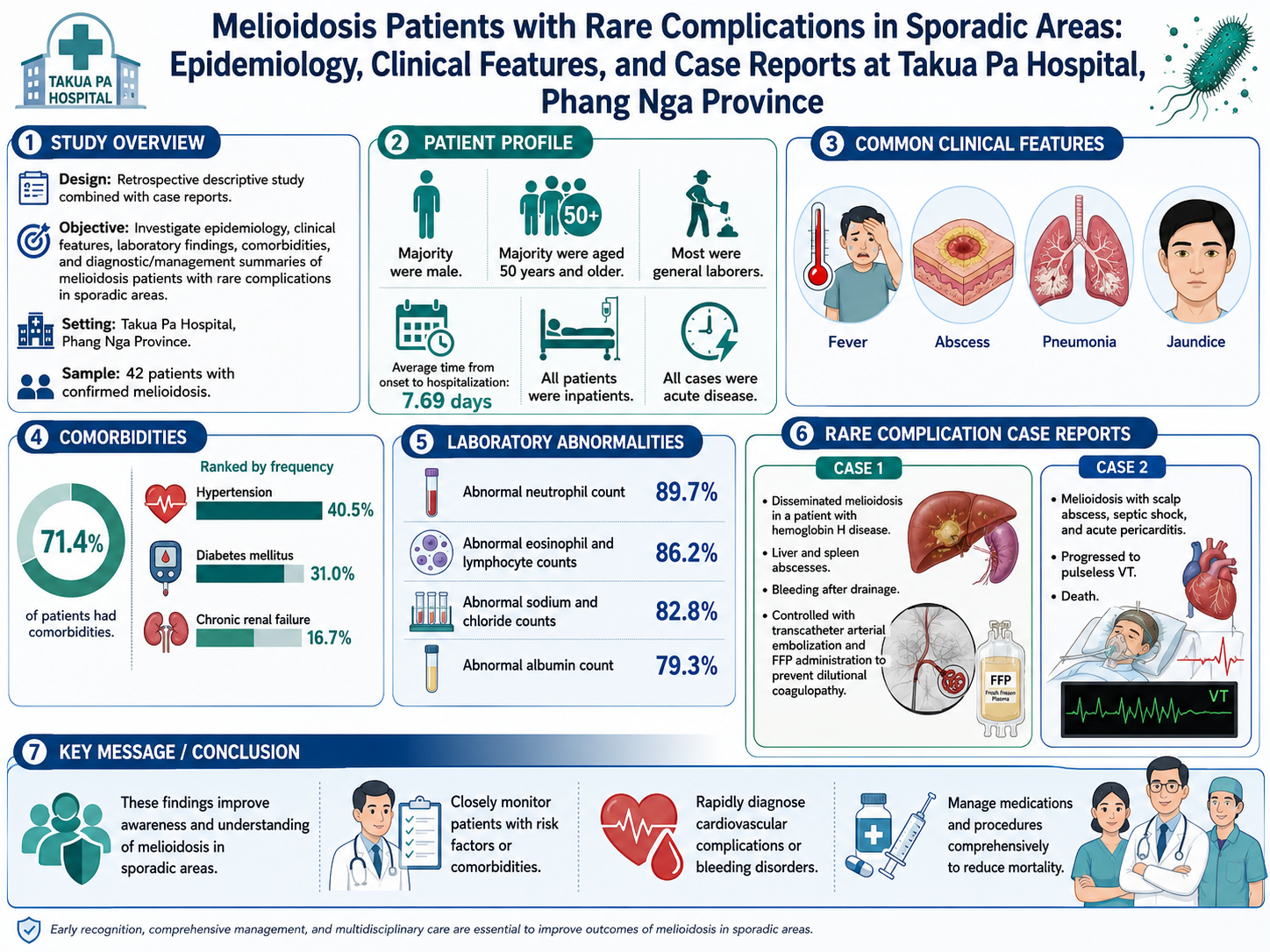
การศึกษาย้อนหลังเชิงพรรณนาร่วมกับรายงานผู้ป่วยครั้งนี้มีวัตถุประสงค์เพื่อศึกษาระบาดวิทยา ลักษณะทางคลินิก ผลทางห้องปฏิบัติการ โรคประจำตัว และสรุปการวินิจฉัยรวมถึงการดูแลรักษาผู้ป่วยโรคเมลิออยโดสิสที่มีอาการแทรกซ้อนที่พบไม่บ่อยในพื้นที่เกิดโรคประปราย กลุ่มตัวอย่างที่ศึกษาเป็นผู้ป่วยที่ได้รับการวินิจฉัยยืนยันโรคเมลิออยโดสิสและเข้ารับการรักษาในโรงพยาบาลตะกั่วป่า จังหวัดพังงา จำนวน 42 ราย
ผลการศึกษาพบว่า กลุ่มตัวอย่างส่วนใหญ่เป็นเพศชาย อายุตั้งแต่ 50 ปีขึ้นไป ประกอบอาชีพรับจ้างทั่วไป ระยะเวลาเริ่มป่วยจนถึงโรงพยาบาลเฉลี่ย 7.69 วัน ผู้ป่วยทุกรายได้รับการรักษาเป็นผู้ป่วยใน และเป็นชนิดเฉียบพลัน ด้านอาการทางคลินิกที่พบมากที่สุดคือ ไข้ ฝีหนอง ปอดบวม และดีซ่าน ขณะที่ผู้ป่วยร้อยละ 71.4 มีโรคประจำตัว โดยพบความดันโลหิตสูงมากที่สุด ร้อยละ 40.5 รองลงมาคือเบาหวาน ร้อยละ 31.0 และไตวายเรื้อรัง ร้อยละ 16.7 สำหรับผลตรวจทางห้องปฏิบัติการพบ Neutrophil ผิดปกติ ร้อยละ 89.7, Eosinophil และ Lymphocyte ผิดปกติร้อยละ 86.2, Sodium และ Chloride ผิดปกติร้อยละ 82.8 และ Albumin ผิดปกติร้อยละ 79.3 สำหรับกรณีศึกษาภาวะแทรกซ้อนที่ไม่พบบ่อย รายที่ 1 เป็น Disseminated Melioidosis ในผู้ป่วย Hemoglobin H disease เกิดฝีในตับและม้ามร่วมกับภาวะเลือดออกหลังหัตถการระบายหนอง ซึ่งควบคุมได้ด้วยการทำ Transcatheter Arterial Embolization ร่วมกับการให้ FFP เพื่อป้องกัน Dilutional Coagulopathy ส่วนรายที่ 2 เป็น Melioidosis ที่มีฝีที่หนังศีรษะ(Scalp abscess) ร่วมกับ Septic Shock และ Acute Perimyocarditis ซึ่งนำไปสู่การเกิด Pulseless VT และเสียชีวิต
ผลการวิจัยนี้จึงช่วยเพิ่มความตระหนักและยกระดับความเข้าใจแก่แพทย์และบุคลากรทางการแพทย์ในพื้นที่ที่เกิดโรคประปราย โดยเฉพาะการเฝ้าระวังผู้ป่วยที่มีปัจจัยเสี่ยงหรือมีโรคร่วม การวินิจฉัยภาวะแทรกซ้อนทางระบบหัวใจและหลอดเลือดหรือภาวะเลือดออกผิดปกติอย่างรวดเร็ว รวมถึงการบริหารจัดการยารักษาและหัตถการอย่างครอบคลุม เพื่อลดอัตราการเสียชีวิตของผู้ป่วย
Article Details

อนุญาตภายใต้เงื่อนไข Creative Commons Attribution-NonCommercial-NoDerivatives 4.0 International License.
บทความที่ได้รับการตีพิมพ์เป็นลิขสิทธิ์ของสำนักงานป้องกันควบคุมโรคที่ 11 จังหวัดนครศรีธรรมราช (Office of Disease Prevention and Control Region 11 Nakhon Sri Thammarat)
ข้อความที่ปรากฏในบทความแต่ละเรื่องในวารสารวิชาการเล่มนี้เป็นความคิดเห็นส่วนตัวของผู้เขียนแต่ละท่านไม่เกี่ยวข้องกับสำนักงานป้องกันควบคุมโรคที่ 11 จังหวัดนครศรีธรรมราช และ บุคคลากรท่านอื่น ๆในสำนักงานฯ แต่อย่างใด ความรับผิดชอบองค์ประกอบทั้งหมดของบทความแต่ละเรื่องเป็นของผู้เขียนแต่ละท่าน หากมีความผิดพลาดใดๆ ผู้เขียนแต่ละท่านจะรับผิดชอบบทความของตนเองแต่ผู้เดียว
ห้ามนำข้อความทั้งหมด หรือบางส่วนไปพิมพ์ซ้ำ เว้นแต่จะได้รับอนุญาตจากกองบรรณาธิการวารสาร
เอกสารอ้างอิง
Wiersinga WJ, Currie BJ, Peacock SJ. Melioidosis. N Engl J Med. 2012;367(11):1035–44. doi: 10.1056/NEJMra1204699
Centers for Disease Control and Prevention. Melioidosis [Internet]. [cited 2026 June 9]. Available from: ://www.cdc.gov/melioidosis/about/
Chakravorty A, Heath CH. Melioidosis: An updated review. Aust J Gen Pract. 2019;48(5):327–32. doi: 10.31128/AJGP-04-18-4558
Aldhous P. Tropical medicine: melioidosis? Never heard of it. Nature. 2005;434(7034):692–3. doi: 10.1038/434692a
กองโรคติดต่อทั่วไป กรมควบคุมโรค กระทรวงสาธารณสุข. คู่มือโรคเมลิออยด์. พิมพ์ครั้งที่ 1. นนทบุรี: สำนักพิมพ์อักษรกราฟฟิคแอนด์ดีไซน์; 2564.
สมคิด ไกรพัฒนพงศ์, ณิชกุล พิสิฐพยัต, ดิเรก ลิ้มมธุรสกุล, ปรางณพิชญ์ วิหารทอง, ธนพล ยิสารคุณ, สุกัลยา บัวฟัก, และคณะ. สถานการณ์โรคเมลิออยโดสิส ประเทศไทย ปี พ.ศ. 2567. วารสารรายงานการเฝ้าระวังทางระบาดวิทยาประจำสัปดาห์ 2568;56(6):1-5, e6263.
Currie BJ. Melioidosis: an important cause of pneumonia in residents of and travellers returned from endemic regions. Eur Respir J. 2003;22(3):542–50. doi: 10.1183/09031936.03.00006203
Wiersinga WJ, van der Poll T, White NJ, Day NP, Peacock SJ. Melioidosis: insights into the pathogenicity of Burkholderia pseudomallei. Nat Rev Microbiol. 2006;4(4):272–82. doi: 10.1038/nrmicro1385
Gassiep I, Armstrong M, Norton R. Human Melioidosis. Clin Microbiol Rev. 2020;33:e00006–19. doi: 10.1128/CMR.00006-19
Limmathurotsakul D, Golding N, Dance DA, Messina JP, Pigott DM, Moyes CL, et al. Predicted global distribution of Burkholderia pseudomallei and burden of melioidosis. Nat Microbiol. 2016;1:15008. doi: 10.1038/nmicrobiol.2015.8
Birnie E, Virk HS, Savelkoel J, Spijker R, Bertherat E, Dance DAB, et al. Global burden of melioidosis in 2015: a systematic review and data synthesis. Lancet Infect Dis. 2019;19(8):892–902. doi: 10.1016/S1473-3099(19)30157-4
Leelarasamee A, Bovornkitti S. Melioidosis: review and update. Rev Infect Dis. 1989;11(3):413–25. doi: 10.1093/clinids/11.3.413
Birnie E, Biemond JJ, Wiersinga WJ. Drivers of melioidosis endemicity: epidemiological transition, zoonosis, and climate change. Curr Opin Infect Dis. 2022;35(3):196–204. doi: 10.1097/QCO.0000000000000827
Chewapreecha C, Holden MT, Vehkala M, Välimäki N, Yang Z, Harris SR, et al. Global and regional dissemination and evolution of Burkholderia pseudomallei. Nat Microbiol. 2017;2:16263. doi: 10.1038/nmicrobiol.2016.263
Meumann EM, Limmathurotsakul D, Dunachie SJ, Wiersinga WJ, Currie BJ. Burkholderia pseudomallei and melioidosis. Nat Rev Microbiol. 2024;22(3):155–69. doi: 10.1038/s41579-023-00972-5
Omran AR. The epidemiologic transition: a theory of the epidemiology of population change. 1971. Milbank Q. 2005;83(4):731–57. doi: 10.1111/j.1468-0009.2005.00398.x
Birnie E, Savelkoel J, Reubsaet F, Roelofs J, Soetekouw R, Kolkman S, et al. Melioidosis in travelers: An analysis of Dutch melioidosis registry data 1985-2018. Travel Med Infect Dis. 2019;32:101461. doi: 10.1016/j.tmaid.2019.07.017
Currie BJ, Meumann EM, Kaestli M. The Expanding Global Footprint of Burkholderia pseudomallei and Melioidosis. Am J Trop Med Hyg. 2023;108(6):1081–3. doi: 10.4269/ajtmh.23-0223
Kaestli M, Grist EPM, Ward L, Hill A, Mayo M, Currie BJ. The association of melioidosis with climatic factors in Darwin, Australia: A 23-year time-series analysis. J Infect. 2016;72(6):687–97. doi: 10.1016/j.jinf.2016.02.015
Hoffmaster AR, AuCoin D, Baccam P, Baggett HC, Baird R, Bhengsri S, et al. Melioidosis diagnostic workshop, 2013. Emerg Infect Dis. 2015;21(2). doi: 10.3201/eid2102.141045
Mariappan V, Vellasamy KM, Vadivelu J. Host-Adaptation of Burkholderia pseudomallei Alters Metabolism and Virulence: a Global Proteome Analysis. Sci Rep. 2017;7(1):9015. doi: 10.1038/s41598-017-09373-0
Kanaphun P, Thirawattanasuk N, Suputtamongkol Y, Naigowit P, Dance DA, Smith MD, et al. Serology and carriage of Pseudomonas pseudomallei: a prospective study in 1000 hospitalized children in northeast Thailand. J Infect Dis. 1993;167(1):230–3. doi: 10.1093/infdis/167.1.230
Wuthiekanun V, Chierakul W, Langa S, Chaowagul W, Panpitpat C, Saipan P, et al. Development of antibodies to Burkholderia pseudomallei during childhood in melioidosis-endemic northeast Thailand. Am J Trop Med Hyg. 2006;74(6):1074–5.
Ashdown LR, Guard RW. The prevalence of human melioidosis in Northern Queensland. Am J Trop Med Hyg. 1984;33(3):474–8. doi: 10.4269/ajtmh.1984.33.474
Currie BJ, Fisher DA, Anstey NM, Jacups SP. Melioidosis: acute and chronic disease, relapse and re-activation. Trans R Soc Trop Med Hyg. 2000;94(3):301–4. doi: 10.1016/s0035-9203(00)90333-x
Currie BJ, Ward L, Cheng AC. The epidemiology and clinical spectrum of melioidosis: 540 cases from the 20 year Darwin prospective study. PLoS Negl Trop Dis. 2010;4(11):e900. doi: 10.1371/journal.pntd.0000900
Suputtamongkol Y, Chaowagul W, Chetchotisakd P, Lertpatanasuwun N, Intaranongpai S, Ruchutrakool T, et al. Risk factors for melioidosis and bacteremic melioidosis. Clin Infect Dis. 1999;29(2):408–13. doi: 10.1086/520223
Chaowagul W, White NJ, Dance DA, Wattanagoon Y, Naigowit P, Davis TM, et al. Melioidosis: a major cause of community-acquired septicemia in northeastern Thailand. J Infect Dis. 1989;159(5):890–9. doi: 10.1093/infdis/159.5.890
White NJ, Dance DA, Chaowagul W, Wattanagoon Y, Wuthiekanun V, Pitakwatchara N. Halving of mortality of severe melioidosis by ceftazidime. Lancet. 1989;2(8665):697–701. doi: 10.1016/s0140-6736(89)90768-x
Lipsitz R, Garges S, Aurigemma R, Baccam P, Blaney DD, Cheng AC, et al. Workshop on treatment of and postexposure prophylaxis for Burkholderia pseudomallei and B. mallei Infection, 2010. Emerg Infect Dis. 2012;18(12):e2. doi: 10.3201/eid1812.120638
Meumann EM, Cheng AC, Ward L, Currie BJ. Clinical features and epidemiology of melioidosis pneumonia: results from a 21-year study and review of the literature. Clin Infect Dis. 2012;54(3):362–9. doi: 10.1093/cid/cir808
Norman FF, Blair BM, Chamorro-Tojeiro S, González-Sanz M, Chen LH. The Evolving Global Epidemiology of Human Melioidosis: A Narrative Review. Pathogens. 2024;13(11). doi: 10.3390/pathogens13110926
Filimão DBC, Moon TD, Senise JF, Diaz RS, Sidat M, Castelo A. Individual factors associated with time to non-adherence to ART pick-up within HIV care and treatment services in three health facilities of Zambézia Province, Mozambique. PLoS One. 2019;14(3):e0213804. doi: 10.1371/journal.pone.0213804
กองระบาดวิทยา กรมควบคุมโรค กระทรวงสาธารณสุข. สถานการณ์โรคเมลิออยโดสิส [อินเทอร์เน็ต]. [สืบค้นเมื่อ 13 กรกฎาคม 2569]. แหล่งข้อมูล: https://ddc.moph.go.th/disease_detail.php?d=99
Selvam K, Ganapathy T, Najib MA, Khalid MF, Abdullah NA, Harun A, et al. Burden and risk factors of Melioidosis in Southeast Asia: A scoping review. Int J Environ Res Public Health. 2022;19(23). doi: 10.3390/ijerph192315475
Dan M. Melioidosis in Travelers: Review of the Literature. J Travel Med. 2015;22(6): 410–4. doi:10.1111/jtm.12236
Le Tohic S, Montana M, Koch L, Curti C, Vanelle P. A review of melioidosis cases imported into Europe. Eur J Clin Microbiol Infect Dis. 2019;38(8):1395–408. doi: 10.1007/s10096-019-03548-5
ธานินทร์ ศิลป์จารุ. การวิจัยและวิเคราะห์ข้อมูลทางสถิติด้วย SPSS. พิมพ์ครั้งที่ 9. กรุงเทพ ฯ: บิสซิเนสอาร์แอนด์ดี; 2551.
