
Melioidosis in Sporadic Areas of Phang Nga Province, 2012-2026: Epidemiology and Management of Patients with Rare Complications
Article Sidebar
Main Article Content
Abstract
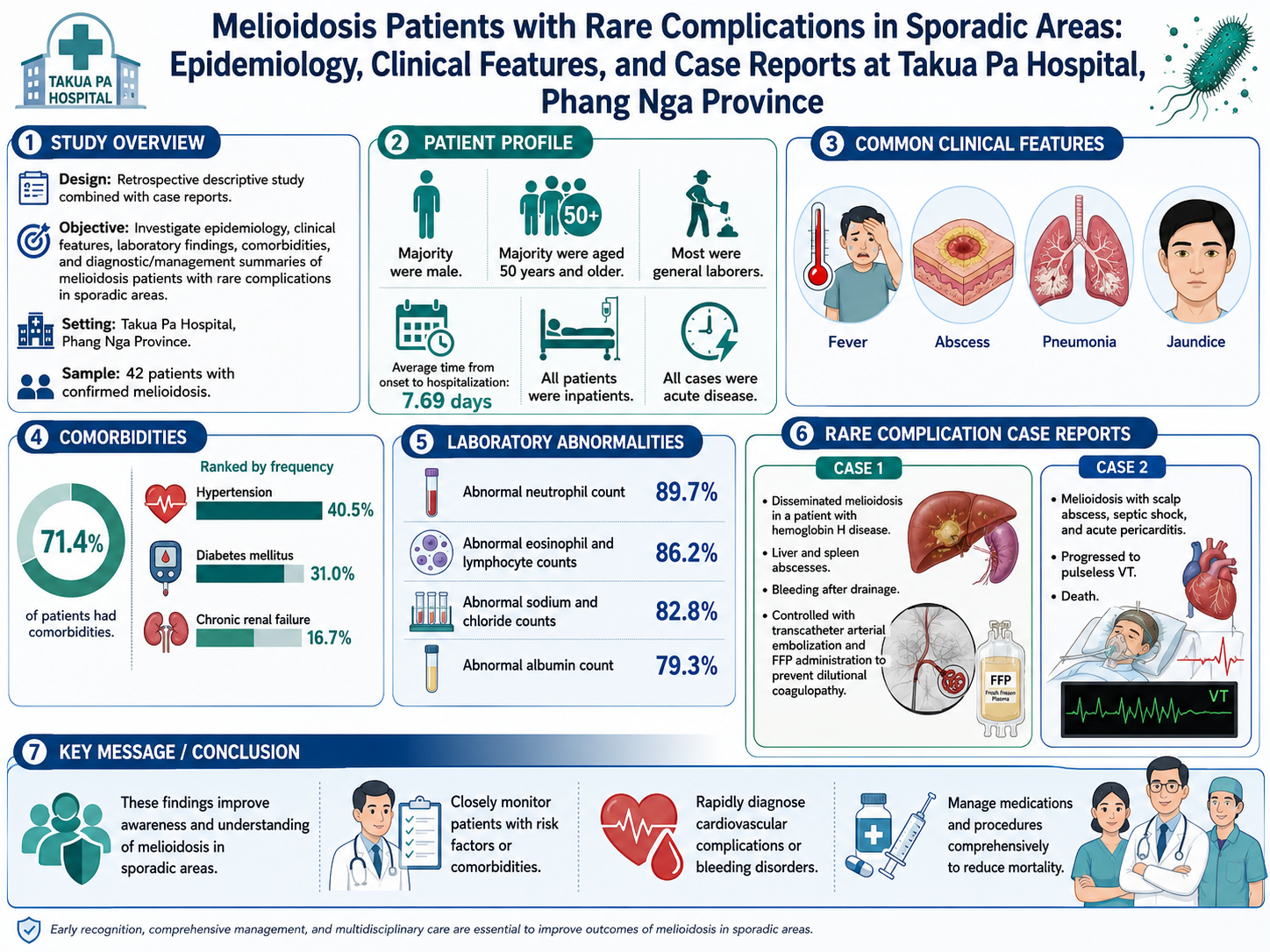
This retrospective descriptive study, combined with case reports, aimed to investigate the epidemiology, clinical features, laboratory findings, comorbidities, and diagnostic and management summaries of melioidosis patients with rare complications in sporadic areas. The study sample consisted of 42 patients diagnosed with confirmed melioidosis and admitted to Takua Pa Hospital, Phang Nga Province.
The results exhibited the majority of the sample were male, aged 50 years and older, and employed as general laborers. The average time from onset to hospitalization was 7.69 days. All patients were inpatients, and the disease was acute. The most common clinical symptoms were fever, abscess, pneumonia, and jaundice. Furthermore, 71.4% of the patients had comorbidities. The most common complication was hypertension (40.5%), followed by diabetes mellitus (31.0%) and chronic renal failure (16.7%). Laboratory findings showed abnormal neutrophil counts in 89.7%, eosinophil and lymphocyte counts in 86.2%, abnormal sodium and chloride counts in 82.8%, and abnormal albumin counts in 79.3%. Case studies of rare complications included: Case 1, disseminated melioidosis in a patient with hemoglobin H disease, resulting in liver and spleen abscesses and bleeding after drainage. This was controlled with transcatheter arterial embolization and FFP administration to prevent dilutional coagulopathy. Case 2 involved melioidosis with a scalp abscess, septic shock, and acute pericarditis, leading to pulseless VT and death.
These research findings help raise awareness and improve understanding among physicians and healthcare personnel in areas with sporadic melioidosis. Specifically, it is crucial to closely monitor patients with risk factors or comorbidities, diagnose cardiovascular complications or bleeding disorders rapidly, and manage medications and procedures comprehensively to reduce patient mortality.
Article Details

This work is licensed under a Creative Commons Attribution-NonCommercial-NoDerivatives 4.0 International License.
The articles published in this academic journal are copyrighted by the Office of Disease Prevention and Control Region 11, Nakhon Si Thammarat.
The views and opinions expressed in each article are solely those of the respective authors and do not reflect the opinions or positions of the Office of Disease Prevention and Control Region 11, Nakhon Si Thammarat, or its personnel. The authors are fully responsible for the content of their respective articles. In the event of any errors, the authors alone assume full responsibility for their works.
Reproduction of all or part of any article is strictly prohibited unless prior permission has been obtained from the journal editorial board.
This statement is intended for publication on the official website of the academic journal of the Office of Disease Prevention and Control Region 11, Nakhon Si Thammarat.
References
Wiersinga WJ, Currie BJ, Peacock SJ. Melioidosis. N Engl J Med. 2012;367(11):1035–44. doi: 10.1056/NEJMra1204699
Centers for Disease Control and Prevention. Melioidosis [Internet]. [cited 2026 June 9]. Available from: ://www.cdc.gov/melioidosis/about/
Chakravorty A, Heath CH. Melioidosis: An updated review. Aust J Gen Pract. 2019;48(5):327–32. doi: 10.31128/AJGP-04-18-4558
Aldhous P. Tropical medicine: melioidosis? Never heard of it. Nature. 2005;434(7034):692–3. doi: 10.1038/434692a
กองโรคติดต่อทั่วไป กรมควบคุมโรค กระทรวงสาธารณสุข. คู่มือโรคเมลิออยด์. พิมพ์ครั้งที่ 1. นนทบุรี: สำนักพิมพ์อักษรกราฟฟิคแอนด์ดีไซน์; 2564.
สมคิด ไกรพัฒนพงศ์, ณิชกุล พิสิฐพยัต, ดิเรก ลิ้มมธุรสกุล, ปรางณพิชญ์ วิหารทอง, ธนพล ยิสารคุณ, สุกัลยา บัวฟัก, และคณะ. สถานการณ์โรคเมลิออยโดสิส ประเทศไทย ปี พ.ศ. 2567. วารสารรายงานการเฝ้าระวังทางระบาดวิทยาประจำสัปดาห์ 2568;56(6):1-5, e6263.
Currie BJ. Melioidosis: an important cause of pneumonia in residents of and travellers returned from endemic regions. Eur Respir J. 2003;22(3):542–50. doi: 10.1183/09031936.03.00006203
Wiersinga WJ, van der Poll T, White NJ, Day NP, Peacock SJ. Melioidosis: insights into the pathogenicity of Burkholderia pseudomallei. Nat Rev Microbiol. 2006;4(4):272–82. doi: 10.1038/nrmicro1385
Gassiep I, Armstrong M, Norton R. Human Melioidosis. Clin Microbiol Rev. 2020;33:e00006–19. doi: 10.1128/CMR.00006-19
Limmathurotsakul D, Golding N, Dance DA, Messina JP, Pigott DM, Moyes CL, et al. Predicted global distribution of Burkholderia pseudomallei and burden of melioidosis. Nat Microbiol. 2016;1:15008. doi: 10.1038/nmicrobiol.2015.8
Birnie E, Virk HS, Savelkoel J, Spijker R, Bertherat E, Dance DAB, et al. Global burden of melioidosis in 2015: a systematic review and data synthesis. Lancet Infect Dis. 2019;19(8):892–902. doi: 10.1016/S1473-3099(19)30157-4
Leelarasamee A, Bovornkitti S. Melioidosis: review and update. Rev Infect Dis. 1989;11(3):413–25. doi: 10.1093/clinids/11.3.413
Birnie E, Biemond JJ, Wiersinga WJ. Drivers of melioidosis endemicity: epidemiological transition, zoonosis, and climate change. Curr Opin Infect Dis. 2022;35(3):196–204. doi: 10.1097/QCO.0000000000000827
Chewapreecha C, Holden MT, Vehkala M, Välimäki N, Yang Z, Harris SR, et al. Global and regional dissemination and evolution of Burkholderia pseudomallei. Nat Microbiol. 2017;2:16263. doi: 10.1038/nmicrobiol.2016.263
Meumann EM, Limmathurotsakul D, Dunachie SJ, Wiersinga WJ, Currie BJ. Burkholderia pseudomallei and melioidosis. Nat Rev Microbiol. 2024;22(3):155–69. doi: 10.1038/s41579-023-00972-5
Omran AR. The epidemiologic transition: a theory of the epidemiology of population change. 1971. Milbank Q. 2005;83(4):731–57. doi: 10.1111/j.1468-0009.2005.00398.x
Birnie E, Savelkoel J, Reubsaet F, Roelofs J, Soetekouw R, Kolkman S, et al. Melioidosis in travelers: An analysis of Dutch melioidosis registry data 1985-2018. Travel Med Infect Dis. 2019;32:101461. doi: 10.1016/j.tmaid.2019.07.017
Currie BJ, Meumann EM, Kaestli M. The Expanding Global Footprint of Burkholderia pseudomallei and Melioidosis. Am J Trop Med Hyg. 2023;108(6):1081–3. doi: 10.4269/ajtmh.23-0223
Kaestli M, Grist EPM, Ward L, Hill A, Mayo M, Currie BJ. The association of melioidosis with climatic factors in Darwin, Australia: A 23-year time-series analysis. J Infect. 2016;72(6):687–97. doi: 10.1016/j.jinf.2016.02.015
Hoffmaster AR, AuCoin D, Baccam P, Baggett HC, Baird R, Bhengsri S, et al. Melioidosis diagnostic workshop, 2013. Emerg Infect Dis. 2015;21(2). doi: 10.3201/eid2102.141045
Mariappan V, Vellasamy KM, Vadivelu J. Host-Adaptation of Burkholderia pseudomallei Alters Metabolism and Virulence: a Global Proteome Analysis. Sci Rep. 2017;7(1):9015. doi: 10.1038/s41598-017-09373-0
Kanaphun P, Thirawattanasuk N, Suputtamongkol Y, Naigowit P, Dance DA, Smith MD, et al. Serology and carriage of Pseudomonas pseudomallei: a prospective study in 1000 hospitalized children in northeast Thailand. J Infect Dis. 1993;167(1):230–3. doi: 10.1093/infdis/167.1.230
Wuthiekanun V, Chierakul W, Langa S, Chaowagul W, Panpitpat C, Saipan P, et al. Development of antibodies to Burkholderia pseudomallei during childhood in melioidosis-endemic northeast Thailand. Am J Trop Med Hyg. 2006;74(6):1074–5.
Ashdown LR, Guard RW. The prevalence of human melioidosis in Northern Queensland. Am J Trop Med Hyg. 1984;33(3):474–8. doi: 10.4269/ajtmh.1984.33.474
Currie BJ, Fisher DA, Anstey NM, Jacups SP. Melioidosis: acute and chronic disease, relapse and re-activation. Trans R Soc Trop Med Hyg. 2000;94(3):301–4. doi: 10.1016/s0035-9203(00)90333-x
Currie BJ, Ward L, Cheng AC. The epidemiology and clinical spectrum of melioidosis: 540 cases from the 20 year Darwin prospective study. PLoS Negl Trop Dis. 2010;4(11):e900. doi: 10.1371/journal.pntd.0000900
Suputtamongkol Y, Chaowagul W, Chetchotisakd P, Lertpatanasuwun N, Intaranongpai S, Ruchutrakool T, et al. Risk factors for melioidosis and bacteremic melioidosis. Clin Infect Dis. 1999;29(2):408–13. doi: 10.1086/520223
Chaowagul W, White NJ, Dance DA, Wattanagoon Y, Naigowit P, Davis TM, et al. Melioidosis: a major cause of community-acquired septicemia in northeastern Thailand. J Infect Dis. 1989;159(5):890–9. doi: 10.1093/infdis/159.5.890
White NJ, Dance DA, Chaowagul W, Wattanagoon Y, Wuthiekanun V, Pitakwatchara N. Halving of mortality of severe melioidosis by ceftazidime. Lancet. 1989;2(8665):697–701. doi: 10.1016/s0140-6736(89)90768-x
Lipsitz R, Garges S, Aurigemma R, Baccam P, Blaney DD, Cheng AC, et al. Workshop on treatment of and postexposure prophylaxis for Burkholderia pseudomallei and B. mallei Infection, 2010. Emerg Infect Dis. 2012;18(12):e2. doi: 10.3201/eid1812.120638
Meumann EM, Cheng AC, Ward L, Currie BJ. Clinical features and epidemiology of melioidosis pneumonia: results from a 21-year study and review of the literature. Clin Infect Dis. 2012;54(3):362–9. doi: 10.1093/cid/cir808
Norman FF, Blair BM, Chamorro-Tojeiro S, González-Sanz M, Chen LH. The Evolving Global Epidemiology of Human Melioidosis: A Narrative Review. Pathogens. 2024;13(11). doi: 10.3390/pathogens13110926
Filimão DBC, Moon TD, Senise JF, Diaz RS, Sidat M, Castelo A. Individual factors associated with time to non-adherence to ART pick-up within HIV care and treatment services in three health facilities of Zambézia Province, Mozambique. PLoS One. 2019;14(3):e0213804. doi: 10.1371/journal.pone.0213804
กองระบาดวิทยา กรมควบคุมโรค กระทรวงสาธารณสุข. สถานการณ์โรคเมลิออยโดสิส [อินเทอร์เน็ต]. [สืบค้นเมื่อ 13 กรกฎาคม 2569]. แหล่งข้อมูล: https://ddc.moph.go.th/disease_detail.php?d=99
Selvam K, Ganapathy T, Najib MA, Khalid MF, Abdullah NA, Harun A, et al. Burden and risk factors of Melioidosis in Southeast Asia: A scoping review. Int J Environ Res Public Health. 2022;19(23). doi: 10.3390/ijerph192315475
Dan M. Melioidosis in Travelers: Review of the Literature. J Travel Med. 2015;22(6): 410–4. doi:10.1111/jtm.12236
Le Tohic S, Montana M, Koch L, Curti C, Vanelle P. A review of melioidosis cases imported into Europe. Eur J Clin Microbiol Infect Dis. 2019;38(8):1395–408. doi: 10.1007/s10096-019-03548-5
ธานินทร์ ศิลป์จารุ. การวิจัยและวิเคราะห์ข้อมูลทางสถิติด้วย SPSS. พิมพ์ครั้งที่ 9. กรุงเทพ ฯ: บิสซิเนสอาร์แอนด์ดี; 2551.
