
Success Factors for Driving the Office of the Permanent Secretary, Ministry of Public Health Towards Government 4.0 (PMQA 4.0) in the Digital Society Era
Article Sidebar
Main Article Content
Abstract
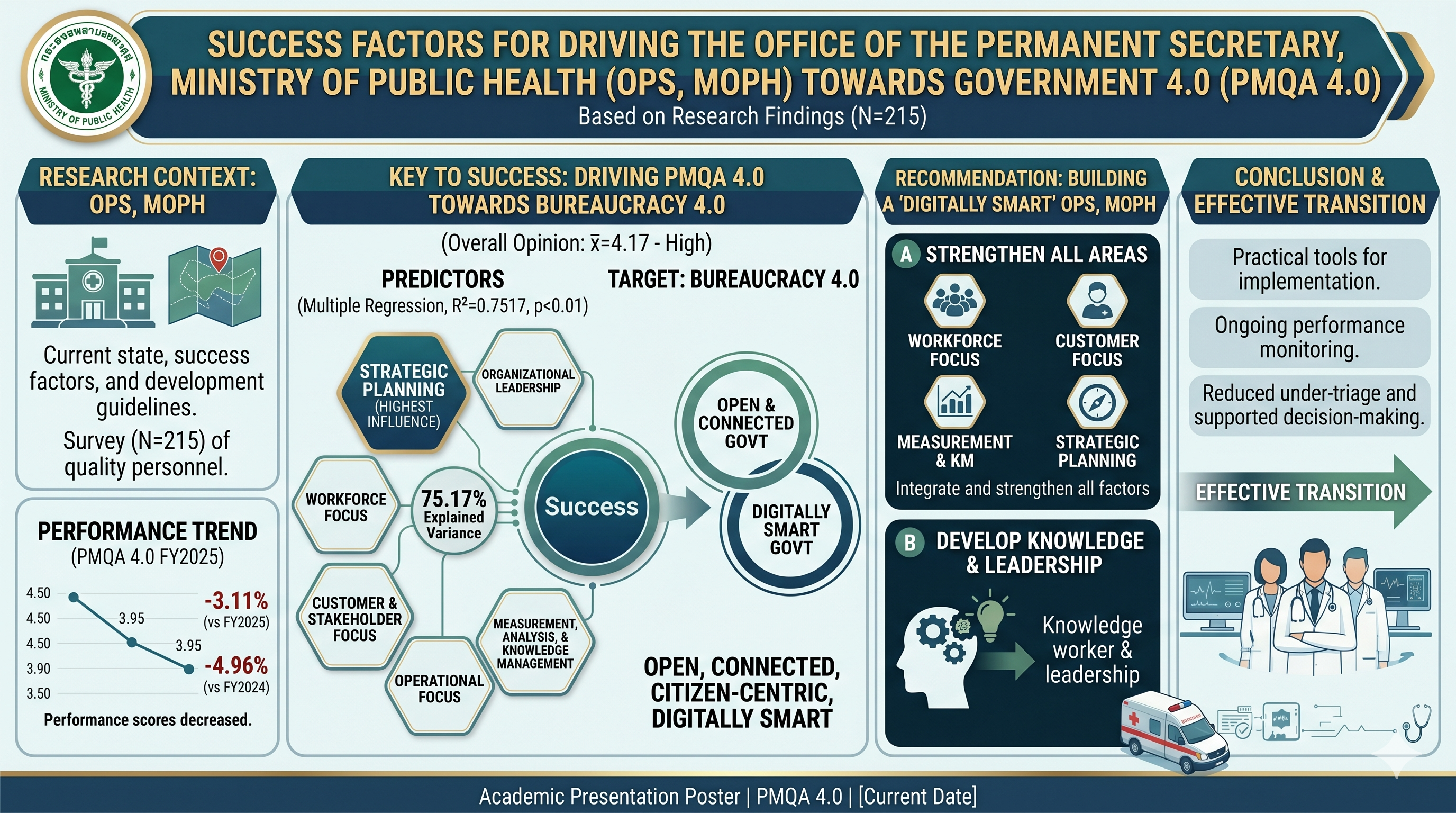
This survey research aimed to investigate the current state, factors affecting success, and propose development guidelines for the Office of the Permanent Secretary, Ministry of Public Health (OPS, MOPH), towards becoming a Bureaucracy 4.0 according to the PMQA 4.0 criteria. Data were collected using questionnaires from personnel responsible for or involved in PMQA quality development across 13 central and 76 regional offices under the OPS, MOPH. The sample size, calculated using Taro Yamane's formula, consisted of 215 respondents.
The results revealed that the performance scores based on the PMQA 4.0 criteria for the fiscal year 2025 decreased by 3.11% and 4.96% compared to the fiscal years 2023 and 2024, respectively. The overall opinion regarding the success of driving the organization was at a high level (x̅=4.17). Multiple regression analysis demonstrated that variables including organizational leadership, strategic planning, customer and stakeholder focus, measurement, analysis, and knowledge management, workforce focus, and operational focus of the agency had a statistically significant positive effect on the success according to the PMQA 4.0 criteria (p-value=0.01). These factors could collectively explain 75.17% of the variance in success, with strategic planning exerting the highest influence.
Based on the findings, it is recommended that the OPS, MOPH emphasizes strengthening all areas and developing knowledge, particularly in organizational leadership. This aims to create an open, connected, and digitally smart government that focuses on providing services aligned with public needs, thereby effectively driving the transition towards a Bureaucracy 4.0.
Article Details

This work is licensed under a Creative Commons Attribution-NonCommercial-NoDerivatives 4.0 International License.
The articles published in this academic journal are copyrighted by the Office of Disease Prevention and Control Region 11, Nakhon Si Thammarat.
The views and opinions expressed in each article are solely those of the respective authors and do not reflect the opinions or positions of the Office of Disease Prevention and Control Region 11, Nakhon Si Thammarat, or its personnel. The authors are fully responsible for the content of their respective articles. In the event of any errors, the authors alone assume full responsibility for their works.
Reproduction of all or part of any article is strictly prohibited unless prior permission has been obtained from the journal editorial board.
This statement is intended for publication on the official website of the academic journal of the Office of Disease Prevention and Control Region 11, Nakhon Si Thammarat.
References
สำนักงานคณะกรรมการพัฒนาระบบราชการ. คู่มือการพัฒนาระบบราชการ 4.0 BEST PRACTICES SHARING [อินเทอร์เน็ต]. กรุงเทพมหานคร; 21 มกราคม 2568. [สืบค้นเมื่อ 4 เมษายน 2568]. 120 หน้า.แหล่งข้อมูล: www.opdc.go.th
สำนักงานคณะกรรมการพัฒนาระบบราชการ. คู่มือการประเมินสถานะของหน่วยงานภาครัฐในการเป็นระบบราชการ 4.0 (ฉบับปรับปรุง พ.ศ. 2566) [อินเทอร์เน็ต]. กรุงเทพมหานคร; พฤศจิกายน 2565; 100 หน้า. [สืบค้นเมื่อ 13 มกราคม 2568]. แหล่งข้อมูล: www.opdc.go.th
สำนักงานคณะกรรมการพัฒนาระบบราชการ. คู่มือหลักเกณฑ์การประเมินสถานะการเป็นระบบราชการ 4.0 (ฉบับปรับปรุง พ.ศ. 2567) [อินเทอร์เน็ต]. กรุงเทพมหานคร; 27 พฤศจิกายน 2567; 112 หน้า. [สืบค้นเมื่อ 13 มกราคม 2568]. แหล่งข้อมูล: www.opdc.go.th
กองยุทธศาสตร์และแผนงาน. แผนปฏิบัติราชการกระทรวงสาธารณสุข ประจำปี พ.ศ. 2568 [อินเทอร์เน็ต]. นนทบุรี; ธันวาคม 2567; 186 หน้า. [สืบค้นเมื่อ 13 มกราคม 2568]. แหล่งข้อมูล: https://spd.moph.go.th
สำนักงานคณะกรรมการพัฒนาระบบราชการ.คู่มือแนวทางการพัฒนาองค์การสู่ระบบราชการ 4.0 ปี 2561 [อินเทอร์เน็ต]. กรุงเทพมหานคร; กรุงเทพมหานคร; ธันวาคม 2560; 94 หน้า. [สืบค้นเมื่อ 13 มกราคม 2568]. แหล่งข้อมูล: www.opdc.go.th
สำนักงานคณะกรรมการพัฒนาระบบราชการ. คู่มือการประเมินสถานะของหน่วยงานภาครัฐในการเป็นระบบราชการ 4.0 (ตามกรอบการประเมินผลการปฏิบัติราชการประจำปี พ.ศ. 2568) [อินเทอร์เน็ต]. กรุงเทพมหานคร; 10 มีนาคม 2568. 106 หน้า. [สืบค้นเมื่อ 4 เมษายน 2568]. เข้าถึงได้จาก https://www.opdc.go.th
สำนักวิจัยและพัฒนาระบบงานบุคคล. ระบบราชการไทยบริบทไทยแลนด์ 4.0 [อินเทอร์เน็ต]. [สืบค้นเมื่อ 25 มกราคม 2568]. แหล่งข้อมูล: https://www.ocsc.go.th/wp-content/uploads/2023/12/PDF-ระบบราชการไทยในบริบทไทยแลนด์-4.0.pdf
นลพรรณ บุญฤทธิ์. ปัจจัยที่มีผลต่อประสิทธิภาพในการปฏิบัติงานของบุคลากรองค์การบริหารส่วนจังหวัดชลบุรี [วิทยานิพนธ์ หลักสูตรบริหารธุรกิจมหาบัณฑิต สาขาวิชาการจัดการสาธารณะ วิทยาลัยพาณิชยศาสตร์] ชลบุรี: มหาวิทยาลัยบูรพา; 2558. 104 หน้า.
กระทรวงสาธารณสุข. กฎกระทรวงแบ่งส่วนราชการสำนักงานปลัดกระทรวง กระทรวงสาธารณสุข พ.ศ. 2567. ราชกิจจานุเบกษา เล่มที่ 141, ตอนที่ 12 ก (ลงวันที่ 17 มีนาคม 2567).
สำนักงานคณะกรรมการพัฒนาระบบราชการ. ผลการประเมินสถานะของหน่วยงานภาครัฐในการเป็นระบบราชการ 4.0 ปี 2568 [อินเทอร์เน็ต]. [สืบค้นเมื่อ 28 พฤศจิกายน 2568]. แหล่งข้อมูล: https://old-awards.opdc.go.th/awardsregister/awards/survey_data/
Joe F. Hair, Marko Sarstedt, Christian M. Ringle, Jeannette A. Mena. An Assessment of the Use of Partial Least Squares Structural Equation Modeling in Marketing Research. Journal of the Academy of Marketing Science 2012;40(3):414–33.
อังคณา แย้มนิล. การพัฒนาคุณภาพการบริหารจัดการภาครัฐ (PMQA) ในการบริหารองค์กร ภายใต้นโยบาย Thailand 4.0 ของหน่วยงานในสังกัดกระทรวงทรัพยากรธรรมชาติและสิ่งแวดล้อม. วารสารวิทยาการจัดการ มหาวิทยาลัยราชภัฏนครปฐม 2564;8(1).
โกศล จิตวิรัตน์. ปัจจัยแห่งความสำเร็จในการเปลี่ยนแปลงสู่องค์การดิจิทัลไทยแลนด์ 4.0 ในศตวรรษที่ 21. วารสารอิเล็กทรอนิกส์ Veridian มหาวิทยาลัยศิลปากร (มนุษยศาสตร์สังคมศาสตร์และศิลปะ) 2563;12(6).
อิสระพงศ์ กุลนรัตน์, ธนวิทย์ บุตรอุดม. ปัจจัยที่มีอิทธิพลต่อการเป็นระบบราชการ 4.0 ของเทศบาลนครอุดรธานี. วารสารมนุษยศาสตร์และสังคมศาสตร์ปริทัศน์ มหาวิทยาลัยราขภัฏลำปาง 2564;9(1):37-48.
นัฐพล วัฒนสุข. ปัจจัยที่ส่งผลต่อความสำเร็จของสำนักงานคณะกรรมการการอาชีวศึกษาในการพัฒนาองค์การเป็นระบบราชการ 4.0 [อินเทอร์เน็ต]. [สืบค้นเมื่อ 1 กรกฎาคม 2568]. แหล่งข้อมูล: https://psdg.vec.go.th/Portals/5/Doc66/Factor_Affecting_%20the_Success%20.pdf
ปรียวรรณ สุวรรณสูนย์. ระบบราชการไทย 4.0. หอสมุดรัฐสภา [อินเทอร์เน็ต]. [สืบค้นเมื่อ 1 กรกฎาคม 2568]. แหล่งข้อมูล: https://library.parliament.go.th/th/radioscript/rabbrachkarithy-40
