
Development of a Long-Term Care Model for the Elderly in a Dependent
Article Sidebar
Main Article Content
Abstract
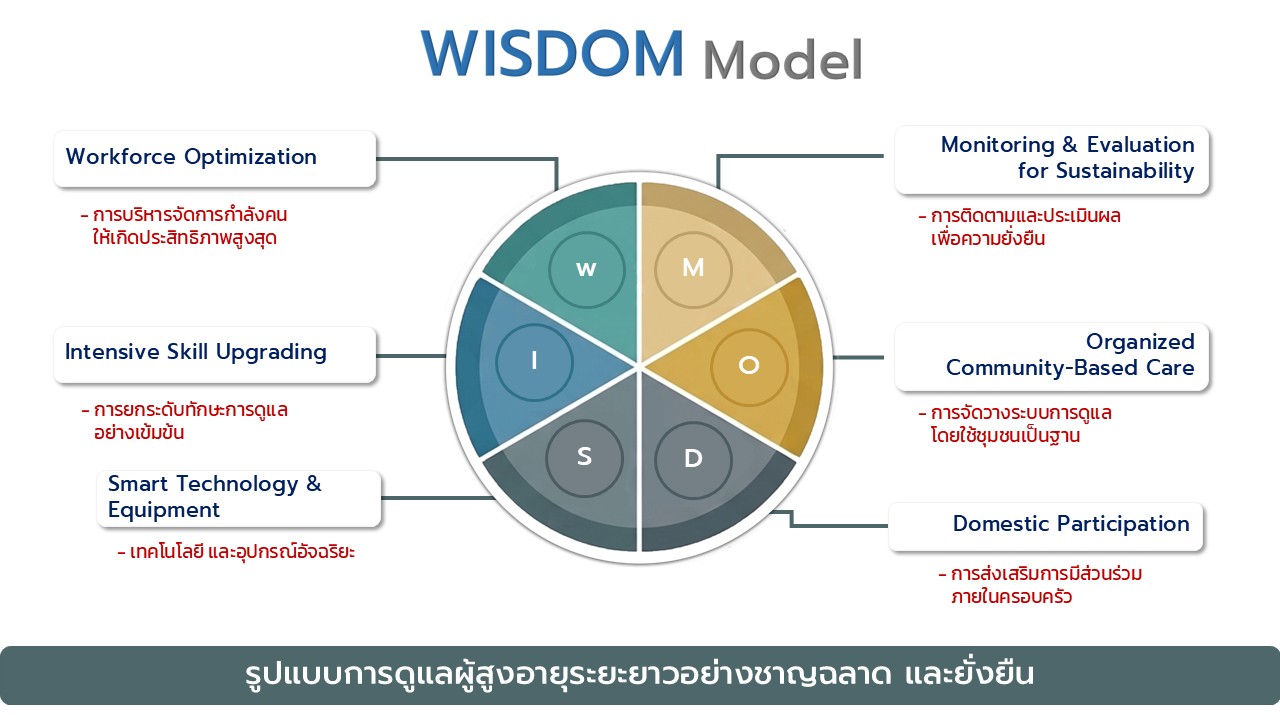
This action research aimed to 1) analyze the problems and needs for developing a long-term care model for dependent elderly individuals, 2) develop a long-term care model for dependent elderly individuals, and 3) evaluate the developed model. The study was conducted in Bang Nai Si Subdistrict, Takuapa District, Phang Nga Province. The sample consisted of 45 dependent elderly individuals, 30 family leaders and caregivers, and 21 network partners. The research instruments included interview questionnaires, focus group discussions, satisfaction questionnaires, and the Barthel ADL (Activities of Daily Living) Index. Data were analyzed using content analysis, descriptive statistics, and paired T-tests. The results showed that seven major limitations identified in the existing problems and needs were: an inappropriate caregiver-to-patient ratio, limited caregiver skills, a shortage of caregivers, insufficient medical equipment, an increasing number of target individuals, lack of rehabilitation equipment, and a lack of continuity in family care due to the top-down approach of the previous model lacking family participation. The researchers developed the "WISDOM Model," comprising Workforce Optimization, Intensive Skill Upgrading, Smart Technology & Equipment, Domestic Participation, Organized Community-Based Care, and Monitoring & Evaluation. This model is driven by seven key activities, focusing on a shift from individual dependence to a community-based system and the use of supporting technology. Process and output evaluations revealed that stakeholders and network partners expressed a high to very high level of satisfaction with the model. Impact assessments showed a significant improvement in the health status of the target elderly group. A 10-month post-implementation evaluation demonstrated a reduction in health problems across all dimensions from "most severe" to "moderate to low." The WISDOM Model is an effective long-term care model for the elderly, tangibly improving the quality of life for dependent individuals through sustainable integrated collaboration between families and community networks.
Article Details

This work is licensed under a Creative Commons Attribution-NonCommercial-NoDerivatives 4.0 International License.
The articles published in this academic journal are copyrighted by the Office of Disease Prevention and Control Region 11, Nakhon Si Thammarat.
The views and opinions expressed in each article are solely those of the respective authors and do not reflect the opinions or positions of the Office of Disease Prevention and Control Region 11, Nakhon Si Thammarat, or its personnel. The authors are fully responsible for the content of their respective articles. In the event of any errors, the authors alone assume full responsibility for their works.
Reproduction of all or part of any article is strictly prohibited unless prior permission has been obtained from the journal editorial board.
This statement is intended for publication on the official website of the academic journal of the Office of Disease Prevention and Control Region 11, Nakhon Si Thammarat.
References
United Nations, Department of Economic and Social Affairs. World population prospects 2022: summary of results [Internet]. New York: United Nations Publication; 2022 [cited 2026 January 9]. 52 Pages. Available from:https://www.un.org/development/desa/pd/sites/www.un.org.development.desa.pd/files/ wpp2022_summary_of_results.pdf
World Health Organization. Ageing and health [Internet]. 2022 [cited 2025 December 15]. Available from: https://www.who.int/news-room/fact-sheets/detail/ageing-and-health
European Commission. European Commission Report on the Impact of Demographic Change [Internet]. 2020 [cited 2025 December 22]. Available from: https://commission.europa.eu/system/files/2020-6/demography_report_2020_n.pdf
สุชน ยิ้มรัตนบวร. ปัจจัยที่มีผลต่อความเป็นไปได้ในการออกแบบอาคารพักอาศัยรวม: กรณีศึกษา Baron Residence ย่านบางกะปิ. Veridian E-Journal Silpakorn University 2558;8(3):1269–83.
Wu SC, Chuang KY. Aging in place: the direction of Taiwan long-term care policy in the 21st century. Taiwan J of Public Health 2001;20(3):192–201.
สำนักอนามัยผู้สูงอายุ กรมอนามัย. คู่มือสนับสนุนระบบการบริหารจัดการระบบบริการดูแลระยะยาวด้านสาธารณสุขสำหรับผู้สูงอายุที่มีภาวะพึ่งพิงในระบบหลักประกันสุขภาพแห่งชาติ [อินเทอร์เน็ต]. กรุงเทพฯ: สำนักงานหลักประกันสุขภาพแห่งชาติ (สปสช.); 2559 [สืบค้นเมื่อ 9 ธันวาคม 2568]. 86 หน้า. แหล่งข้อมูล: https://eh.anamai.moph.go.th/th/elderly-manual/201572
สำนักงานสถิติแห่งชาติ กระทรวงดิจิทัลเพื่อเศรษฐกิจและสังคม. การสำรวจประชากรสูงอายุในประเทศไทย พ.ศ. 2567 [อินเทอร์เน็ต]. [สืบค้นเมื่อ 16 พฤศจิกายน 2568]. แหล่งข้อมูล: https://www.nso.go.th/nsoweb/storage/survey_detail/2025/20241209145003_27188.
World Health Organization. Global strategy on human resources for health: workforce 2030. Geneva: WHO; 2020.
Threapleton DE, Chung RY, Wong SY, Wong E, Chau P, Woo J, et al. Integrated care for older adults with frailty: a systematic review. Health Syst Reform. 2017;3(2):148–60. doi: 10.1093/intqhc/mzx041
Spasova S, Baeten R, Coster S, Ghailani D, Pena-Casas R, Vanhercke B. Challenges in long-term care in Europe: a study of national policies. Brussels: European Social Observatory; 2018. doi:10.2767/84573
สุธิดา แจ้งประจักษ์. การดูแลผู้สูงอายุระยะยาวของประเทศไทย: มุมมองด้านนโยบาย. วารสารมหาจุฬานาครทรรศน์. 2566;10(5):233–43.
กัลยา เกื้อกูล. รูปแบบการดูแลระยะยาวของผู้สูงอายุที่มีภาวะพึ่งพิงอย่างมีส่วนร่วมของโรงพยาบาลส่งเสริมสุขภาพตำบลแห่งหนึ่งในภาคใต้ ประเทศไทย. วารสารอนามัยสิ่งแวดล้อมและสุขภาพชุมชน. 2568;10(4):1–12.
Park YJ, Chun YL. Effects of community-based rehabilitation program on activities of daily living and cognition in elderly chronic stroke survivors. J. Phys. Ther. Sci. 2016;28:3264–6. doi:10.1589/jpts.28.3264
Liu L, Stroulia E, Nikolaidis I, Miguel-Cruz A, Rios Rincon A. Smart homes and home health monitoring technologies for older adults: a systematic review. Int J Med Inform. 2016;91:44–59. doi:10.1016/j.ijmedinf.2016.04.007
Xin W, Xu D, Dou Z, Jacques A, Umbella J, Hill AM. Effectiveness of community-based rehabilitation (CBR) centres for improving physical fitness for community-dwelling older adults: a systematic review protocol. BMJ Open. 2022;12(10):e062992. doi:10.1136/bmjopen-2022-062992
Somtua N, Nuntaboot K. Community-based rehabilitation for older adults post-stroke in Thailand: an ethnographic study. Belitung Nurs J. 2025;11(2):205–14. doi: 10.33546/bnj.3690
Faul F, Erdfelder E, Lang AG, Buchner A. G*Power 3: a flexible statistical power analysis 2007;39(2):175-91. doi:10.3758/bf03193146
Cohen J. Statistical Power Analysis for the Behavioral Sciences. (2nd). New York: Lawrence Erlbaum Associates, Publishers; 1988.
Crabtree, BF, & Miller, WF. A template approach to text analysis: developing and using codebooks. In: Crabtree BF, Miller WF, editors. Doing qualitative research. Newbury Park (CA): Sage; 1992. p.93–109.
กรมกิจการผู้สูงอายุ กระทรวงการพัฒนาสังคมและความมั่นคงของมนุษย์. สถานการณ์ผู้สูงอายุไทย พ.ศ. 2566. พิมพ์ครั้งที่ 1. กรุงเทพฯ: โรงพิมพ์โกโกพริ้นท์ (ไทยแลนด์) จำกัด; 2567.
มูลนิธิสถาบันวิจัยและพัฒนาผู้สูงอายุไทย สถาบันวิจัยประชากรและสังคม มหาวิทยาลัยมหิดล. สถานการณ์ผู้สูงอายุไทย พ.ศ. 2565. พิมพ์ครั้งที่ 1. กรุงเทพฯ: อมรินทร์ คอร์ปเปอร์เรชั่นส์ จำกัด (มหาชน); 2566.
ปรียาวดี บุญไชยโย. การพัฒนารูปแบบการดูแลสุขภาพผู้สูงอายุระยะยาวในกลุ่มที่มีภาวะพึ่งพิง โรงพยาบาลนามน จังหวัดกาฬสินธุ์. วารสารอนามัยสิ่งแวดล้อมและสุขภาพชุมชน. 2567;9(6):831-8.
วรางคณา ศรีภูวงษ์, ชาญยุทธ ศรีภูวงษ์, สุรศักดิ์ เทียบฤทธิ์. การพัฒนารูปแบบการดูแลสุขภาพผู้สูงอายุระยะยาวในกลุ่มที่มีภาวะพึ่งพิง ตำบลท่าขอนยาง อำเภอกันทรวิชัย จังหวัดมหาสารคาม. วารสารวิชาการสาธารณสุขชุมชน. 2563;6(2):13–28.
รัชพล สัมฤทธิ์. การพัฒนาการดำเนินงานเตรียมรองรับสังคมสูงวัยด้วยกลไกคณะกรรมการพัฒนาคุณภาพชีวิตระดับอำเภอ อำเภอปะเหลียน จังหวัดตรัง. วารสารการพยาบาลและการศึกษา. 2568;18(1):1–17.
Knickman JR, Snell EK. The 2030 problem: caring for aging baby boomers. Health Serv Res. 2002;37(4):849-84. doi:10.1034/j.1600-0560.2002.56.x
ศศิพัฒน์ ยอดเพชร. สังคมสูงอายุ และสังคมอายุยืน : แนวทางการพัฒนาบริการเพื่ออนาคต. วารสารสภาวิชาชีพสังคมสงเคราะห์แห่งประเทศไทย. 2568;1(2):71-81.
Kim I, An H, Yun S, Park HY. Effectiveness of community-based interventions for older adults living alone: a systematic review and meta-analysis. Epidemiol Health. 2024;46:e2024013. doi:10.4178/epih.e2024013
Age Platform Europe. ICT for ageing well: listen to what older people think! [Internet]. 2014; [cited 2026 March 1]. Available from: https://www.age-platform.eu/ict-for-ageing-well-listen-to-what-older-persons-think/
Tsutsui T. Implementation process and challenges for the community-based Integrated care system in Japan. Int J Integr Care. 2014;14:1-9. doi:10.5334/IJIC.988
Prince M, Acosta D, Ferri CP, Guerra M, Huang Y, Rodriguez JJL, et al. Dementia incidence and mortality in middle-income countries, and associations with indicators of cognitive reserve: a 10/66 Dementia Research Group population-based cohort study. Lancet. 2012;380(9836):50-8. doi:10.1016/s0140-6736(12)60399-7
Balqis-Ali NZ, Jawahir S, Chan YM, Lim AW, Azlan UW, Shaffie SSM, et al. The impact of long-term care interventions on healthcare utilisation among older persons: a scoping review of reviews. BMC Geriatr. 2024;24(1):484. doi:10.1186/s12877-024-05097-9
