
Effects of Brief Mindfulness-Based Counseling Program on Self-Management Behavior and Clinical Outcomes in Type 2 Diabetes Patients at Lansaka Hospital
Article Sidebar
Main Article Content
Abstract
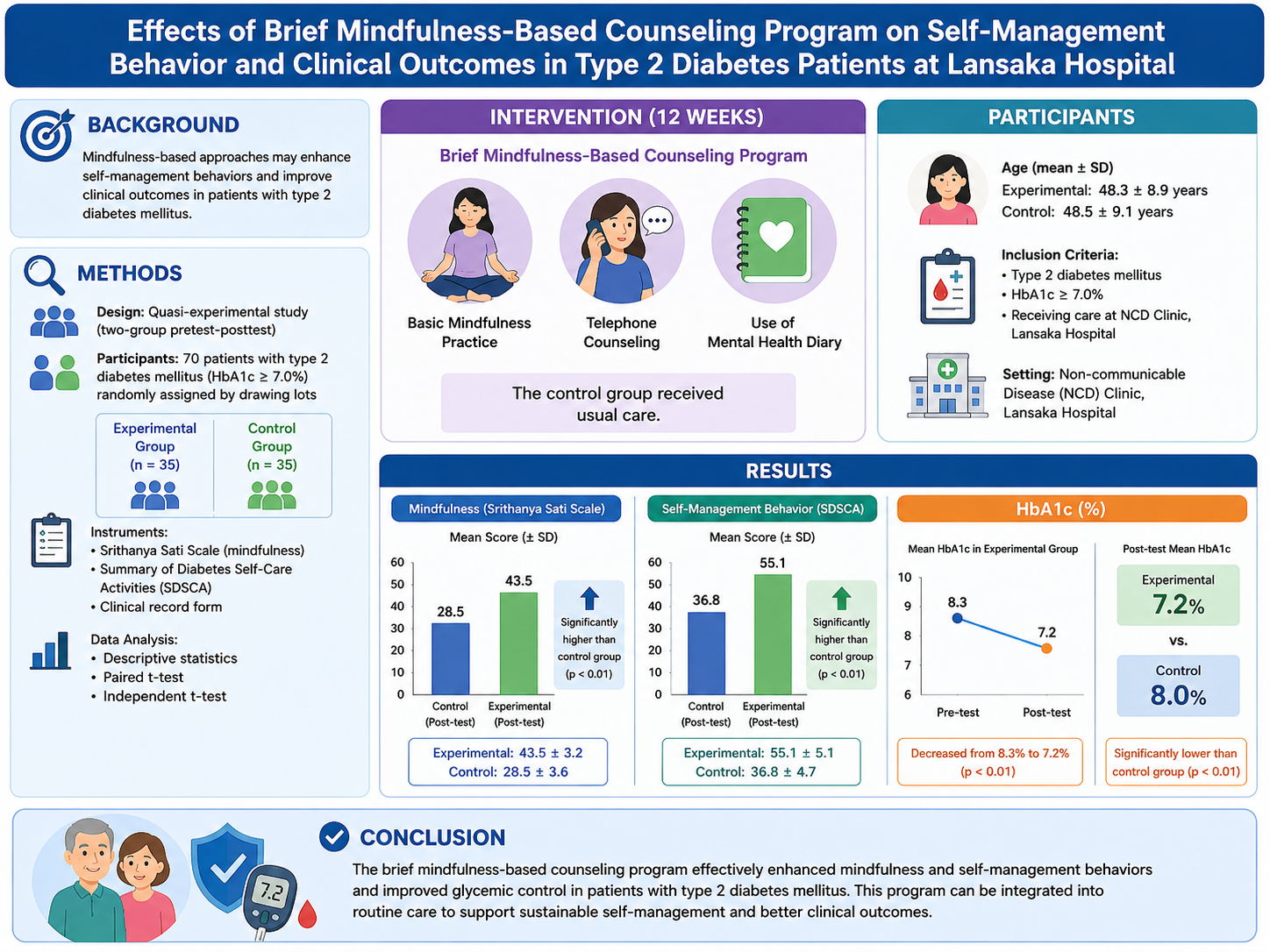
This quasi-experimental study employed a two-group pretest-posttest design to examine the effectiveness of a brief mindfulness-based counseling program among patients with type 2 diabetes mellitus attending the non-communicable disease clinic at Lan Saka Hospital. The participants were 70 patients with type 2 diabetes mellitus who had HbA1c levels of 7.0% or higher. They were assigned to an experimental group and a control group, with 35 participants in each group, using simple random allocation by drawing lots. The research instruments included the Srithanya Sati Scale, the Summary of Diabetes Self-Care Activities questionnaire, and a clinical record form. The experimental group received a 12-week program consisting of basic mindfulness practice, telephone counseling, and the use of a mental health diary. Data were analyzed using descriptive statistics and inferential statistics including paired t-test, and independent t-test.
The results showed that the experimental group had significantly higher mean scores for mindfulness (43.5 ± 3.2) and self-management behaviors (55.1 ± 5.1) than the control group (p-value < 0.01). In addition, the mean HbA1c level in the experimental group decreased from 8.3% to 7.2%, which was significantly lower than that of the control group, which had a mean HbA1c level of 8.0% (p-value < 0.01).
These findings indicate that the brief mindfulness-based counseling program was effective in promoting self-management behaviors and improving glycemic control among patients with type 2 diabetes mellitus.
Article Details

This work is licensed under a Creative Commons Attribution-NonCommercial-NoDerivatives 4.0 International License.
The articles published in this academic journal are copyrighted by the Office of Disease Prevention and Control Region 11, Nakhon Si Thammarat.
The views and opinions expressed in each article are solely those of the respective authors and do not reflect the opinions or positions of the Office of Disease Prevention and Control Region 11, Nakhon Si Thammarat, or its personnel. The authors are fully responsible for the content of their respective articles. In the event of any errors, the authors alone assume full responsibility for their works.
Reproduction of all or part of any article is strictly prohibited unless prior permission has been obtained from the journal editorial board.
This statement is intended for publication on the official website of the academic journal of the Office of Disease Prevention and Control Region 11, Nakhon Si Thammarat.
References
International Diabetes Federation. IDF Diabetes Atlas [Internet]. 10th ed. Brussels: International Diabetes Federation; 2021 [cited 2025 December 14]. Available from: https://idf.org/about-diabetes/resources/idf-diabetes-atlas-2021/
กระทรวงสาธารณสุข. ระบบคลังข้อมูลด้านการแพทย์และสุขภาพ (HDC) เขตสุขภาพที่ 11 ปี 2567- 2568 [อินเทอร์เน็ต]. นนทบุรี: กระทรวงสาธารณสุข; 2568 [สืบค้นเมื่อ 3 ธันวาคม 2568]. แหล่งข้อมูล: https://r11.hdc.moph.go.th/hdc/main/index.php
โรงพยาบาลลานสกา. รายงานสถิติผู้ป่วยคลินิกโรคไม่ติดต่อเรื้อรัง (NCDs) ประจำปี 2568. นครศรีธรรมราช: คลินิกโรคเบาหวาน โรงพยาบาลลานสกา; 2568.
DeFronzo RA, Ferrannini E, Groop L, Henry RR, Herman WH, Holst JJ, et al. Type 2 diabetes mellitus. Nat Rev Dis Primers. 2015;1:15019. doi: 10.1038/nrdp.2015.19
Whitlock EP, Orleans CT, Pender N, Allan J. Evaluating primary care behavioral counseling interventions: an evidence-based approach. Am J Prev Med. 2002;22(4):267-84. doi: 10.1016/s0749-3797(02)00415-4
Abraham AM, Sudhir PM, Philip M, Bantwal G. Efficacy of a brief self-management intervention in type 2 diabetes mellitus: A randomized controlled trial from India. Indian J Psychol Med. 2020;42(6):540-8. doi: 10.1177/0253717620932250
Shrivastava SR, Shrivastava PS, Ramasamy J. Role of self-care in management of diabetes mellitus. J Diabetes Metab Disord. 2013;12(1):14. doi: 10.1186/2251-6581-12-14
Wallace AS, Seligman HK, Davis TC, Schillinger D, Arnold CL, Bryant-Shilliday B, et al. Literacy-appropriate educational materials and brief counseling improve diabetes self-management. Patient Educ Couns. 2009;75(3):328-33. doi: 10.1016/j.pec.2008.12.017
Fall E, Roche B, Izaute M, Batisse M, Tauveron I, Chakroun N. A brief psychological intervention to improve adherence in type 2 diabetes. Diabetes Metab. 2013;39(5):432-8. doi: 10.1016/j.diabet.2013.05.003
Sherwani SI, Khan HA, Ekhzaimy A, Masood A, Sakharkar MK. Significance of HbA1c test in diagnosis and prognosis of diabetic patients. Biomark Insights. 2016;11:95–104. doi: 10.4137/BMI.S38440
Merakou K, Knithaki A, Karageorgos G, Theodoridis D, Barbouni A. Group patient education: effectiveness of a brief intervention in people with type 2 diabetes mellitus in primary health care in Greece: a clinically controlled trial. Health Educ Res. 2015;30(2):223–32. doi: 10.1093/her/cyv001
Kabat-Zinn J. Mindfulness-based interventions in context: past, present, and future. Clin. Psychol.: Sci. Pract. 2003;10(2):144-56. doi: 10.1093/clipsy.bpg016
Páez-Márquez CS, Higuera-Dagovett E, Rojas-Valencia JT. Effect of mindfulness-based intervention in patients with diabetes: a meta-analytic review. Psychol Health Med. 2025;30(8):1790–813. doi: 10.1080/13548506.2025.2487948
Wang H, Ge L, Yan Yan Kwok J, Zhang Z, Wiley J, Guo J. A blended mindfulness-based stress reduction program to improve diabetes self-management among people with type 2 diabetes mellitus: a mediation effect analysis. Ann Behav Med. 2025;59(1). doi: 10.1093/abm/kaae075
Ngan HY, Chong YY, Chien WT. Effects of mindfulness- and acceptance-based interventions on diabetes distress and glycaemic level in people with type 2 diabetes: Systematic review and meta-analysis. Diabet Med. 2021;38(4):e14525. doi: 10.1111/dme.14525
Ni YX, Ma L, Li JP. Effects of mindfulness-based intervention on glycemic control and psychological outcomes in people with diabetes: A systematic review and meta-analysis. J Diabetes Investig. 2021;12(6):1092–103. doi: 10.1111/jdi.13439
นิตยา สุขชัยสงค์, พนิตนันท์ พรหมดำ. ประสิทธิผลของโปรแกรมการจัดการตนเองร่วมกับการฝึกสติ ในผู้ป่วยโรคเบาหวานที่คุมไม่ได้. วารสารพยาบาลเกื้อการุณย์. 2566;30(2):241-55.
โรงพยาบาลศรีธัญญา. คู่มือแบบประเมินสติศรีธัญญา (Srithanya Sati Scale: SSS). นนทบุรี: โรงพยาบาลศรีธัญญา กรมสุขภาพจิต กระทรวงสาธารณสุข; 2560.
ภาวนา กีรติยุตวงศ์, สมจิต หนุเจริญกุล. การติดตามประสิทธิภาพในระยะยาวของโปรแกรมการจัดการดูแลตนเองในผู้ที่เป็นเบาหวานชนิดที่ 2. รามาธิบดีพยาบาลสาร. 2556;16(2):293-308.
Toobert DJ, Hampson SE, Glasgow RE. The summary of diabetes self-care activities measure: results from 7 studies and a revised scale. Diabetes Care. 2000;23(7):943–50. doi: 10.2337/diacare.23.7.943
นิตยา สุขชัยสงค์, พนิตนันท์ พรหมดำ, ณัฐศิวัช ชุมฝาง. การฝึกสติต่อพฤติกรรมการรับประทานอาหาร: การประยุกต์ใช้ในผู้ป่วยเบาหวาน. วชิรเวชสารและวารสารเวชศาสตร์เขตเมือง. 2562;63(Suppl):S159-66.
วาสนา ยินดีมาก, หทัยวรรณ แสงคำไพ, ภัทราพร ตันนุกูล. ผลของโปรแกรมการให้คำปรึกษาแบบสั้นโดยใช้สติเป็นพื้นฐาน ต่อพฤติกรรมการจัดการตนเองและระดับน้ำตาลในเลือด ในผู้ป่วยเบาหวาน ชนิดที่ 2 ที่ควบคุมไม่ได้. วารสารโรงพยาบาลมหาสารคาม. 2568;22(1):180-94.
