
Development of nursing model for diabetic patients with foot ulcers with self-care management and case management in outpatient department SaKaeo Crown Prince Hospital
Article Sidebar
Main Article Content
Abstract
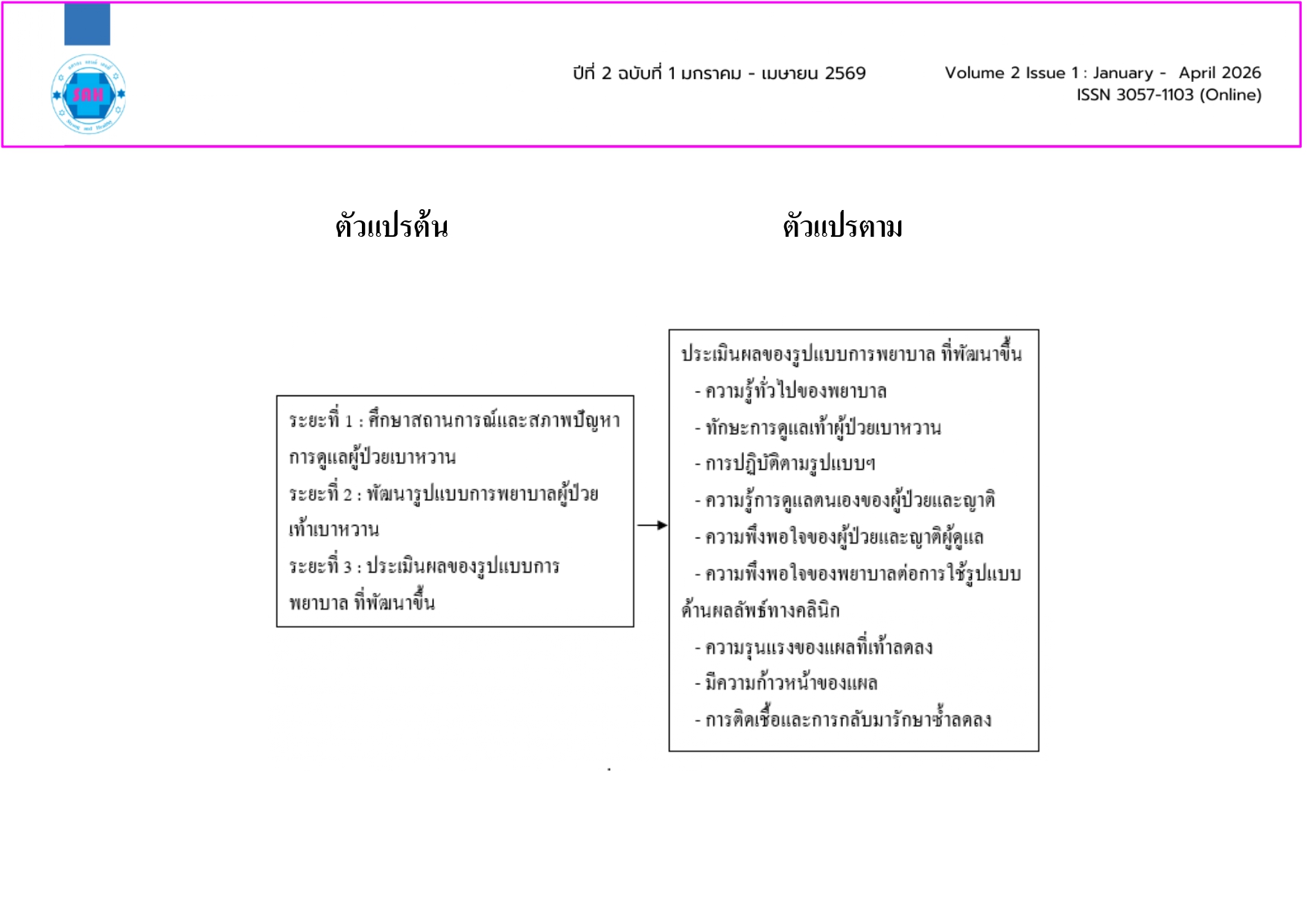
The objectives of this study were to 1) describe the situation and challenges in caring for diabetic patients with foot ulcers, 2) develop a nursing care model for diabetes patients, and 3) evaluate the development of a nursing care model for diabetic patients. The population consists of diabetic patients with foot ulcers and caregivers, outpatient nurses at Sa Kaeo Prince Hospital. The conceptual framework was the applied self-management theory of Kanfer and Gaelick-Buys. The methodology is research and development. The population consisted of patients with diabetes and their relatives, as well as registered nurses, totaling 7,441 people. The sample was divided into three groups: 1) ten registered nurses, 2) thirty‑five diabetic patients with foot ulcers, and 3) thirty‑five relatives/caregivers. The participants were selected using purposive sampling. The research tools included an interview protocol, a knowledge assessment, and a questionnaire. The Content Validity Index (CVI) of the instruments was 0.82, and the difficulty and discrimination indices were 0.34 and 0.82, respectively. The reliability of the entire instrument was 0.847. Statistical analyses included frequency, percentage, mean, standard deviation, paired sample t-test, and Wilcoxon sign rank test.
The study results showed that 1) Nurses still lack the specific knowledge and skills required to care for diabetic patients with foot ulcers. 2) The nursing care model for patients with diabetes includes: 1) Screening, assessment, and classification of diabetic patients based on their risk levels for developing diabetic foot ulcers. 2) Management of diabetic foot ulcers to promote wound healing. 3) Self‑management for continued diabetic foot care at home. 4) Case management and coordination with a multidisciplinary healthcare team: after developing the nursing model for patients with diabetes and their relatives, the mean score of knowledge regarding foot care was significantly higher than before the model development at the .01 level. The diabetic patients and their relatives had significantly higher mean foot‑wound care behavior scores after the development of the nursing model than before, at the .01 level of statistical significance. The severity of diabetic foot ulcers showed significantly lower mean scores after the development of the nursing model than before, also at the .01 level of significance. The satisfaction of diabetic patients and their relatives with the nursing model was at a high level. Nurses adhered to the developed diabetic foot‑ulcer nursing model at 100%. After the development of the nursing model, the mean knowledge scores were significantly higher than before, at the .01 level. The overall mean skills in diabetic foot care were also significantly higher after the development of the nursing model, at the .01 level of significance. After the development of the nursing model, satisfaction was at the highest level, and no wound infections or readmissions were found.
Article Details

This work is licensed under a Creative Commons Attribution-NonCommercial-NoDerivatives 4.0 International License.
References
กองโรคไม่ติดต่อ กรมควบคุมโรค กระทรวงสาธารณสุข. (2567). รายงานประจำปี 2567. กรุงเทพฯ. สำนักพิมพ์อักษรกราฟฟิคแอนด์ดีไซน์.
International Diabetes Federation. (2023). Diabetes fact sheet. [cited 2025 April 1]. Available from:
http:// www.idf.org/webdata /docs/Background_inf.
มนัสดา คํารินทร์. (2563). การพยาบาลผู้ป่วยเบาหวานที่มีแผลที่เท้า. วารสารโรงพยาบาลมหาสารคาม. 17(1):139-148)
กรวรรณ ผมทอง,เขมารดี มาสิงบุญ และ วัลภา คุณทรงเกียรติ. (2562). ปัจจัยที่มีอิทธิพลต่อพฤติกรรม การดูแลเท้าของผู้ป่วยเบาหวานกลุ่มเสี่ยงต่อการเกิดแผลที่เท้า. วารสารการพยาบาลและการดูแล สุขภาพ. 37(4):109-118.
กัลปังหา โชสิวสกุล,เพียงใจ ศรียอด,วรางคณา ตาปสนันท์, นิตยา เศรษฐวรานนท์. (2566). ปัจจัยที่มี ความสัมพันธ์กับการเกิดแผลที่เท้าของผู้ป่วยเบาหวานชนิดที่ 2 ในคลินิกเบาหวาน. วารสารวิจัย สุขภาพและการพยาบาล. 39(2):184-194.
วนิดา เสนามนต์, พีรพงษ์ บุญสวัสดิ์กุลชัย. (2567). การปฏิบัติบทบาทของพยาบาลผู้จัดการรายกรณีใน การปรับปรุงคุณภาพ การดูแลผู้ป่วยโรคเบาหวานในโรงพยาบาลชุมชน เขตสุขภาพที่10. วารสาร วิทยาศาสตร์สุขภาพ วิทยาลัยพยาบาลบรมราชชนนี สรรพสิทธิประสงค์. 8(1):1-13.
ศูนย์สารสนเทศ โรงพยาบาลสมเด็จพระยุพราชสระแก้ว. (2568). รายงานประจำปี 2568. สระแก้ว:
โรงพยาบาลสมเด็จพระยุพราชสระแก้ว.
บุญเชิด ภิญโญอนันตพงษ์. (2545). การวัดประเมินผลการเรียนรู้. คณะศึกษาศาสตร์ มหาวิทยาลัย
ศรีนครินทร์:กรุงเทพมหานคร
บุญธรรม กิจปรีดาบริสุทธิ์. (2549). สถิติวิเคราะห์เพื่อการวิจัย. พิมพ์ครั้งที่ 4. กรุงเทพ:จามจุรีโปรดักท์.
บุญชม ศรีสะอาด. (2551). การวิจัยเบื้องต้น. พิมพ์ครั้งที่ 6. กรุงเทพฯ: สุวีริยาสาสน์.
The ADAPTE Collaboration. (2010). The ADAPTE Process: Resource Toolkit for Guideline Adaptation. Version 2.0. 2010. (online). from : URL: https://g-i-n.net/wp-content/uploads
/2021/05/ADAPTE-Resource toolkit-V2.1-March-2010-updated disclaimer.pdf.
ละอองดาว คำชาตา เนาวรัตน์ เสนาไชยและสุขมาพร พึ่งผาสุข. (2559). บทบาทพยาบาลกับการจัดการ รายกรณีผู้ป่วยเบาหวานที่มีแผลที่เท้า. วารสารมหาวิทยาลัยนครพนม ฉบับการประชุมวิชาการ ครบรอบ 25 ปี. 6(1): 240-247.
Kanfer, F. H., & Gaelick-Buys, L. (1991). Self-management methods. In F. Kanfer & A. Goldtein
(Eds.), Helping people change: A text book of methods. (4th ed.). New York:Pergamonpress.
ทิพมาส ชิณวงศ์. (2560). การจัดการรายกรณีผู้ที่เป็นเบาหวานและความดันโลหิตสูงในชุมชน. วารสาร พยาบาลสงขลานครินทร์ 2560; 37(1):148-57
เพ็ญศรี แคนยุกต์, อัญชลี พรดำรัศมี, สัตตบงกช คีรีรัตน์. (2565). พัฒนารูปแบบการพยาบาลผู้ป่วยเท้า เบาหวาน โรงพยาบาลตรัง. วารสารวิชาการสำนักงานสาธารณสุขจังหวัดมหาสารคาม. 6(11):1-23.
ณัฐนันท์ วัฒนวิการ, เพลินพิศ บุณยมาลิกและปาหนัน พิชยภิญโญ. (2567). ผลของโปรแกรมป้องกัน ก เกิดแผลเท้าเบาหวาน ต่อความรู้และพฤติกรรม การดูแลเท้า และสุขภาพเท้าของผู้สูงอายุที่เป็น เบาหวานชนิดที่ 2 ในศูนย์บริการสาธารณสุขแห่งหนึ่ง. วารสารควบคุมโรค. 50(4):664-677.
สุชานันท์ บัวเผื่อนและคณะ. (2568). ผลของโปรแกรมการส่งเสริมพฤติกรรมในการดูแลเท้าต่อความรู้ พฤติกรรมและอาการชาเท้าในกลุ่มผู้ป่วยเบาหวานที่ไม่สามารถควบคุมระดับน้ำตาลในเลือดได้ ตำบลจานลาน อำเภอพนา จังหวัดอำนาจเจริญ. วารสารการพยาบาลและสุขภาพ. 4(1):91-102.
จันทร์เพ็ญ เยาวเรศ ลัดดา อะโนศรี และอาทิตยา รูวชินพงษ์. (2562). การพัฒนารูปแบบการพยาบาล สำหรับแผลเบาหวานที่เท้าใน โรงพยาบาลกาฬสินธุ์. วารสารการพยาบาลและการดูแลสุขภาพ. 37(1):128-137.
อนงค์ เอื้อวัฒนา,อนุรักษ์ ชิดดีและปิยพร นิสสัยกล้า. (2561). ระบบการดูแลผู้ป่วยเบาหวานที่มีแผลที่ เท้าโรงพยาบาลอำนาจเจริญ. วารสารการพยาบาลและการดูแลสุขภาพ. 36(1):198-206.
