Effects of a Care Program for Patients with Type 2 Diabetes to Achieve Remission and Tele-Nursing on Self-Care Behaviors and Glycated Hemoglobin Levels among Type 2 Diabetes Patients at Doi Saket Hospital, Chiang Mai Province
Article Sidebar
Main Article Content
Abstract
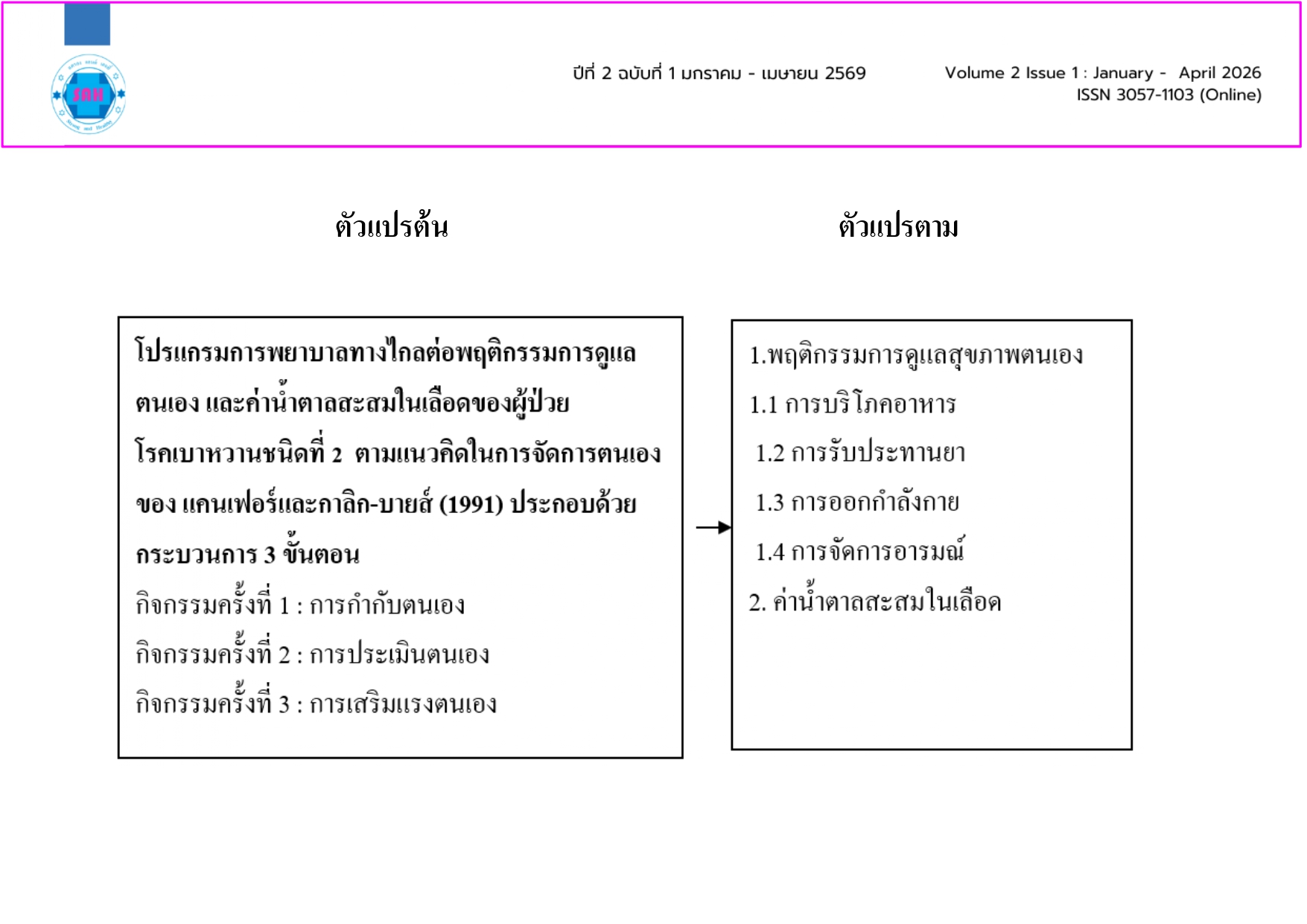
The objectives of this study were to 1) compare the mean self-care behavior scores of patients with type 2 diabetes before and after receiving the program between the experimental group and the control group, and 2) compare the glycated hemoglobin (HbA1c) levels of patients with type 2 diabetes before and after receiving the program between the intervention group and the control group. The conceptual framework was the applied self-management theory of Kanfer and Gaelick-Buys for self-regulation, self-assessment, self-reinforcement. The methodology is a quasi-experimental research design with two-group measurement. Population: 4,023 people; Experimental group: 32 people; Comparison group: 32 people; Selected by purposive sampling. The research instrument is a behavioral assessment scale. The index of content validity was .72. The reliability coefficient of the entire instrument was .794. Statistics used for the data analysis include percentage, mean and standard deviation, paired t-test, and independent sample t-test statistics.
The results of the study found that 1) after receiving the program, the experimental group had a higher mean score for self-care health behaviors than before receiving the program and significantly higher than the comparison group at the 0.05 level, and 2) after receiving the program, the experimental group had a significantly lower level of glycated hemoglobin (HbA1c) compared to before receiving the program and compared to the control group at the 0.05 significance level.
This study suggests that a tele-nursing program can effectively improve health behaviors in patients with type 2 diabetes. Implementing tele-nursing for these patients can help them adopt proper self-care practices, maintain normal blood glucose levels, reduce HbA1c, and ultimately decrease the severity of the disease.
Article Details

This work is licensed under a Creative Commons Attribution-NonCommercial-NoDerivatives 4.0 International License.
References
กระทรวงสาธารณสุข. (2568). Health Data Center (HDC). https://hdc.moph.go.th/cmi/public/standard-report-detail/e9fb648fe9f1858878714a410222eef1
จรูญ บุญธกานนท์. (2566). ปัจจัยที่มีความสัมพันธ์กับการลดลงของอัตราการกรองของไตอย่าง
รวดเร็วในผู้ป่วยโรคไตเรื้อรังระยะ 3–4 โรงพยาบาลเกษตรสมบูรณ์ จังหวัดชัยภูมิ. วารสารศูนย์อนามัยที่ 9: วารสารส่งเสริมสุขภาพและอนามัยสิ่งแวดล้อม, 17(1), 13–27.
งานผู้ป่วยนอก โรงพยาบาลดอยสะเก็ด. (2567). CQI การดูแลผู้ป่วยโรคเรื้อรัง งานผู้ป่วยนอก โรงพยาบาลดอยสะเก็ด ปี 2567. งานผู้ป่วยนอก โรงพยาบาลดอยสะเก็ด.
นิยม ประโกสันตัง. (2567). ผลของการใช้รูปแบบการพยาบาลทางไกลต่อระดับน้ำตาลในเลือดของผู้ป่วยเบาหวานชนิดที่ 2. วารสารวิจัยและพัฒนานวัตกรรมทางสุขภาพ, 5(2).
ปิยะพร ศิษย์กุลอนันต์ และพรสวรรค์ คำทิพย์. (2563). ผลของโปรแกรมการจัดการตนเองและการติดตามด้วยแอปพลิเคชันไลน์ต่อพฤติกรรมการรับประทานอาหาร การออกกำลังกายแกว่งแขน และระดับน้ำตาลในเลือดของสตรีที่มีภาวะเบาหวานขณะตั้งครรภ์. วารสารสภาการพยาบาล, 35(2).
ราชวิทยาลัยแพทย์เวชศาสตร์ครอบครัวแห่งประเทศไทย. (2565). แนวทางการดูแลผู้ป่วยเบาหวานชนิดที่ 2 ให้เข้าสู่โรคเบาหวานระยะสงบด้วยการปรับเปลี่ยนพฤติกรรมอย่างเข้มงวดสำหรับบุคลากรทางการแพทย์และสาธารณสุข. กรุงเทพฯ.
วรรวิษา สำราญเนตร, นิตยา กออิสรานุภาพ, & วลัยนารี พรมลา. (2564). บทบาทพยาบาลในการชะลอไตเสื่อมในผู้ป่วยโรคเบาหวานชนิดที่ 2 ที่ไม่สามารถควบคุมระดับน้ำตาลได้. วารสารศูนย์อนามัยที่ 9, 15(38), 456–468.
สมาคมโรคเบาหวานแห่งประเทศไทย. (2566). แนวทางเวชปฏิบัติสำหรับโรคเบาหวาน 2566. บริษัท ศรีเมืองการพิมพ์ จำกัด.
สำนักงานสาธารณสุขจังหวัดเชียงใหม่. (2568). Health Data Center (HDC). https://hdc.moph.go.th/cmi/public/standard-report-detail/e9fb648fe9f1858878714a410222eef1
บุญชม ศรีสะอาด. (2545). การวิจัยเบื้องต้น (พิมพ์ครั้งที่ 6). สุวีริยาสาส์น.
บุญเชิด ภิญโญอนันตพงษ์. (2545). สถิติการศึกษาและการวัดผล 302. ภาควิชาพื้นฐานการศึกษา มหาวิทยาลัยศรีนครินทรวิโรฒ.
สุนันทา ภักดีอำนาจ, เชาวกิจ ศรีเมืองวงศ์ และสุรีรัตน์ ณ วิเชียร. (2566). ผลของโปรแกรมพัฒนาความรู้และการปรับเปลี่ยนพฤติกรรมสุขภาพต่อความรู้ พฤติกรรม และระดับน้ำตาลในเลือดของผู้ป่วยเบาหวานชนิดที่ 2 ในเขตเมือง. วารสารวิทยาลัยพยาบาลบรมราชชนนี สุพรรณบุรี, 6(2), 53–66.
American Diabetes Association. (2019). Diabetes advocacy: Standards of medical care in diabetes. Diabetes Care, 42(Suppl. 1), S182–S183.
Best, J. W. (1997). Research in education (3rd ed.). Prentice Hall.
Hoogeveen, E. K. (2022). The epidemiology of diabetic kidney disease. Kidney and Dialysis, 2(3), 43–55.
International Diabetes Federation. (2021). IDF diabetes atlas (10th ed.). International Diabetes Federation.
Kanfer, F., & Gaelick, L. (1991). Self-management methods. In F. Kanfer & A. Goldstein (Eds.), Helping people change: A textbook of methods (4th ed., pp. 305–360). Pergamon Press.
Tuckman, B. (1999). Conducting educational research. Harcourt Brace College Publishers.
