
The Work Efficiency of Support Personnel at Sakaeo Crown Prince Hospital
Article Sidebar
Main Article Content
Abstract
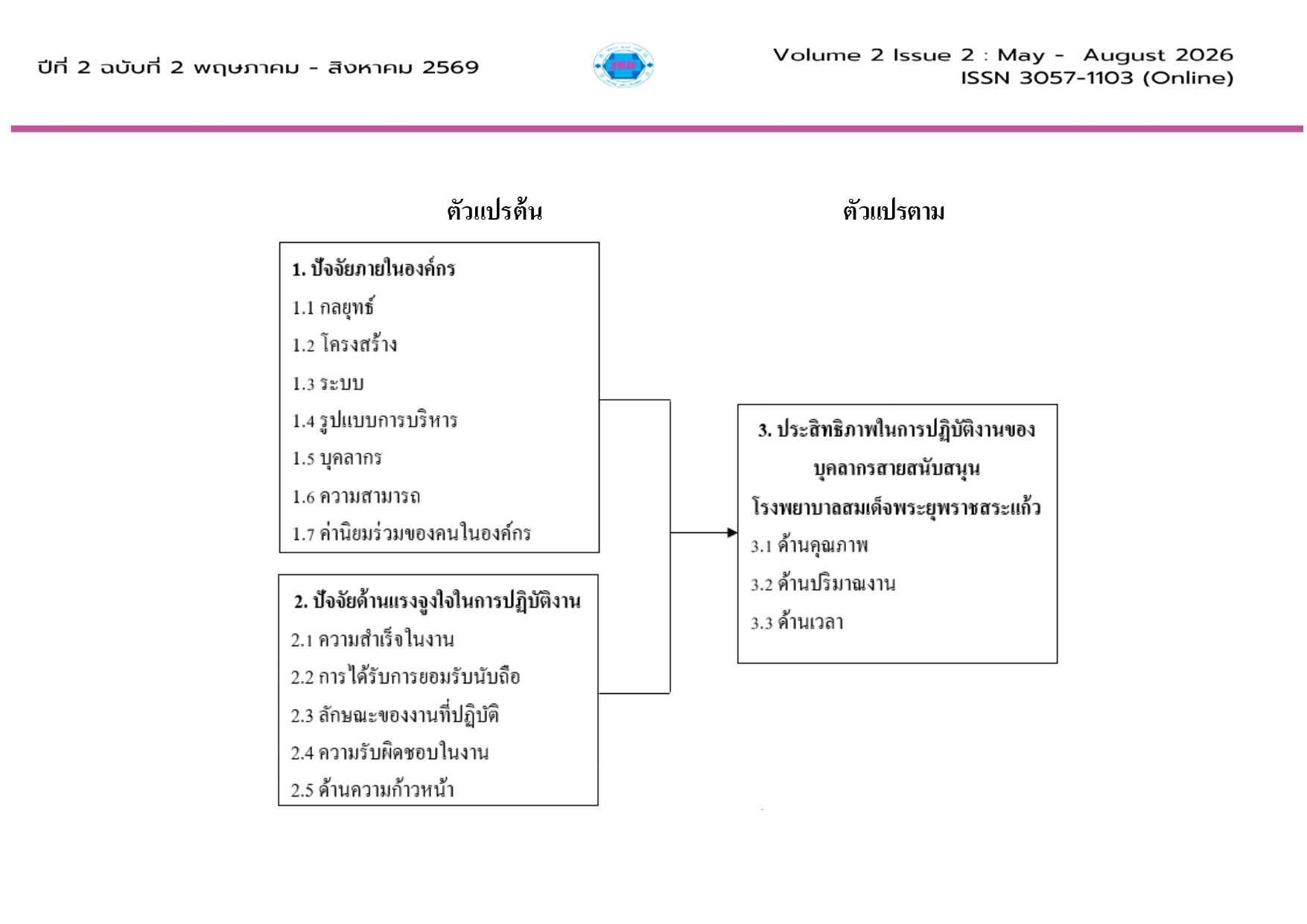
This study aimed to 1) The level of the performance efficiency of support personnel at Sakaeo Crown Prince Hospital. 2) The level of Internal organizational factors 7S McKinsey and Motivation factors. 3) The influence of the Internal organizational factors and Motivation factors for the performance efficiency of support personnel at Sakaeo Crown Prince Hospital. By applying the concept McKinsey 7S Framework and Motivation factors of Frederick Herzberg. The purposive random sampling technique was used to 288 support personnel. Quantitative research methods. The research instrument was a questionnaire. The consistency index of the instrument was 0.96 and the reliability of the entire instrument was 0.97. The statistics used for data analysis were number, percentage, mean, standard deviation, multiple regression analysis.
The study results revealed that The overall average performance efficiency of support personnel at Sakaeo Crown Prince Hospital is at a high level. The average level internal organizational factors is at a high level. The average level motivation factors is at a high level. And Internal organizational factors affecting the performance statistically significant at a level of .05 including the systems aspect was able to predict the performance by 79.50 (=0.795). Motivation factors affecting the performance statistically significant at a level of .05 including the responsibility aspect was able to predict the performance by 73.70 (
=0.737). Achievement aspect was able to predict the performance by 78.70 (
=0.787). Advancement aspect was able to predict the performance by 79.90 (
=0.799).
Article Details

This work is licensed under a Creative Commons Attribution-NonCommercial-NoDerivatives 4.0 International License.
References
กนก เพ่งจินดา, นิวรัตน์ วิจิตรกุลสวัสดิ์, & อัจฉรา หล่อตระกูล. (2567). ปัจจัยแรงจูงใจที่ส่งผลต่อขวัญกำลังใจในการปฏิบัติงานของบุคลากร เขตบางกะปิ. วารสารนวัตกรรมการจัดการศึกษาและการวิจัย, 6(2), 377–386.
กิตติพร กมลเวชช และพิสมัย เหล่าไทย. (2563). ปัจจัย 7S ของแมคเคนซี่ที่ส่งผลต่อประสิทธิภาพการปฏิบัติงานของบุคลากรโรงพยาบาลแห่งหนึ่งในจังหวัดสมุทรปราการ. วารสารการจัดการและการพัฒนา มหาวิทยาลัยราชภัฏอุบลราชธานี, 12(1), 231–245.
ธัญญารัตน์ สาลิกา. (2566). ปัจจัยที่ส่งผลต่อประสิทธิภาพในการปฏิบัติงานของผู้ปฏิบัติงานด้านการเงินการคลัง มหาวิทยาลัยเทคโนโลยีราชมงคลสุวรรณภูมิ (รายงานวิจัย). มหาวิทยาลัยเทคโนโลยีราชมงคลสุวรรณภูมิ.
พระมหาคณาธิป จันทร์สง่า. (2561). ปัจจัยที่ส่งผลต่อประสิทธิภาพการปฏิบัติงานของข้าราชการสำนักงานเขต สำนักงานเขตสัมพันธวงศ์ กรุงเทพมหานคร [สารนิพนธ์ปริญญารัฐประศาสนศาสตรมหาบัณฑิต, มหาวิทยาลัยสยาม].
ธนภรณ์ พรรณราย. (2565). ปัจจัยที่ส่งผลต่อประสิทธิภาพในการปฏิบัติงานของบุคลากรองค์การบริหารส่วนจังหวัดสงขลา [สารนิพนธ์ปริญญารัฐประศาสนศาสตรมหาบัณฑิต, มหาวิทยาลัยสงขลานครินทร์].
Afolabi, A., Fernando, S., & Bottiglieri, T. (2018). The effect of organisational factors in motivating healthcare employees: A systematic review. British Journal of Healthcare Management, 24(12), 603–622. https://doi.org/10.12968/bjhc.2018.24.12.603
Karaferis, D., Aletras, V., Raikou, M., & Niakas, D. (2022). Factors influencing motivation and work engagement of healthcare professionals. Materia Socio-Medica, 34(3), 216–224. https://doi.org/10.5455/msm.2022.34.216-224
