The Effects of a Counseling Program on Behavioral Changes in Self-Care Among Patients with Type 2 Diabetes in Phuket Municipality, Phuket Province
Article Sidebar
Main Article Content
Abstract
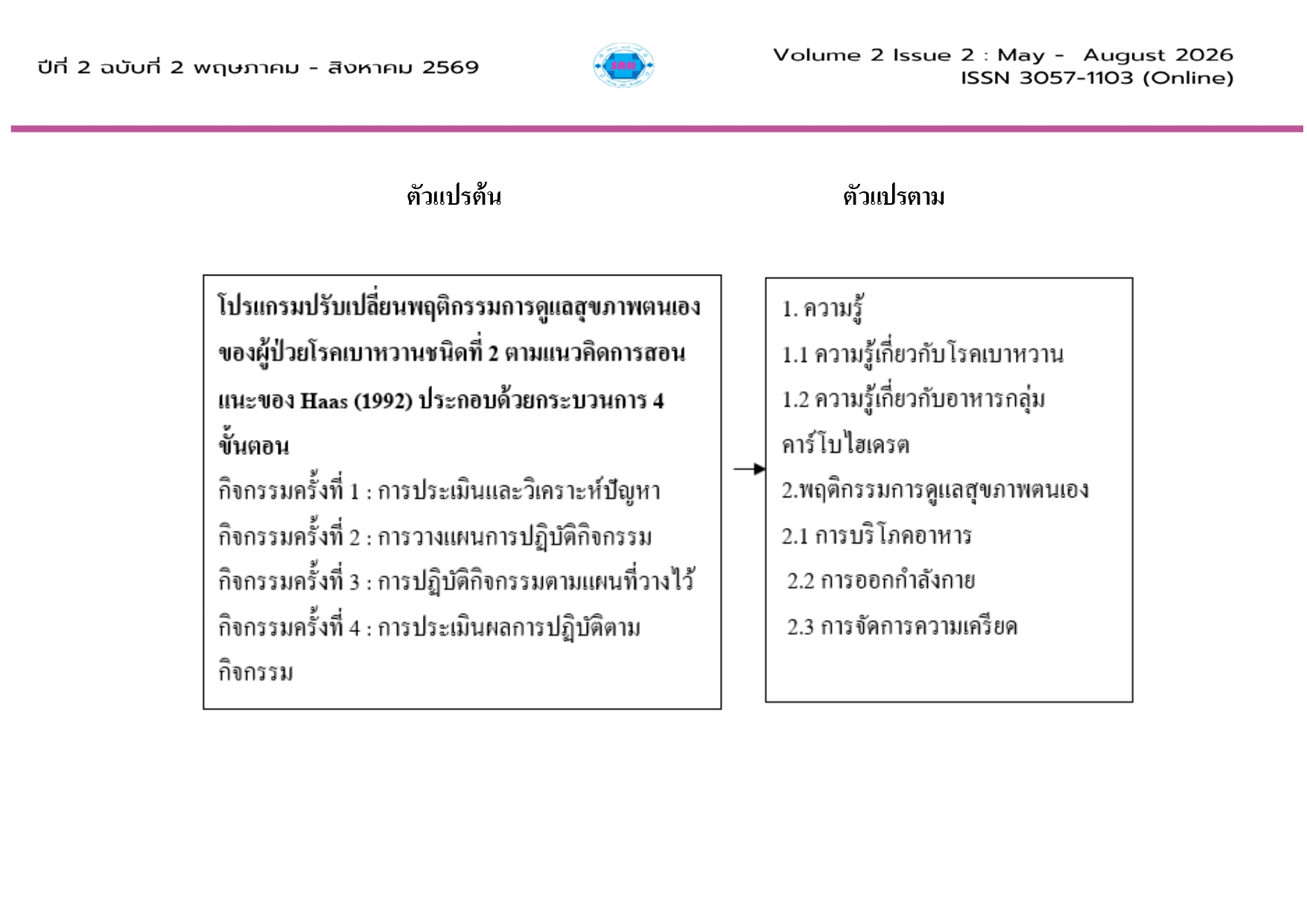
The objectives of this study were to 1) compare the average knowledge scores about diabetes among patients with type 2 diabetes before and after receiving the program, 2) Compare the average self-care behavior of patients with type 2 diabetes before and after receiving the program. The applying of theoretical related to coaching of Eaton & Johnson. The methodology is a quasi-experimental research design with one-group measurement. The population of 116 people, with 40 people selected purposively. The instruments employed in this study included a knowledge assessment test and a questionnaire. The index of content validity was .72. The difficulty and discrimination indices were .42 and .69, respectively. The reliability coefficient of the entire instrument was .794. Statistics used for the data analysis include percentage, mean and standard deviation, and Piar t-test statistics.
The results of the study found that 1) After receiving the program, the experimental group had a significantly higher average score on knowledge about diabetes compared to before receiving the program, at the .01 level of statistical significance. 2) After receiving the program, the experimental group had a significantly higher mean score for self-care health behaviors compared to before receiving the program, at the .01 level of statistical significance.
This educational recommendation suggests that coaching can improve health behaviors in patients with type 2 diabetes. Encouraging the use of individualized coaching processes with patients will help them correctly adopt self-care behaviors, enabling them to maintain normal blood sugar levels.
Article Details

This work is licensed under a Creative Commons Attribution-NonCommercial-NoDerivatives 4.0 International License.
References
กองการแพทย์ เทศบาลนครภูเก็ต. (2566). รายงานประจำปี 2566. เทศบาลนครภูเก็ต.
กองการแพทย์ เทศบาลนครภูเก็ต. (2567). รายงานประจำปี 2567. เทศบาลนครภูเก็ต.
กองการแพทย์ เทศบาลนครภูเก็ต. (2568). รายงานประจำปี 2568. เทศบาลนครภูเก็ต.
บุญเชิด ภิญโญอนันตพงษ์. (2545). การวัดประเมินผลการเรียนรู้. คณะศึกษาศาสตร์ มหาวิทยาลัยศรี นครินทรวิโรฒ.
บุญชม ศรีสะอาด. (2545). การวิจัยเบื้องต้น (พิมพ์ครั้งที่ 6). สุวีริยาสาส์น.
บุญชม ศรีสะอาด. (2549). การวิจัยเพื่อแก้ปัญหาและพัฒนาผู้เรียน. สุวีริยาสาส์น.
บุญเชิด ภิญโญอนันตพงษ์. (2545). สถิติการศึกษาวัดผล 302. ภาควิชาพื้นฐานการศึกษา มหาวิทยาลัยศรี นครินทรวิโรฒ.
สุนันทา ภักดีอำนาจ, เชาวกิจ ศรีเมืองวงศ์ และสุรีรัตน์ ณ วิเชียร. (2566). ผลของโปรแกรมพัฒนาความรู้และปรับเปลี่ยนพฤติกรรมสุขภาพต่อความรู้ พฤติกรรม และระดับน้ำตาลในเลือดของผู้ป่วยเบาหวานชนิดที่ 2 ในเขตเมือง. วารสารวิทยาลัยพยาบาลบรมราชชนนี สุพรรณบุรี, 6(2), 53–66.
สำนักงานสาธารณสุขจังหวัดภูเก็ต. (2566). รายงานสถานการณ์ด้านสาธารณสุขจังหวัดภูเก็ต ปี 2566. สำนักงานสาธารณสุขจังหวัดภูเก็ต.
Best, J. W. (1970). Research in education. Prentice-Hall.
Best, J. W. (1997). Research in education (3rd ed.). Prentice Hall.
Eaton, J., & Johnson, R. (2000). Coaching successfully. Dorling Kindersley Publishing.
The WHOQOL Group. (1995). The World Health Organization Quality of Life Assessment (WHOQOL): Position paper from the World Health Organization. Social Science & Medicine, 41(10), 1403–1409.
Tuckman, B. W. (1999). Conducting educational research (5th ed.). Harcourt Brace College Publishers. World Health Organization. (2016). Global report on diabetes: Executive summary. World Health Organization.
