The Effect of Clinical Nursing Practice Guideline for Prevention Extravasation from Norepinephrine Injection Intensive Care Unit Crown Prince Hospital Sa Kaeo
Article Sidebar
Main Article Content
Abstract
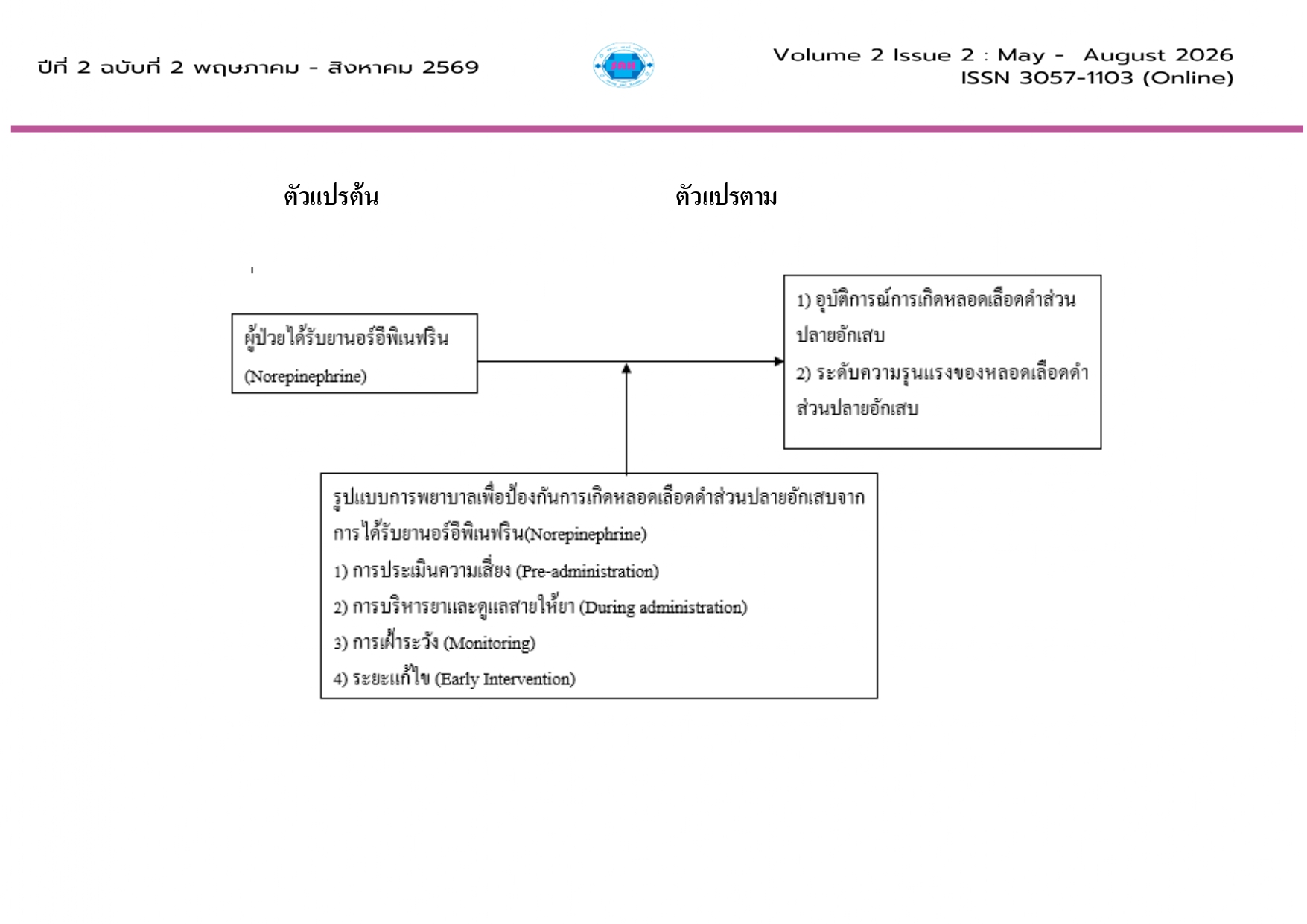
This study is a quasi-experimental research design with two groups: a control group and an experimental group. The objectives are to develop nursing guidelines for the prevention of norepinephrine-associated phlebitis and to compare the incidence of phlebitis in a control group receiving care according to the guidelines and an experimental group receiving care according to the guidelines along with the use of the aloe vera gel developed by the researchers, the possibility of using the nursing guidelines to prevent phlebitis was examined a study was conducted in the Intensive Care Unit 3 of a tertiary hospital in Sa Kaeo Province, following the Iowa model with data collected between February 2024 and April 2024 the sample group consisted of 60 patients receiving norepinephrine and admitted to the medical intensive care unit. Data were analyzed using descriptive statistics and the independent T-test.
The research findings showed that the nursing practice combined with the use of aloe vera gel significantly reduced the incidence of phlebitis in the experimental group by 3.22 times compared to the control group (OR=3.22, 95%CI 0.32-32.8). . Furthermore, there was a statistically significant difference in the severity of phlebitis between the two groups.
This set of nursing practice guidelines can be used in the care of patients receiving norepinephrine as a good measure to improve the monitoring of high-risk medications in the intensive care unit, thereby increasing nursing outcomes for patients and enhancing the quality of care provided by professional nurses
This study is a quasi-experimental research design with two groups: a control group and an experimental group. The objectives are to develop nursing guidelines for the prevention of norepinephrine-associated phlebitis and to compare the incidence of phlebitis in a control group receiving care according to the guidelines and an experimental group receiving care according to the guidelines along with the use of the aloe vera gel developed by the researchers, the possibility of using the nursing guidelines to prevent phlebitis was examined a study was conducted in the Intensive Care Unit 3 of a tertiary hospital in Sa Kaeo Province, following the Iowa model (Titler, et al., 2001), with data collected between February 2024 and April 2024 the sample group consisted of 60 patients receiving norepinephrine and admitted to the medical intensive care unit. Data were analyzed using descriptive statistics and the independent T-test.
The research findings showed that the nursing practice combined with the use of aloe vera gel significantly reduced the incidence of phlebitis in the experimental group by 3.22 times compared to the control group (OR=3.22, 95%CI 0.32-32.8). . Furthermore, there was a statistically significant difference in the severity of phlebitis between the two groups.
This se t of nursing practice guidelines can be used in the care of patients receiving norepinephrine as a good measure to improve the monitoring of high-risk medications in the intensive care unit, thereby increasing nursing outcomes for patients and enhancing the quality of care provided by professional nurses
Article Details

This work is licensed under a Creative Commons Attribution-NonCommercial-NoDerivatives 4.0 International License.
References
กาญจนา อุดมอัษฎาพร และ มยุรี พรมรินทร์. (2561). ประสิทธิผลของการใช้แนวทางปฏิบัติการป้องกันการอักเสบของหลอดเลือดดําและการรั่วซึมออกนอกหลอดเลือดดําจากการใช้ยากระตุ้นการหดตัวของหลอดเลือดหอผู้ป่วยหนักโรคหัวใจโรงพยาบาลเชียงรายประชานุเคราะห์. วารสารสาธารณสุขล้านนา, 14(1), 35-45.
จรีณา คงพันธุ์ และผกากรอง พันธุ์ไพโรจน์. (2563). ผลของการใช้แนวปฏิบัติการให้ยาที่มีความเสี่ยงสูงต่อการปฏิบัติการพยาบาลและอุบัติการณ์การเกิดภาวะหลอดเลือดดําส่วนปลายอักเสบ ในหอผู้ป่วยกึ่งวิกฤตอายุรกรรมโรงพยาบาลสงขลา. วารสารวิทยาลัยพยาบาลพระจอมเกล้า จังหวัดเพชรบุรี, 4(1), 156- 169.
ช่อทิพย์ คชเสนีย์. (2543). ผลของเจลว่านหางจระเข้ เรพาริลเจล ต่อการเกิดภาวะหลอดโลหิตดำอักเสบส่วนปลายในคนไข้ที่ได้รับสารอาหารทางหลอดเลือดดำส่วนปลาย. (วิทยานิพนธ์ปริญญามหาบัณฑิต)มหาวิทยาลัยมหิดล, นครปฐม.
ฐิติพร ปฐมจารุวัฒน์. (2559). ผลของการใช้แนวปฏิบัติทางการพยาบาลเพื่อป้องกันและจัดการกับภาวะ Extravasation. วารสารสภาการพยาบาล. 31(2). 81-95.
ทิฎฐิ ศรีวิลัย และวิมล อ่อนเส็ง. (2560). ภาวะช็อคจากการติดเชื้อ ความท้าทายของพยาบาลห้องฉุกเฉิน. วารสารวิทยาลัยพยาบาลบรมราชชนนี อุตรดิตถ์. 9(2), 152-162.
ปาจรีย์ ศักดิ์วาลี้สกุล และอุษณีย์ ศิริวงศ์พรหม. (2562). ผลของแนวปฏิบัติการพยาบาลเพื่อป้องกันหลอดเลือดดำอักเสบจากการได้รับยานอร์อีพิเนฟริน. วารสารมหาวิทยาลัยคริสเตียน. 25(2), 94-101.
สมพร อยู่ดี. (2565). ผลการใช้แนวปฏิบัติการพยาบาลผู้ป่วยที่ได้รับยานอร์อิพิเนฟรินทางหลอดเลือดดําส่วนปลาย. มหาราชนครศรีธรรมราชเวชสาร,5(1), 62-72.
อุสาห์ รุจิระวิโรจน์ และคณะ. (2551). การใช้หลักฐานเชิงประจักษ์ในการพัฒนาแนวปฏิบัติการพยาบาลเพื่อลดอุบัติการณ์การเกดิหลอดเลือดดำส่วนปลายอักเสบในผู้ป่วยที่ได้รับสารน้ำทางงหลอดเลือดดำส่วนปลาย. รามาธิบดีพยาบาลสาร. 14(1), 51-65.
Maddox, RR., & Rugh., D.R. (1977). Double blind study to investigate methods to prevent cephalothin-induced phlebitis. American Journal of Hospital Pharmacy. 34(1), 29-34.
Titler, ey al., (2001). The Iowa Model of evidence-based practice to promote quality of care. 2Clitical Care Nursing of North America. 13(4), 497-509.
