The Effects of Using an Online Media Program to Promote Physical and Psychological Rehabilitation in Breast Cancer Patients After Chemotherapy at Uttaradit Hospital
Article Sidebar
Main Article Content
Abstract
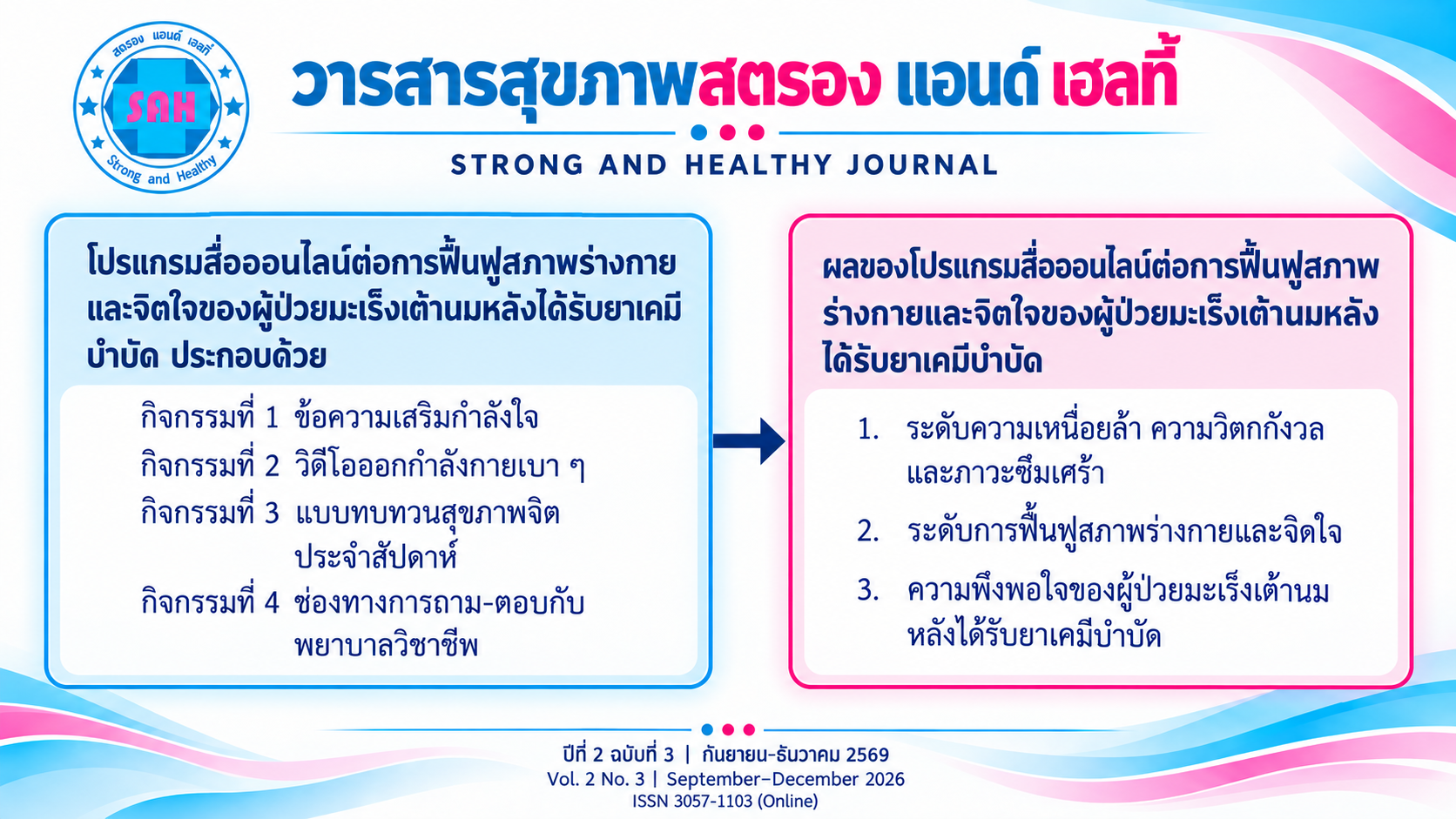
The objectives of this study were to 1) comparison of the mean levels of fatigue, anxiety, and depression in breast cancer patients after receiving chemotherapy, before and after participation in the program, 2) comparison of the mean levels of physical and psychological recovery of breast cancer patients after receiving chemotherapy, before and after participation in the program, and 3) assessment of satisfaction among breast cancer patients after receiving chemotherapy following the program. The applying of a conceptual framework of online media programs for physical and mental rehabilitation. The methodology is a quasi-experimental research design: one-group pretest–posttest design. The study population consisted of patients diagnosed with stage I–III breast cancer who were receiving chemotherapy. They received treatment at the chemotherapy unit of Uttaradit Hospital between September and December 2025. A total of 32 patients were included, selected through purposive sampling. Specifically, the research instruments consisted of an online media program for physical and mental rehabilitation, and assessment scales measuring fatigue, anxiety, and physical and mental health recovery. The index of content validity was .72. The reliability coefficient of the entire instrument was .794. Statistics used for the data analysis include percentage, mean and standard deviation, and Pair t – test statistics.
The results of the study found that: After receiving the program, the experimental group demonstrated significantly lower levels of fatigue, anxiety, and depression among breast cancer patients after chemotherapy compared with before the program, with statistical significance at the .01 level. After receiving the program, after participating in the program, the experimental group showed significantly lower physical and psychological rehabilitation scores than before participation (p < .01) reflecting improved physical and psychological recovery among breast cancer patients following chemotherapy. And after receiving the program, the experimental group had a mean level of satisfaction with the online media program designed to promote physical and psychological rehabilitation among breast cancer patients following chemotherapy at the highest level.
The results of this study indicate that an online media program can promote physical and psychological rehabilitation in breast cancer patients after receiving chemotherapy.
Article Details

This work is licensed under a Creative Commons Attribution-NonCommercial-NoDerivatives 4.0 International License.
References
งานทะเบียนมะเร็ง โรงพยาบาลอุตรดิตถ์. (2567). สถิติมะเร็งเต้านม ปี 2565–2567.
บุญเชิด ภิญโญอนันตพงษ์. (2545). การวัดประเมินผลการเรียนรู้. คณะศึกษาศาสตร์ มหาวิทยาลัยศรีนครินทรวิโรฒ.
บุญเชิด ภิญโญอนันตพงษ์. (2545). สถิติการศึกษาวัดผล 302. ภาควิชาพื้นฐานการศึกษา มหาวิทยาลัยศรีนครินทรวิโรฒ.
บุญชม ศรีสะอาด. (2545). การวิจัยเบื้องต้น (พิมพ์ครั้งที่ 6). สุวีริยาสาสน์.
วันทนีย์ งามวงศ์. (2564). ผลของโปรแกรมไลน์ร่วมกับชี่กงต่อความวิตกกังวลก่อนผ่าตัด [วิทยานิพนธ์, จุฬาลงกรณ์มหาวิทยาลัย].
สำนักนโยบายและยุทธศาสตร์ กระทรวงสาธารณสุข. (2565). สถิติสาธารณสุข.
Best, J. W. (1997). Research in education (3rd ed.). Prentice Hall.
International Agency for Research on Cancer. (2020). Global cancer statistics 2020. https://gco.iarc.fr/today
Sung, H., Ferlay, J., Siegel, R. L., Laversanne, M., Soerjomataram, I., Jemal, A., & Bray, F. (2021). Global cancer statistics 2020: GLOBOCAN estimates of incidence and mortality worldwide. CA: A Cancer Journal for Clinicians, 71(3), 209–249.
World Health Organization. (2023). Breast cancer. https://www.who.int/news-room/fact-sheets/detail/breast-cancer
