
Intraoperative monitoring of endotracheal cuff pressure after cuff inflation with positive pressure leak test in pediatric patient undergoing open cardiac surgery
Article Sidebar
Main Article Content
Abstract
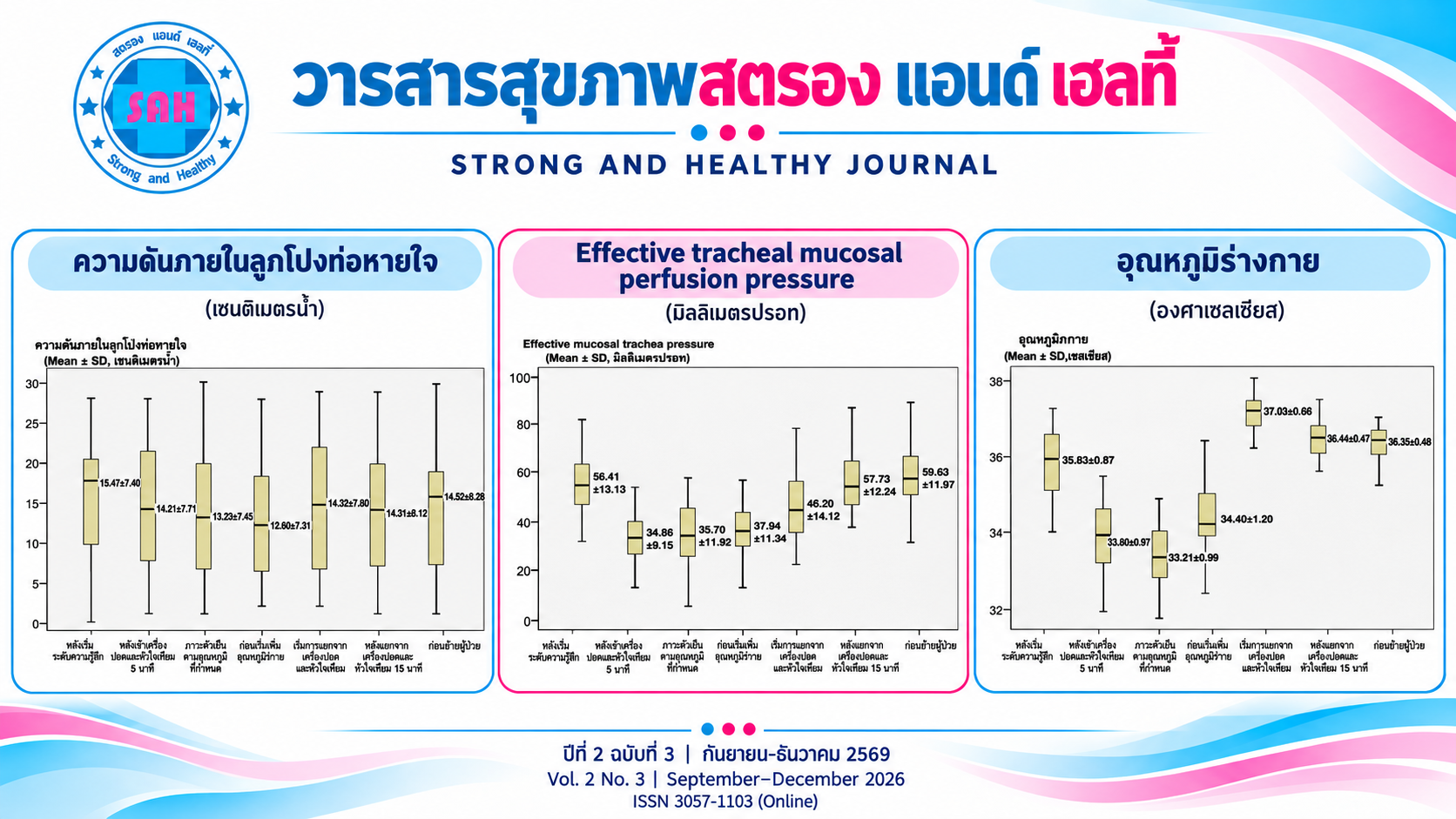
Using cuffed endotracheal tubes (ETTs) in pediatric cardiac surgery helps minimize air leaks and complications. However, cardiopulmonary bypass (CPB) induces changes that may alter cuff pressure, potentially leading to patients’ complications. Objective To investigate changes in endotracheal cuff pressure and associated factors during cardiac surgery using CPB in pediatric patients. This prospective observational study included 40 pediatric patients (<8 years) undergoing open cardiac surgery. After intubation, the ETT cuff was inflated using a positive pressure leak test. Cuff pressure was monitored from post-induction to pre-transfer. Data were analyzed using repeated measures ANOVA.
The mean initial cuff pressure was 15.47 ± 7.40 cmH2O. During CPB, cuff pressure significantly decreased (p < 0.05), reaching its lowest point just before rewarming (12.60 ± 7.31 cmH2O). Following rewarming, the pressure returned to baseline levels during the weaning phase (14.32 ± 7.80 cmH2O).
Endotracheal cuff pressure in pediatric patients undergoing CPB fluctuates significantly, decreasing then returning to baseline after rewarming. Continuous monitoring and adjustment of cuff pressure are essential to ensure airway safety and prevent complications.
Article Details

This work is licensed under a Creative Commons Attribution-NonCommercial-NoDerivatives 4.0 International License.
References
Adams, P. S., Corcoran, T. E., Lin, J.-H., Weiner, D. J., Sanchez-de-Toledo, J., & Lo, C. W. (2021). Mucociliary clearance scans show infants undergoing congenital cardiac surgery have poor airway clearance function. Frontiers in Cardiovascular Medicine, 8, Article 652158. https://doi.org/10.3389/fcvm.2021.652158
Chow, S.-C., Shao, J., & Wang, H. (2008). Sample size calculations in clinical research (2nd ed.). Chapman & Hall/CRC. https://doi.org/10.1201/9781584889830
De Orange, F. A., Andrade, R. G. A. C., Lemos, A., Borges, P. S. G. N., Figueiroa, J. N., & Kovatsis, P. G. (2017). Cuffed versus uncuffed endotracheal tubes for general anaesthesia in children aged eight years and under. Cochrane Database of Systematic Reviews, 2017(11), Article CD011954. https://doi.org/10.1002/14651858.CD011954.pub2
Gomes, J., Cabete, S., Pedro, L., Cardoso, T. M., & Duarte, S. (2025). Cuff pressure in pediatric patients: From monitoring to clinical practice. Cureus, 17(11), Article e96956. https://doi.org/10.7759/cureus.96956
Kako, H., Alkhatib, O., Krishna, S. G., Khan, S., Naguib, A., & Tobias, J. D. (2015). Changes in intracuff pressure of a cuffed endotracheal tube during surgery for congenital heart disease using cardiopulmonary bypass. Paediatric Anaesthesia, 25(7), 705–710. https://doi.org/10.1111/pan.12631
Kanno, K., Fujiwara, N., Moromizato, T., Fujii, S., Ami, Y., Tokushige, A., & Ueda, S. (2023). Pre-extubation cuffed tube leak test and subsequent post-extubation laryngeal edema: Prospective, single-center evaluation of PICU patients. Pediatric Critical Care Medicine, 24(9), 767–774. https://doi.org/10.1097/PCC.0000000000003282
Kishimoto, Y., Mizuno, K., Kawai, Y., Mizuno, K., Hirabayashi, H., Furukawa, K., Morimoto, N., Maeda, K., Kaneko, K., & Omori, K. (2024). National epidemiological survey on pharyngeal, laryngeal, and tracheal stenosis in Japan: A national survey on airway stenosis. Auris Nasus Larynx, 51(6), 911–916. https://doi.org/10.1016/j.anl.2024.08.008
Ozalp, S., & Gumus Ozcan, F. (2025). The impact of Down syndrome on perioperative anesthetic management and outcomes in infants undergoing isolated ventricular septal defect closure. Diagnostics, 15(15), Article 1839. https://doi.org/10.3390/diagnostics15151839
Parpucu, U. M., & Sahin, N. (2023). The effect of the ultrasonography measurement method and the conventional measurement method used in endotracheal tube size selection in the pediatric patient group on postextubation complications and patient recovery. Cureus, 15(9), Article e46184. https://doi.org/10.7759/cureus.46184
Rosero, E. B., Ozayar, E., Eslava-Schmalbach, J., Minhajuddin, A., & Joshi, G. P. (2018). Effects of increasing airway pressures on the pressure of the endotracheal tube cuff during pelvic laparoscopic surgery. Anesthesia & Analgesia, 127(1), 120–125. https://doi.org/10.1213/ANE.0000000000002657
Shibasaki, M., Nakajima, Y., Ishii, S., Shimizu, F., Shime, N., & Sessler, D. I. (2010). Prediction of pediatric endotracheal tube size by ultrasonography. Anesthesiology, 113(4), 819–824. https://doi.org/10.1097/ALN.0b013e3181ef6757
Simonato, M., Padalino, M., Vedovelli, L., Carollo, C., Sartori, A., Vida, V., Gregori, D., Carnielli, V., & Cogo, P. (2023). Effect of preoperative pulmonary hemodynamic and cardiopulmonary bypass on lung function in children with congenital heart disease. European Journal of Pediatrics, 182(6), 2549–2557. https://doi.org/10.1007/s00431-023-04926-0
Zaqout, M., De Baets, F., Schelstraete, P., Suys, B., Panzer, J., Francois, K., Bove, T., Coomans, I., & De Wolf, D. (2010). Pulmonary function in children after surgical and percutaneous closure of atrial septal defect. Pediatric Cardiology, 31(8), 1171–1175. https://doi.org/10.1007/s00246-010-9778-6