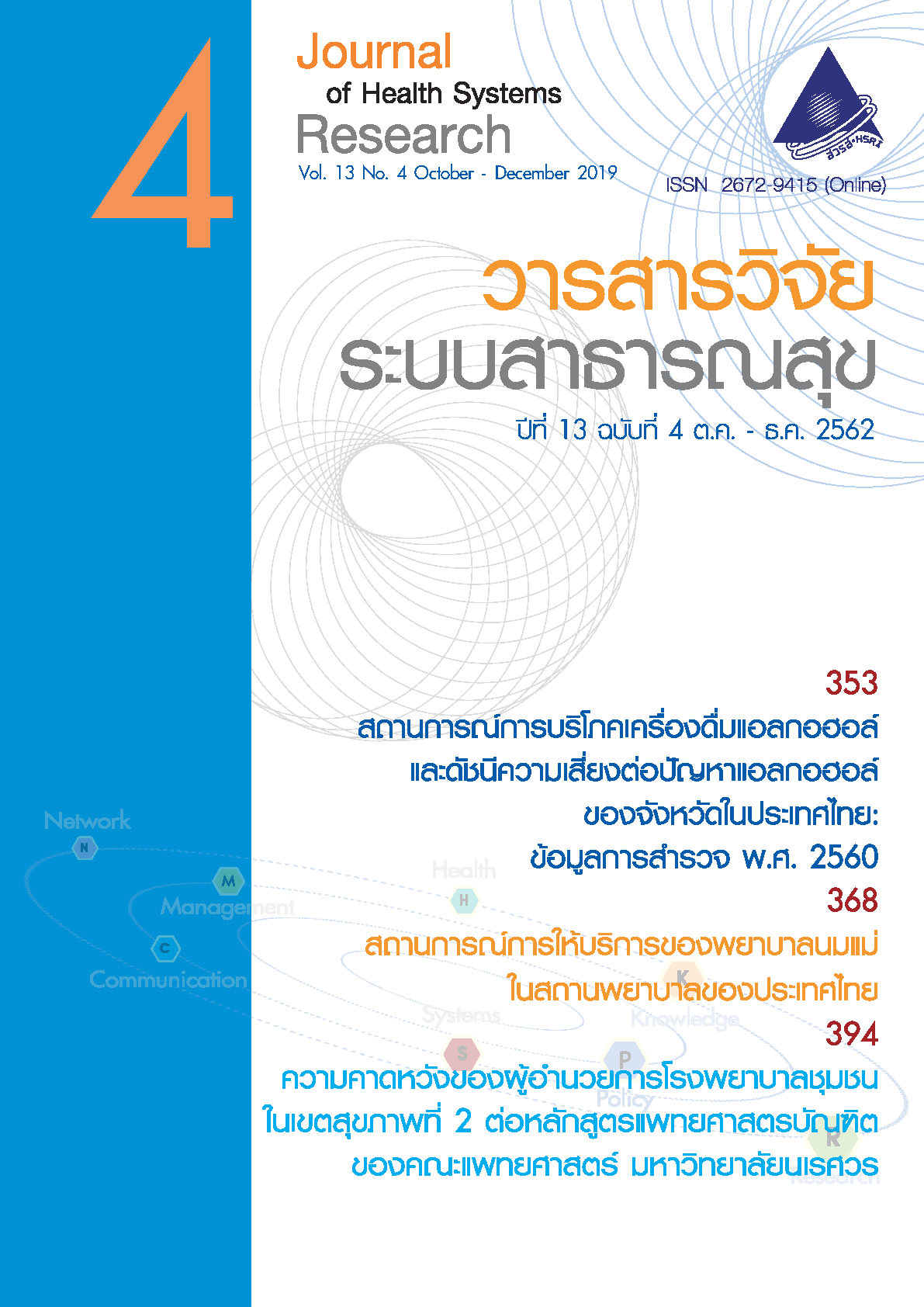
Alcohol Drinking and Provincial Alcohol Problem Index (PAPI) in Thailand: The 2017 Survey
Keywords:
alcohol, Provincial Alcohol Problem Index, ThailandAbstract
The objective of this study was to report drinking patterns and alcohol-related health risks using Provincial Alcohol Problem Index (PAPI) of Thai population by region and province. Data from the 2017 Cigarette Smoking and Alcohol Drinking Behavior Survey, a stratified two-stage random sampling to select 120,003 Thai participants aged 15 years and over, were analyzed using descriptive statistics. The prevalence was estimated by weighted proportion and presented at national, regional and provincial levels. A composite PAPI score, ranging from 0-1, was also calculated to represent a relative level of alcohol risk problem in each province. At regional level, the Northern and Northeastern regions had the highest prevalence of adult (35.4% and 32.8%, respectively) and adolescent drinkers (19.0% and 16.8%, respectively), while the Central and Southern regions had the highest proportions of regular to heavy drinkers and drink driving. Provinces with the highest PAPI score were scattered in the Northern and Central regions, including Lampang (0.72 point), Chiang Rai (0.69 point), Phitsanulok (0.65 point), Chantaburi (0.64 point) and Sukhothai (0.63 point). This study showed that alcohol use and related problems remained significant health issues in Thailand with a diversity of specific problems that needed to be prioritized in each local area. Lampang, Chiang Rai, Northern, and Northeastern regions should urgently consider these issues. These hence warrant comprehensive measures targeting both establishment of local community actions and national alcohol policies.
References
World Health Organization. Global action plan for the prevention and control of non-communicable diseases 2013-2020. Geneva: World Health Organization; 2013. p. 65-70.
United Nations. Transforming our world: The 2030 agenda for sustainable development. Resolution adopted by the General Assembly [internet]. 2015 [cited 2019]. Available from: https://www.un.org/en/development/desa/population/migration/generalassembly/docs/globalcompact/A_RES_70_1_E.pdf.
World Health Organization. Global status report on alcohol and health 2014. Geneva: World Health Organization; 2014.
Rehm J, Rehn N, Room R, Monteiro M, Gmel G, Jernigan D, et al. The global distribution of average volume of alcohol consumption and patterns of drinking. European Addiction Research 2003;9(4):147-56.
Lumley T. Survey: analysis of complex survey samples. 2014. R package version. 2014;3(2).
Bivand R, Lewin-Koh N. Maptools: tools for reading and handling spatial objects. R package version 08. 2013;27.
Pebesma E, Bivand RS. Classes and methods for spatial data: the sp package. R news. 2005;5(2):9-13.
Chaiyasong S, Phakdeesettakun K, Thamarangsi T. Thailand Provincial Alcohol Report 2011. Bangkok: Thailand Substance Abuse Academic Network & Centre for Alcohol Studies; 2013. (in Thai)
Scott S, Muirhead C, Shucksmith J, Tyrrell R, Kaner E. Does industry-driven alcohol marketing influence adolescent drinking behaviour? A systematic review. Alcohol Alcohol. 2017;52(1):84-94.
Liang W, Chikritzhs T. Age at first use of alcohol predicts the risk of heavy alcohol use in early adulthood: a longitudinal study in the United States. Int J Drug Policy. 2015;26(2):131-4.
Kim MJ, Mason WA, Herrenkohl TI, Catalano RF, Toumbourou JW, Hemphill SA. Influence of early onset of alcohol use on the development of adolescent alcohol problems: a longitudinal binational study. Prev Sci 2017;18(1):1-11.
Richmond-Rakerd LS, Slutske WS, Lynskey MT, Agrawal A, Madden PAF, Bucholz KK, et al. Age at first use and later substance use disorder: shared genetic and environmental pathways for nicotine, alcohol, and cannabis. J Abnormal Psychology 2016;125(7):946-59.
Hingson RW, Heeren T, Edwards EM. Age at drinking onset, alcohol dependence, and their relation to drug use and dependence, driving under the influence of drugs, and motor-vehicle crash involvement because of drugs. J Stud Alcohol Drugs 2008;69(2):192-201.
Nguyen-Louie TT, Matt GE, Jacobus J, Li I, Cota C, Castro N, et al. Earlier alcohol use onset predicts poorer neuropsychological functioning in young adults. Alcohol Clin Exp Res 2017;41(12):2082-92.
Jiang H, Xiang X, Hao W, Room R, Zhang X, Wang X. Measuring and preventing alcohol use and related harm among young people in Asian countries: a thematic review. Glob Health Res Policy 2018;3:14.
Hingson RW, Edwards EM, Heeren T, Rosenbloom D. Age of drinking onset and injuries, motor vehicle crashes, and physical fights after drinking and when not drinking. Alcohol Clin Exp Res 2009;33(5):783-90.
Office of the Secretariat to the National Mental Health Commission. Results from Implementation the integrated management of alcohol intervention program in health care system (i-MAP Health) in piloted settings: a qualitative study. Bangkok: Office of the Secretariat to the National Mental Health Commission; 2013. (in Thai)
World Health Organization. Global status report on alcohol and health 2018. Geneva: World Health Organization; 2018.
Dawson DA. Volume of ethanol consumption: effects of different approaches to measurement. J Stud Alcohol 1998;59(2):191-7.
Rehm J, Scafato E. Indicators of alcohol consumption and attributable harm for monitoring and surveillance in European Union countries. Addiction 2011;106 Suppl 1:4-10.
National Health Medical Research Council. Australian guidelines to reduce health risks from drinking alcohol. Canbera: Commonwealth of Australia; 2009.
Rehm J, Room R, Taylor B. Method for moderation: measuring lifetime risk of alcohol attributable mortality as a basis for drinking guidelines. Int J Methods Psychiatr Res. 2008;17(3):141-51.
Rehm J, Baliunas D, Borges GL, Graham K, Irving H, Kehoe T, et al. The relation between different dimensions of alcohol consumption and burden of disease: an overview. Addiction 2010;105(5):817-43.
Downloads
Published
How to Cite
Issue
Section
License

This work is licensed under a Creative Commons Attribution-NonCommercial-NoDerivatives 4.0 International License.
Journal of Health Systems Research is licensed under a Creative Commons Attribution-NonCommercial-NoDerivatives 4.0 International (CC BY-NC-ND 4.0) license, unless otherwise stated.