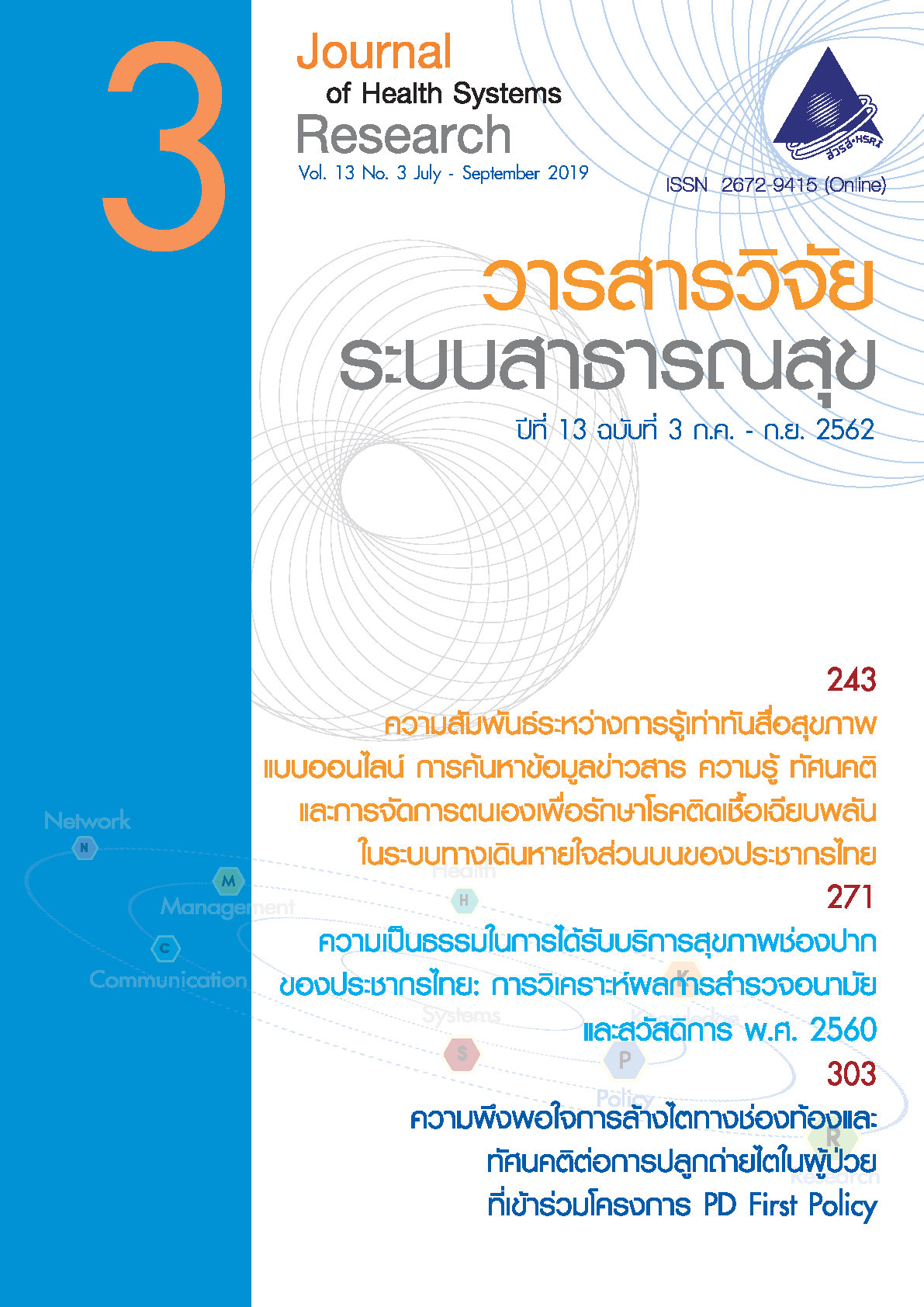
ความสัมพันธ์ระหว่างการรู้เท่าทันสื่อสุขภาพแบบออนไลน์ การค้นหาข้อมูลข่าวสาร ความรู้ ทัศนคติ และการจัดการตนเองเพื่อรักษาโรคติดเชื้อเฉียบพลันในระบบทางหายใจส่วนบนของประชากรไทย
คำสำคัญ:
การรู้เท่าทันสื่อสุขภาพแบบออนไลน์, การค้นหาข้อมูลข่าวสาร, การจัดการตนเอง, โรคติดเชื้อเฉียบพลันในระบบทางหายใจส่วนบนบทคัดย่อ
ถึงแม้ว่าการดำเนินการรณรงค์เพื่อส่งเสริมการใช้ยาปฏิชีวนะอย่างสมเหตุผลในประเทศไทยจะได้เริ่มต้นขับเคลื่อนในระดับประเทศมาตั้งแต่ปี พ.ศ. 2550 แล้ว แต่ประชากรไทยยังคงมีพฤติกรรมการใช้ยาปฏิชีวนะอย่างไม่สมเหตุผล สถานการณ์ดังกล่าวจึงเป็นประเด็นท้าทายอย่างมากในการดำเนินการเพื่อส่งเสริมการใช้ยาปฏิชีวนะอย่างสมเหตุผลในประเทศไทยในระยะต่อไป งานวิจัยนี้มีวัตถุประสงค์เพื่อศึกษาความสัมพันธ์ระหว่างการรู้เท่าทันสื่อสุขภาพแบบออนไลน์ การค้นหาข้อมูลข่าวสาร ความรู้ ทัศนคติ และการจัดการตนเองเพื่อรักษาโรคติดเชื้อเฉียบพลันในระบบทางหายใจส่วนบนในกลุ่มประชากรไทย การวิจัยครั้งนี้เป็นการวิจัยเชิงปริมาณ โดยเก็บข้อมูลจำนวน 2,708 ตัวอย่างจากภาคเหนือ ภาคกลาง ภาคตะวันออกเฉียงเหนือ ภาคใต้และกรุงเทพมหานครและปริมณฑล รวมทั้งสิ้น 21 จังหวัด ผลการวิจัยพบว่า กลุ่มตัวอย่างมีการรู้เท่าทันสื่อสุขภาพแบบออนไลน์ด้านการจำแนกคุณภาพของข้อมูลบนอินเทอร์เน็ตในระดับต่ำ มีการค้นหาข้อมูลข่าวสารเพื่อรักษาโรคติดเชื้อเฉียบพลันในระบบทางหายใจส่วนบนจากครอบครัวและญาติมากที่สุด มีความรู้เกี่ยวกับยาปฏิชีวนะในระดับปานกลาง มีทัศนคติเชิงบวกต่อการใช้ยาปฏิชีวนะ และมีการจัดการตนเองเพื่อรักษาโรคติดเชื้อเฉียบพลันในระบบทางหายใจส่วนบนในระดับต่ำ ผลการวิจัยนำมาสู่ข้อเสนอแนะเชิงปฏิบัติการด้านการสื่อสารเพื่อส่งเสริมการใช้ยาปฏิชีวนะอย่างสมเหตุผล
เอกสารอ้างอิง
Klein EY, Van Boeckel TP, Martinez EM, Pant S, Gandra S, Levin SA, et al. Global increase and geographic convergence in antibiotic consumption between 2000 and 2015. Proceedings of the National Academy of Sciences 2018; United State of America: PNAS; 2018.
World Economic Forum. The global risks report 2018. Geneva: World Economic Forum; 2018.
World Health Organization. Antimicrobial resistance: global report on surveillance. Geneva: World Health Organization; 2014.
Ministry of Public Health and Ministry of Agriculture and Cooperatives. Thailand national strategic plan on antimicrobial resistance 2017-2021. Bangkok: Ministry of Public Health and Ministry of Agriculture and Cooperatives; 2018. (in Thai)
Jamhour A, El-Kheir A, Salameh P, Hanna PA, Mansour H. Antibiotic knowledge and self-medication practices in a developing country: a cross-sectional study. Am J Infect Control 2017;45(4):384-8.
Yusef D, Babaa AI, Bashaireh AZ, Al-Bawayeh HH, Al-Rijjal K, Nedal M, et al. Knowledge, practices & attitude toward antibiotics use and bacterial resistance in Jordan: a cross-sectional study. Infection, Disease & Health 2018;23(1):33-40.
El-Hawy RM, Ashmawy MI, Kamal MM, Khamis HA, El-Hamed NMA, Eladely GI, et al. Studying the knowledge, attitude and practice of antibiotic misuse among Alexandria population. Eur J Hosp Pharm 2017;24(6):349-54.
Virmani S, Nandigam M, Kapoor B, Makhija P, Nair S. Antibiotic use among health science students in an Indian university: a cross sectional study. Clinical Epidemiology and Global Health 2017;5(4):176-9.
Asha V, Yadav KD. Knowledge, attitude and practice of using antibiotics as self-medication among non-medical graduates. International Journal of Dental Research 2017;5(2):101-2.
Jie Chang, Bing Lv, Shan Zhu, Jiale Yu, Yu Zhang, Dan Ye, et al. Non-prescription use of antibiotics among children in urban China: a cross-sectional survey of knowledge, attitudes, and practices. Expert review of anti-infective therapy. 2018;16(2):163-72. doi: 10.1080/14787210.2018.1425616.
Kandelaki K, Lundborg CS, Marrone G. Antibiotic use and resistance: a cross-sectional study exploring knowledge and attitudes among school and institution personnel in Tbilisi, Republic of Georgia. BMC Research Notes 2015;8(1):495.
Bahlas R, Ramadan I, Bahlas A, Bajunaid N, Al-Ahmadi J, Farghaly QM, et al. Knowledge, attitude and practice towards the use of antibiotics. Life Science Journal 2016;13(1).
Yu M, Zhao G, Lundborg CS, Zhu Y, Zhao Q, Xu B. Knowledge, attitudes, and practices of parents in rural China on the use of antibiotics in children: a cross-sectional study. BMC Infectious Diseases 2014;14(1):112.
Tshokey T, Deepika A, Thupten T, Sangay W, Kinley W. Assessing the knowledge, attitudes, and practices on antibiotics among the general public attending the outpatient pharmacy units of hospitals in Bhutan: a cross-sectional survey. Asia Pac J Public Health 2017;29(7):580-8.
Al-Haddad MS, Abdallah QM, Alhamyani AH, Althomali AJ, Alshakhshir SM. General public knowledge and practices about the common cold. Journal of Taibah University Medical Sciences 2016;11(2):104-9.
El Zowalaty ME, Belkina T, Bahashwan SA, El Zowalaty AE, Tebbens JD, Abdel-Salam HA, et al. Knowledge, awareness, and attitudes toward antibiotic use and antimicrobial resistance among Saudi population. International Journal of Clinical Pharmacy 2016;38(5):1261-8.
Almeida Santimano NM, Foxcroft DR. Poor health knowledge and behaviour is a risk for the spread of antibiotic resistance: survey of higher secondary school students in Goa, India. Perspectives in Public Health 2017;137(2):109-13.
Pan DST, Huang JH, Lee MHM, Yu Y, Mark I, Chen C, et al. Knowledge, attitudes and practices towards antibiotic use in upper respiratory tract infections among patients seeking primary health care in Singapore. BMC family practice 2016;17(1):148.
Alkhuzaei AMJ, Salama RE, Eljak IE, Chehab MAH, Selim NAA. The knowledge, practice, and attitude regarding antibiotic use among attendants of primary health care centres: a cross-sectional study in Qatar. International Journal of Community Medicine And Public Health 2017;4(11):3969-75.
Gaarslev C, Yee M, Chan G, Fletcher-Lartey S, Khan R. A mixed methods study to understand patient expectations for antibiotics for an upper respiratory tract infection. Antimicrobial Resistance & Infection Control 2016;5(1):39.
Pereko DD, Lubbe MS, Essack SY. Public knowledge, attitudes and behaviour towards antibiotic usage in Windhoek, Namibia. Southern African Journal of Infectious Diseases 2015;30(4):134-7.
Fredericks I, Hollingworth S, Pudmenzky A, Rossato L, Syed S, Kairuz T. Consumer knowledge and perceptions about antibiotics and upper respiratory tract infections in a community pharmacy. International Journal of Clinical Pharmacy 2015;37(6):1213-21.
Qamar M, Sheikh Abdullah N, Khan J, Mahmud A, Ahmad A. Knowledge and attitude towards antibiotic usage among general public in Shah Alam, Malaysia. UK J Pharm Biosci. 2014;2(6):60-6.
Lim KK, Teh CC. A cross sectional study of public knowledge and attitude towards antibiotics in Putrajaya, Malaysia. Southern Med Review 2012;5(2):26.
Norris P, Ng LF, Kershaw V, Hanna F, Wong A, Talekar M, et al. Knowledge and reported use of antibiotics amongst immigrant ethnic groups in New Zealand. Journal of Immigrant and Minority Health 2010;12(1):107-12.
Sa’ed HZ, Taha AA, Araj KF, Abahri IA, Sawalha AF, Sweileh WM, et al. Parental knowledge, attitudes and practices regarding antibiotic use for acute upper respiratory tract infections in children: a cross-sectional study in Palestine. BMC pediatrics 2015;15(1):176.
Mouhieddine TH, Olleik Z, Itani MM, Kawtharani S, Nassar H, Hassoun R, et al. Assessing the Lebanese population for their knowledge, attitudes and practices of antibiotic usage. Journal of Infection and Public Health 2015;8(1):20-31.
Monkolchapat J, Reumsuk J, Chaipratip A. The study of customer’s knowledge and behavior in using antibiotics at community drug store in Pathum Thani province. EAU Heritage Journal 2012;6(2):91-100. (in Thai)
Sirirassamee B. Antibiotics use behavior of people in Nakhon Pathom province. Nakhon Pathom: Institute for Population and Social Research, Mahidol University; 1997. (in Thai)
Porisutiwutiporn S, Hemchayat M. Influencing factors of antibiotics use behavior of clients in Khlung Hospital, Chanthaburi. The Journal of Prapokklao Hospital Clinical Medical Education Center 2014;31(2):114-27. (in Thai)
Wongwain T. Knowledge on antibiotic use for acute upper respiratory tract infections among outpatients with that infections at Queen Savang Vadhana Memorial Hospital. Thai Journal of Pharmacy Practice 2014;6(2):106-14. (in Thai)
National Statistical Office. The 2017 survey on health and welfare [Internet]. Bangkok: Ministry of Information and Communication Technology; 2017 [cited 2019 March 15]. Available from: http://service.nso.go.th/nso/web/survey/surpop2-5-1.html. (in Thai)
von Wagner C, Steptoe A, Wolf MS, Wardle J. Health literacy and health actions: a review and a framework from health psychology. Health Educ Behav 2009;36(5):860-77.
Sun X, Yang S, Fisher EB, Shi Y, Wang Y, Zeng Q, et al. Relationships of health literacy, health behavior, and health status regarding infectious respiratory diseases: application of a skill-based measure. Journal of Health Communication 2014;19(sup2):173-89.
Prajaknate P, editor. eHealth literacy, knowledge, and self-management of upper respiratory infection (URI) among the Thai population. The Proceedings of the 4th ICADA 2015, The Fourth International Conference on Advancement of Development Administration 2015, Social Sciences and Interdisciplinary Studies; 2015 May 28-30; National Institute of Development Administration, Thailand. Bangkok: National Institute of Development Administration; 2016. p. 271-86.
Schulz PJ, Fitzpatrick MA, Hess A, Sudbury-Riley L, Hartung U. Effects of eHealth literacy on general practitioner consultations: a mediation analysis. J Med Internet Res 2017;19(5):e166. doi: 10.2196/jmir.6317.
Neter E, Brainin E. eHealth literacy: extending the digital divide to the realm of health information. Journal of Medical Internet Research 2012;14(1):e19.
National Statistical Office. The 2017 health and welfare survey [Internet]. Bangkok: Ministry of Digital Economy and Society; 2018 [cited 2019 March 15]. Available from: http://www.nso.go.th/sites/2014en/Survey/social/SocialSecurity/health_and_welfare/2017/Full%20Report_080119.pdf. (in Thai)
National Statistical Office. The 2018 household survey on the use of information communication technology (quarter 1). [cited 2019 June 1]. Available from: www.nso.go.th/sites/2014/DocLib13/.../2561/ict61-สรุปผลที่สำคัญ_Q1.pdf. (in Thai)
Sumpradit N. Promotion of antibiotic smart use: case study of antibiotic smart use project [Internet]. Nonthaburi: Health Intervention and Technology Assessment Program; 2009 [cited 2019 May 31]. Available from: http://newsser.fda.moph.go.th/rumthai/userfiledownload/asu171dl.pdf. (in Thai)
Sumpradit N. The expansion project of antibiotic smart use. Research Report. Nonthaburi: Health Systems Research Institute and Food and Drug Administration; 2009. (in Thai)
National Statistical Office. Table 2.8 number of internet users aged 6 years old and above by region, age and gender In: National Statistical Office Thailand, editor. Bangkok 2018.
Morra-Imas LG, Morra LG, Rist RC. The road to results: designing and conducting effective development evaluation [Internet]. Washington DC: The World Bank; 2009 [cited 2019 March 15]. Available from: http://documents.worldbank.org/curated/en/400101468169742262/pdf/The-road-to-results-designing-and-conducting-effective-development-evaluations.pdf/. doi: 10.1596/978-0-8213-7891-5.
Norman CD, Skinner HA. eHEALS: the eHealth literacy scale. J Med Internet Res 2006;8(4):e27. doi: 10.2196/jmir.8.4.e27.
Saengcharoen W, Lerkiatbundit S, Kaewmang K. Knowledge, attitudes, and behaviours regarding antibiotic use for upper respiratory tract infections: a survey of Thai students. The Southeast Asian Journal of Tropical Medicine and Public Health 2012;43(5):1233-44.
Ajzen I. Attitudes, personality and behaviour. Berkshire: McGraw-Hill Education; 2005.
DiIorio CK. Measurement in health behavior: methods for research and evaluation. Vol. 1. John Wiley & Sons, 2006.
Quinn S, Bond R, Nugent C. Quantifying health literacy and eHealth literacy using existing instruments and browser-based software for tracking online health information seeking behavior. Computers in Human Behavior 2017;69:256-67.
Pavydė E, Veikutis V, Mačiulienė A, Mačiulis V, Petrikonis K, Stankevičius E. Public knowledge, beliefs and behavior on antibiotic use and self-medication in Lithuania. International Journal of Environmental Research and Public Health 2015;12(6):7002-16.
Teck KC, Ghazi HF, Bin Ahmad MI, Binti Abdul Samad N, Ee Yu KL, Binti Ismail NF, et al. Knowledge, attitude, and practice of parents regarding antibiotic usage in treating children’s upper respiratory tract infection at primary health clinic in Kuala Lumpur, Malaysia: pilot study. Health Services Research and Managerial Epidemiology [Internet]. 2016 [cited 2018 May 21];(3):1-3. Available from: https://www.ncbi.nlm.nih.gov/pmc/articles/PMC5266440/pdf/10.1177_2333392816643720.pdf/. doi: 10.1177/2333392816643720.
Esther OA-O, Patience OA, Wasiu OA, Akinlolu GO, Michaeline AI, Mustapha BH, et al. Perceptions and use of antimicrobials among staff of a university community in Southwestern Nigeria. SAGE Open [Internet]. 2014 [cited 2018 May 21];4(2):1-7. Available from: https://journals.sagepub.com/doi/pdf/10.1177/2158244014529778/ doi: 10.1177/2158244014529778.
ดาวน์โหลด
เผยแพร่แล้ว
รูปแบบการอ้างอิง
ฉบับ
ประเภทบทความ
สัญญาอนุญาต

อนุญาตภายใต้เงื่อนไข Creative Commons Attribution-NonCommercial-NoDerivatives 4.0 International License.
วารสารวิจัยระบบสาธารณสุขอยู่ภายใต้การอนุญาต Creative Commons Attribution-NonCommercial-NoDerivatives 4.0 International (CC BY-NC-ND 4.0) เว้นแต่จะระบุไว้เป็นอย่างอื่น