The relationship between knowledge, attitudes, and sodium consumption behavior among residents of Sa Kaeo Municipality
Article Sidebar
Main Article Content
Abstract
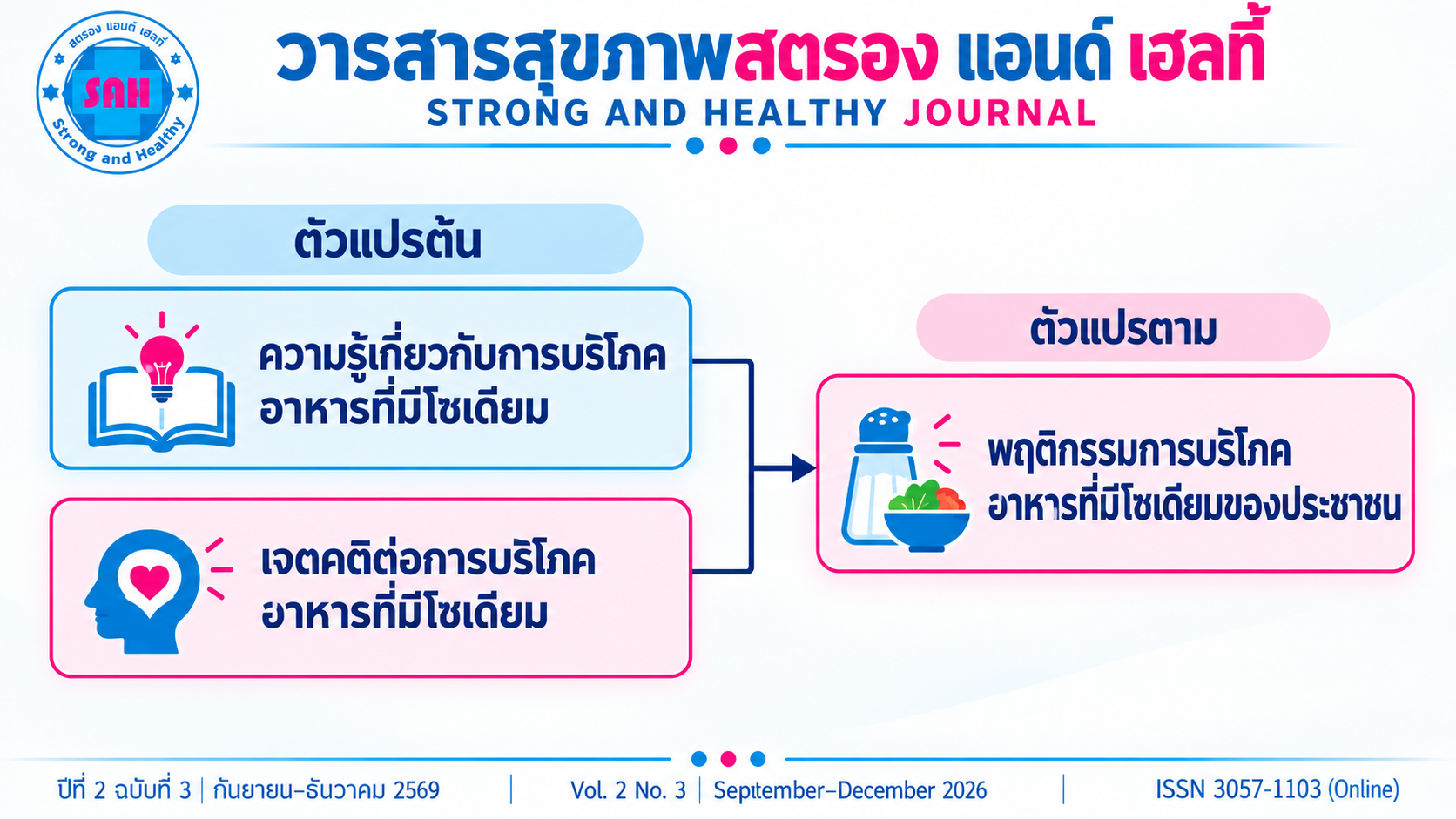
The objectives of this study were to 1) analyze the sodium levels in the food samples, 2) the knowledge, attitudes, and behaviors of the population regarding the consumption of sodium-containing foods, and 3) the relationship between knowledge, attitudes, and the public’s behavior in consuming sodium-rich foods. The conceptual framework was applied to knowledge, attitudes, and behaviors theories of Benjamin Bloom. The study methodology was quantitative research. A population of 12,287 people, a sample size of 373, was determined based on Daniel’s proportion concept, and the sample was obtained through multistage sampling. The research instrument used was a salt meter for measuring sodium levels in food, a knowledge test, and a questionnaire. The consistency index of the instrument was 0.88, the difficulty index and discrimination index are 0.36 and 0.71, respectively, and the reliability of the entire instrument was 0.99. The statistics used for data analysis were number, percentage, mean, standard deviation, and Pearson's correlation coefficients.
The study results revealed that 1) overall, the foods consumed by the sample group contained sodium at a very high (very salty) level, accounting for 76.94%; 2) the level of knowledge regarding the consumption of high‑sodium foods was at a high level on average, and the attitude toward consuming high‑sodium foods was also at a high average level, while the behavior of consuming high‑sodium foods was at a moderate average level; and 3) knowledge about sodium-rich foods and attitudes toward consuming such foods are positively correlated with sodium consumption behavior at the .01 level of statistical significance
Article Details

This work is licensed under a Creative Commons Attribution-NonCommercial-NoDerivatives 4.0 International License.
References
กรมควบคุมโรค. (2566). แนวทางการดำเนินงานลดการบริโภคเกลือและโซเดียมระดับจังหวัด. โครงการขับเคลื่อนการดำเนินงานเฝ้าระวังและลดการบริโภคเกลือแลโซเดียม
กองสาธารณสุข เทศบาลเมืองสระแก้ว. (2567). ฐานข้อมูล HDC
บุญเชิด ภิญโญอนันตพงษ์. (2545). การวัดประเมินการเรียนรู้. วิทยานิพนธ์ปริญญามหาบัณฑิต. คณะศึกษาศาสตร์. มหาวิทยาลัยศรีนครินทรวิโรฒ.
บุญชม ศรีสะอาด. (2545). การวิจัยเบื้องต้น. พิมพ์ครั้งที่ 6. กรุงเทพฯ: สุวีริยาสาสน์.
ดลพร ค าโด, และคณะ. (2568). ปัจจัยที่มีความสัมพันธ์กับพฤติกรรมการบริโภคเกลือโซเดียมในนักศึกษาพยาบาล. วารสารวิจัยการพยาบาลและสุขภาพ, 24(23), 125–139.
สุกิจ รักษาสุข. (2562. บทความมารู้จักโซเดียม. ภาควิชาอายุรศาสตร์ คณะแพทยศาสตร์ศิริราชพยาบาล สืบค้นออนไลน์ เข้าถึงได้ https://www.si.mahidol.ac.th/sidoctor/sirirajonline2021/Article_files/1365_1.pdf
สำนักงานสาธารณสุขจังหวัดสระแก้ว. (2566). การถ่ายโอนให้แล้วเสร็จภายใน ปี พ.ศ. 2570 ตามข้อกำหนดของกระทรวงสาธารณสุขและกฎหมายที่เกี่ยวข้อง. จาก https://sko.moph.go.th/.
สำนักงานกองทุนสนับสนุนการสร้างเสริมสุขภาพ.คนไทยบริโภคโซเดียมสูงกว่า WHO กำหนด 2 เท่า. สืบค้นออนไลน์ เข้าถึงได้ https://www.thaihealth.or.th/?p=237054
อิสระพงศ์ เพลิดเพลิน. (2566). ความรู้ ทัศนคติ พฤติกรรม และปริมาณโซเดียมในอาหารที ่ครัวเรือนปรุงรับประทานต่อการดำเนินงานชุมชนต้นแบบ ลดเค็ม เขตภาคเหนือตอนบนประเทศไทย. วารสารการแพทย์และสาธารณสุขเขต 4, 13(3), 16–31.
Best, J.W. (1997). Research in Education (3rded.). Eagle Wood Clift, NJ: Prentic Hall.
Bloom, S. B. (1956). Handbook on Formative and Summative Evaluation of Student Learning. New York: McGraw-Hill.
