
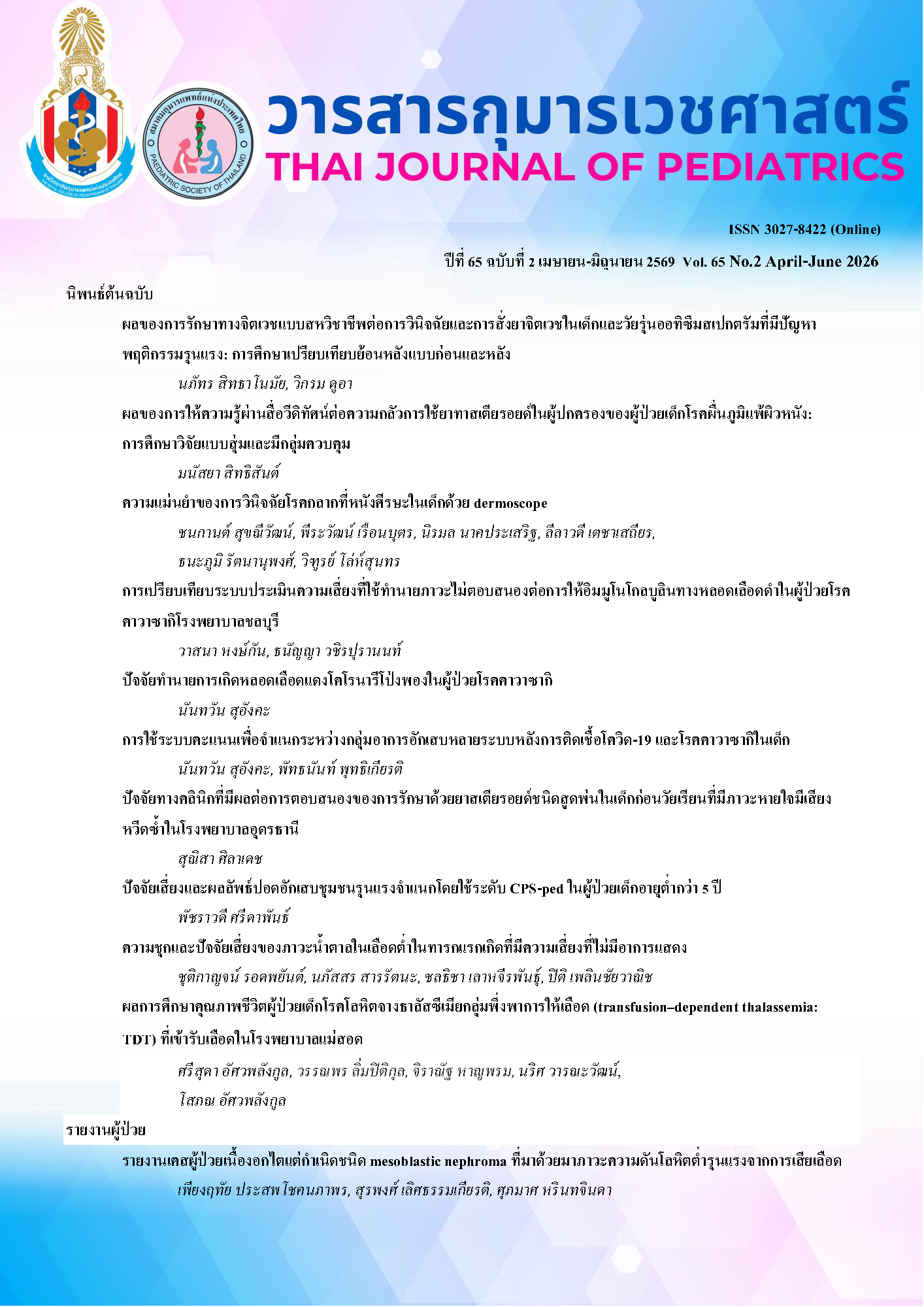
ปัจจัยทางคลินิกที่มีผลต่อการตอบสนองของการรักษาด้วยยาสเตียรอยด์ชนิดสูดพ่นในเด็กก่อนวัยเรียนที่มีภาวะหายใจมีเสียงหวีดซ้ำในโรงพยาบาลอุดรธานี
คำสำคัญ:
เด็กก่อนวัยเรียน, หายใจมีเสียงหวีดซ้ำ, ยาสเตียรอยด์ชนิดสูดพ่น, ปัจจัยที่สัมพันธ์กับการตอบสนองบทคัดย่อ
ความเป็นมา: ภาวะหายใจมีเสียงหวีดซ้ำในเด็กก่อนวัยเรียนเป็นปัญหาที่พบบ่อยและการตอบสนองต่อการรักษาด้วยยาสเตียรอยด์ชนิดสูดพ่น (inhaled corticosteroids; ICS) มีความแตกต่างกัน การทราบปัจจัยที่สัมพันธ์กับการตอบสนองต่อการรักษาจะช่วยให้ดูแลผู้ป่วยกลุ่มนี้ได้ผลดียิ่งขึ้น
วัตถุประสงค์: เพื่อศึกษาปัจจัยทางคลินิกที่มีความสัมพันธ์กับการตอบสนองต่อการรักษาด้วยยา ICS ในเด็กก่อนวัยเรียนที่มีภาวะหายใจมีเสียงหวีดซ้ำ และศึกษาอัตราการตอบสนองต่อการรักษาด้วยยา ICS
วิธีการศึกษา: การศึกษาย้อนหลัง โดยทบทวนเวชระเบียนเด็กอายุ 1–5 ปี ที่มีภาวะหายใจมีเสียงหวีดซ้ำและได้รับการรักษาด้วยยา ICS ต่อเนื่องอย่างน้อย 3 เดือน ในโรงพยาบาลอุดรธานี ระหว่างเดือน มกราคม พ.ศ. 2567 ถึง มิถุนายน พ.ศ. 2568 ประเมินการตอบสนองต่อการรักษาตามแนวทางการรักษาโรคหืดในเด็กของประเทศไทยวิเคราะห์ปัจจัยที่เกี่ยวข้อง ด้วยสถิติ logistic regression
ผลการศึกษา: ผู้ป่วยทั้งหมด 121 ราย พบการตอบสนองต่อการรักษาดี 88 ราย (ร้อยละ 72.7) ปัจจัยที่มีความสัมพันธ์กับการตอบสนองดีอย่างมีนัยสำคัญจากการวิเคราะห์พหุปัจจัย ได้แก่ อายุที่มากขึ้นเมื่อเริ่มรักษา (adjusted OR 1.87; 95% CI 1.18–3.13) และการมี เม็ดเลือดขาวชนิด eosinophil ที่สูง (adjusted OR 12.46; 95% CI 1.92–258.59) เป็นปัจจัยที่สัมพันธ์ต่อการตอบสนองดีต่อการรักษา ส่วนการสัมผัสควันบุหรี่ในบ้าน (adjusted OR 0.27; 95% CI 0.09–0.71) และการมีโรคจมูกอักเสบภูมิแพ้ (adjusted OR 0.22; 95% CI 0.07–0.64) เป็นปัจจัยที่สัมพันธ์กับการตอบสนองต่อยาไม่ดีอย่างมีนัยสำคัญทางสถิติ
สรุป: เด็กก่อนวัยเรียนส่วนใหญ่ตอบสนองดีต่อการรักษาด้วยยา ICS ปัจจัยด้านอายุ การสัมผัสควันบุหรี่ในบ้าน โรคจมูกอักเสบภูมิแพ้ และการมีเม็ดเลือดขาวชนิด eosinophil สูง เป็นปัจจัยที่สัมพันธ์กับการตอบสนองต่อการรักษา การประเมินปัจจัยเหล่านี้ก่อนเริ่มรักษาอาจช่วยเพิ่มประสิทธิภาพ การรักษาในเด็กก่อนวัยเรียนที่มีภาวะหายใจมีเสียงหวีดซ้ำ
Downloads
เอกสารอ้างอิง
Bisgaard H, Szefler S. Prevalence of asthma-like symptoms in young children. Pediatr Pulmonol. 2007;42:723-8.
Martinez FD, Wright AL, Taussig LM, Holberg CJ, Halonen M, Morgan WJ. Asthma and wheezing in the first six years of life. The Group Health Medical Associates. N Engl J Med. 1995;332:133-8.
Global Initiative for Asthma. Global Strategy for Asthma Management and Prevention [Internet]. 2024 [cited 2025 Jan 20]. Available from: https://www.ginasthma.org
สมาคมอุรเวชช์แห่งประเทศไทย ในพระบรมราชูปถัมภ์, สมาคมกุมารแพทย์แห่งประเทศไทย. แนวทางการวินิจฉัยและรักษาโรคหืดในประเทศไทยสำหรับผู้ป่วยเด็ก พ.ศ. 2564. กรุงเทพฯ: บียอนด์เอ็นเทอร์ไพรซ์; 2564.
Castro-Rodriguez JA, Holberg CJ, Wright AL, Martinez FD. A clinical index to define risk of asthma in young children with recurrent wheezing. Am J Respir Crit Care Med. 2000;162:1403-6.
Guilbert TW, Morgan WJ, Zeiger RS, Mauger DT, Boehmer SJ, Szefler SJ, et al. Long-term inhaled corticosteroids in preschool children at high risk for asthma. N Engl J Med. 2006; 354:1985-97.
Szefler SJ, Phillips BR, Martinez FD, Chinchilli VM, Lemanske RF, Strunk RC, et al. Characterization of within-subject responses to fluticasone and montelukast in childhood asthma. J Allergy Clin Immunol. 2005;115:233-42.
Brand PL, Baraldi E, Bisgaard H, Boner AL, Castro-Rodriguez JA, Custovic A, et al. Definition, assessment and treatment of wheezing disorders in preschool children: An evidence-based approach. Eur Respir J. 2008;32:1096-110.
Devulapalli CS, Carlsen KC, Haland G, Munthe-Kaas MC, Pettersen M, Mowinckel P, et al. Severity of obstructive airways disease by age 2 years predicts asthma at 10 years of age. Thorax. 2008;63:8-13.
Sirianansopa K, Ruangnapa K, Prasertsan P, Suwannakeeree P, Theerakittikul T, Rerkpattanapipat T, et al. Probability of successful inhaled corticosteroids cessation in preschool wheezers: A predictive score. Eur J Pediatr. 2023;182:379-86.
Taussig LM, Wright AL, Holberg CJ, Halonen M, Morgan WJ, Martinez FD. Tucson Children's Respiratory Study: 1980 to present. J Allergy Clin Immunol. 2003;111:661-75.
Savenije OE, Granell R, Caudri D, Koppelman GH, Smit HA, Wijga A, et al. Comparison of childhood wheezing phenotypes in 2 birth cohorts: ALSPAC and PIAMA. J Allergy Clin Immunol. 2011;127:1505-12.
Strachan DP, Cook DG. Health effects of passive smoking. 6. Parental smoking and childhood asthma: Longitudinal and case-control studies. Thorax. 1998;53:204-12.
Murray CS, Poletti G, Kebadze T, Morris J, Woodcock A, Johnston SL, et al. Study of modifiable risk factors for asthma exacerbations: Virus infection and allergen exposure increase the risk of asthma hospital admissions in children. Thorax. 2006;61:376-82.
Wanlapakorn N, Sritippayawan S, Deerojanawong J. Prevalence of asthma, level of control and factors associated with asthma control in Thai elementary school students in Bangkok. Asian Pac J Allergy Immunol. 2014;32:287-92.
Chalmers GW, Macleod KJ, Little SA, Thomson LJ, McSharry CP, Thomson NC. Influence of cigarette smoking on inhaled corticosteroid treatment in mild asthma. Thorax. 2002;57:226-30.
Patel M, Pilcher J, Reddel HK, Qi V, Beasley R, Pritchard A, et al. Predictors of severe exacerbations, poor asthma control, and beta-agonist overuse for patients with asthma. J Allergy Clin Immunol Pract. 2014;2:751-8.
Grossman J. One airway, one disease. Chest. 1997;111:S11-6.
Braunstahl GJ, Overbeek SE, Kleinjan A, Prins JB, Hoogsteden HC, Fokkens WJ. Nasal allergen provocation induces adhesion molecule expression and tissue eosinophilia in upper and lower airways. J Allergy Clin Immunol. 2001;107:469-76.
Fitzpatrick AM, Teague WG, Meyers DA, Peters SP, Li X, Li H, et al. Heterogeneity of severe asthma in childhood: Confirmation by cluster analysis of children in the national institutes of health/national heart, lung, and blood institute severe asthma research program. J Allergy Clin Immunol. 2011;127:382-9.
Forno E, Lescher R, Strunk R, Weiss S, Fuhlbrigge A, Celedon JC, et al. Decreased response to inhaled steroids in overweight and obese asthmatic children. J Allergy Clin Immunol. 2011; 127:741-9.
ดาวน์โหลด
เผยแพร่แล้ว
รูปแบบการอ้างอิง
ฉบับ
ประเภทบทความ
สัญญาอนุญาต
ลิขสิทธิ์ (c) 2026 ราชวิทยาลัยกุมารแพทย์แห่งประเทศไทย และ สมาคมกุมารแพทย์แห่งประเทศไทย

อนุญาตภายใต้เงื่อนไข Creative Commons Attribution-NonCommercial-NoDerivatives 4.0 International License.


