
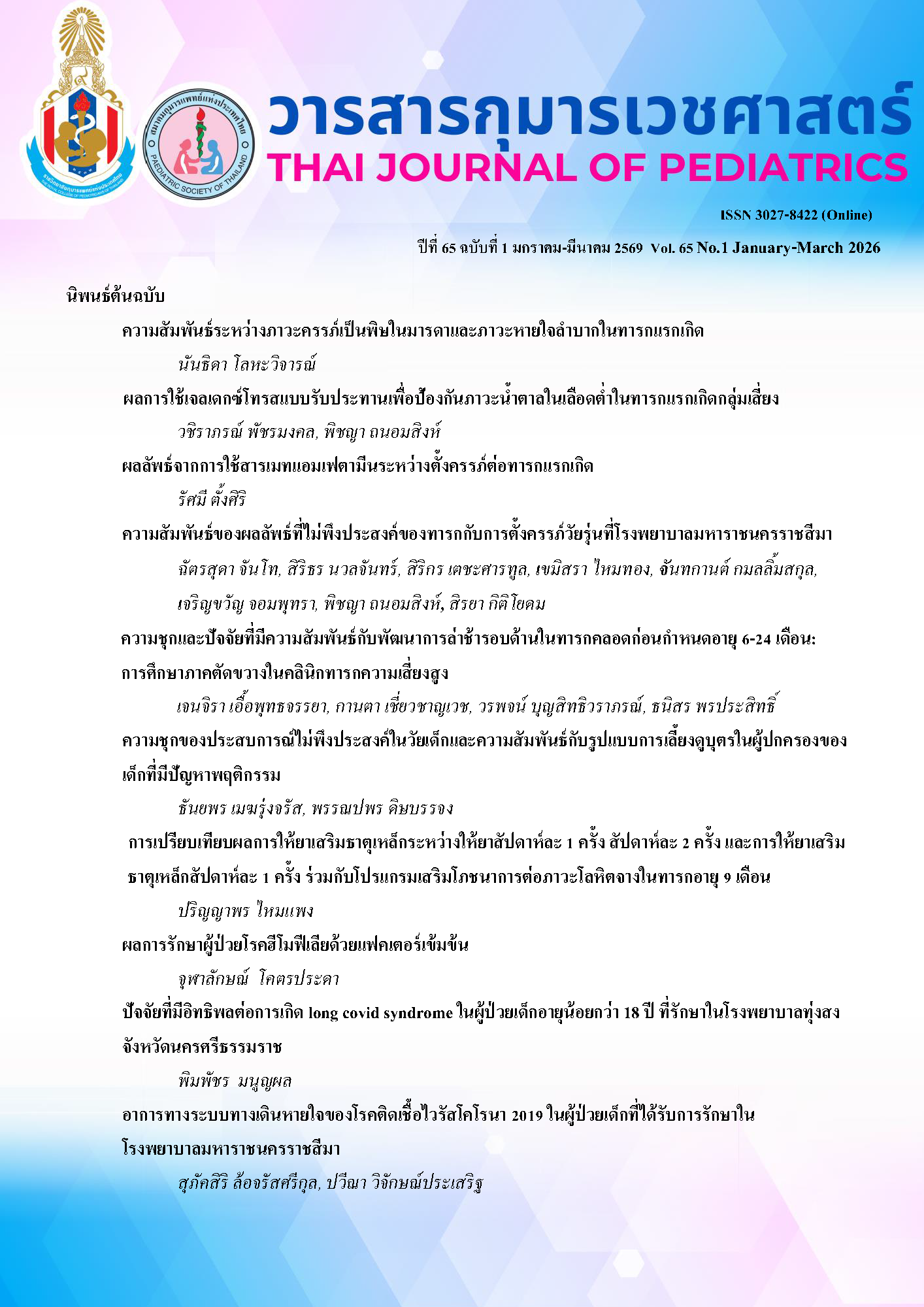
Outcomes of 40% oral dextrose gel for prevention of hypoglycemia in at-risk neonates
Keywords:
Neonatal hypoglycemia, Oral dextrose gel, At-risk neonatesAbstract
Background: Neonatal hypoglycemia is a common problem, especially in at-risk neonates. An innovative prevention protocol adding 40% oral dextrose gel, prepared by hospital pharmacies, was implemented to reduce the incidence of hypoglycemia.
Objectives: To determine the incidence of hypoglycemia at 1 hour of life in asymptomatic high-risk neonates receiving 40% oral dextrose gel according to the prevention protocol, identify factors associated with prevention failure, and compare the incidence of hypoglycemia before and after implementation of the oral dextrose gel protocol.
Methods: A prospective cohort study was conducted between April and December 2023, including 342 at-risk neonates with gestational age ≥ 35 weeks who received 40% oral dextrose gel after birth together with early feeding. The primary outcome was the incidence of hypoglycemia, and secondary outcomes were related clinical outcomes. Results were compared with 418 historical at-risk neonates before implementation of the oral dextrose gel protocol.
Results: Eleven at-risk neonates (3.2%) who received oral dextrose gel developed hypoglycemia, and four neonates (1.2%) required intravenous glucose therapy. Maternal insulin use was identified as a factor associated with prevention failure (p value 0.04). Compared with the historical control, the incidence of hypoglycemia (12.7%) and the requirement for intravenous glucose (12%) decreased significantly (p value < 0.001).
Conclusion: The implementation of 40% oral dextrose gel reduced the incidence of hypoglycemia and the requirement for intravenous glucose therapy. Maternal insulin use during pregnancy was the primary factor associated with prevention failure.
Downloads
References
Thompson-Branch A, Havranek T. Neonatal hypoglycemia. Pediatr Rev. 2017;38:147-57.
Harris DL, Weston PJ, Harding JE. Incidence of neonatal hypoglycemia in babies identified as at risk. J Pediatr. 2012;161:787-91.
McKinlay CJD, Alsweiler JM, Anstice NS, Burakevych N, Chakraborty A, Chase JG, et al. Association of neonatal glycemia with neurodevelopmental outcomes at 4.5 years. JAMA Pediatr. 2017;171:972-83.
Edwards T, Harding JE. Clinical aspects of neonatal hypoglycemia: A mini review. Front Pediatr. 2021;8:562251.
Roberts L, Lin L, Alsweiler J, Edwards T, Liu G, Harding JE. Oral dextrose gel to prevent hypoglycaemia in at-risk neonates. Cochrane Database Syst Rev. 2023;11:CD012152.
Harding JE, Hegarty JE, Crowther CA, Edlin RP, Gamble GD, Alsweiler JM; hPOD Study Group. Evaluation of oral dextrose gel for prevention of neonatal hypoglycemia (hPOD): A multicenter, double-blind randomized controlled trial. PLoS Med. 2021;18:e1003411.
ณัฏฐิยา พงศ์ผาสุก. การพัฒนาและประเมินความคงตัวของตำรับ 40% เดกซ์โทรสเจล. ใน: ณัฏฐิณา รังสินธุ์, สมสินี เกษมศิลป์, นุชนาฎ พรสัจจะ, อเสข แก้วกันหา, ศิวพร บุญเสก, นฤมล จิตปรีชา, และคณะ, บรรณาธิการ. รวมผลงานวิชาการดีเด่น Best Practice Oral Presentation Service Plan Sharing 2024. กรุงเทพฯ; 2567. หน้า 143-145. Available from: https://phdb.moph.go.th/main/upload/ebook/web/20240802202500/index.html#p=143
Phongphasuk N, Tantitanasap S, Permthongchuchai C. Formulation of buccal 40% dextrose gel for the prevention and treatment of hypoglycemia in newborns [Poster session]. In: 29th FAPA Congress 2023; 2023 Oct 24-28; Taipei, Taiwan.
Rivano M, Albrecht M, Longobardo G, Veneziano C. Galenic preparation of 40% dextrose gel: A new approach to the management of neonatal hypoglycemia. Clin Med Insights Endocrinol Diabetes. 2020;13:1179551420928326.
Weston PJ, Harris DL, Battin M, Brown J, Hegarty JE, Harding JE. Oral dextrose gel for the treatment of hypoglycaemia in newborn infants. Cochrane Database Syst Rev. 2016;5:CD011027.
Meneghin F, Manzalini M, Acunzo M, Daniele I, Bastrenta P, Castoldi F, et al. Management of asymptomatic hypoglycemia with 40% oral dextrose gel in near-term at-risk infants to reduce intensive care need and promote breastfeeding. Ital J Pediatr. 2021;47:201.
Hegarty JE, Harding JE, Gamble GD, Crowther CA, Edlin RP, Alsweiler JM. Prophylactic oral dextrose gel for newborn babies at risk of neonatal hypoglycaemia: A randomized controlled dose-finding trial (the Pre-hPOD study). Pediatrics. 2016;137:e20153635.
Adamkin DH; Committee on Fetus and Newborn. Postnatal glucose homeostasis in late-preterm and term infants. Re-affirmed June 2015. Pediatrics 2011;127:575-9.
Wight NE, Stehel E, Noble L, Bartick M, Calhoun S, Kair L, et al. Academy of breastfeeding medicine. ABM clinical protocol #1: Guidelines for glucose monitoring and treatment of hypoglycemia in term and late preterm neonates, revised 2021. Breastfeed Med. 2021;16:353-65.
National Collaborating Centre for Women’s and Children’s Health (UK). Diabetes in pregnancy: Management of diabetes and its complications from preconception to the postnatal period. National Institute for Health and Care Excellence: Clinical Guidelines. 2015.
Das-Kundu S, Fontijn J, Mönkhoff M, Neumann R, Szinnai G, Schulzke S. Prevention and treatment of hypoglycaemia in neonates with a gestational age from 35 0/7 weeks in maternity wards. Swiss Society of Neonatology [Internet]. 2020. Available from: https://www.neonet.ch/application/files/9716/0915/3976/2020_SSN_hypoglycaemia_e_neu.pdf
Wackernagel D, Gustafsson A, Edstedt Bonamy AK, Reims A, Ahlsson F, Elfving M, et al. Swedish national guideline for prevention and treatment of neonatal hypoglycaemia in newborn infants with gestational age ≥ 35 weeks. Acta Paediatr. 2020;109:31-44.
Roeper M, Hoermann H, Kummer S, Meissner T. Neonatal hypoglycemia: Lack of evidence for a safe management. Front Endocrinol (Lausanne). 2023;14:1179102.
Downloads
Published
How to Cite
Issue
Section
License
Copyright (c) 2026 The Royal College of Pediatricians Of Thailand

This work is licensed under a Creative Commons Attribution-NonCommercial-NoDerivatives 4.0 International License.


