
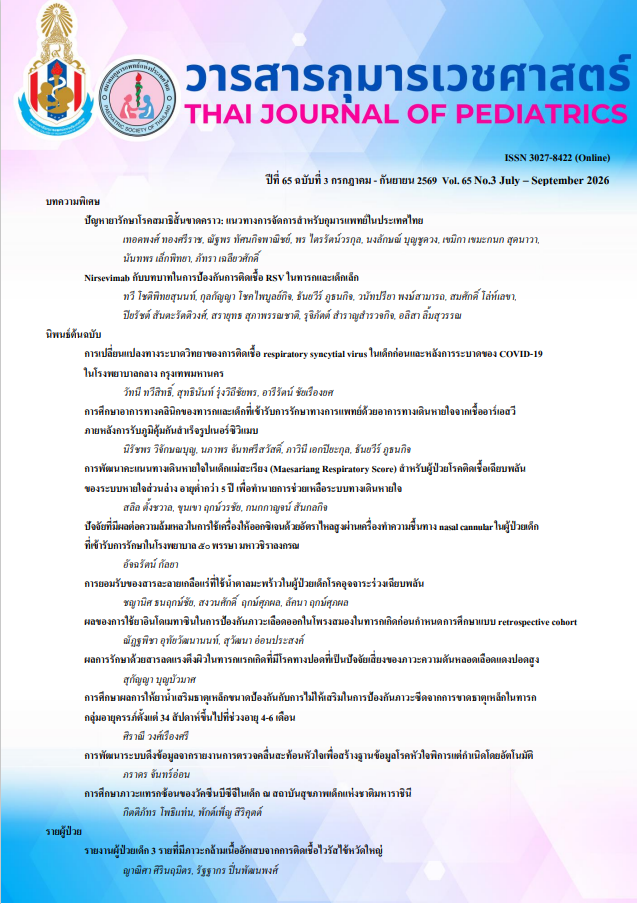
Factors associated with heated humidified high-flow nasal cannula failure in children at 50th Anniversary Mahavajiralongkorn Hospital
Keywords:
HHFNC, Pediatric patients, Failure, S/F ratio, ROX indexAbstract
Background: Respiratory distress is common in pediatric patients. Heated humidified high flow nasal cannula (HHFNC) use has increased at present. Identification of factors associated with treatment failure enables closer monitoring and better treatment outcomes.
Objectives: To determine the rate of HHFNC failure and its associated factors among pediatric patients at 50th Anniversary Mahavajiralongkorn Hospital.
Methods: This was a retrospective study reviewing medical records for pediatric patients aged 1 month to 15 years who received HHFNC therapy between October 1, 2022, and September 30, 2025. Descriptive statistics were used to summarize patient characteristics and incidence, the correlations between factors with HHFNC failure were constructed by chi-square test and binary logistic regression analysis.
Results: A total of 445 patients were included in the study, the mean age was 36 months, and 61.6% were male. Pneumonia was present in 72.6% of cases, and asthma was the most common comorbidity (14.3%). HHFNC failure occurred in 30 patients (6.7%). At 2 hours, the ROX index was lower in the failure group than in the success group (5.68 ± 2.16 vs. 9.26 ± 32.07, p value 0.001). At 4 hours, the S/F ratio was also lower in the failure group (200.84 ± 84.88 vs. 215.94 ± 80.74, p value 0.017). Factors associated with HHFNC failure included history of prior mechanical ventilation (OR 4.35, 95% CI 1.23-14.29), a respiratory-rate reduction <20% within 2 hours (OR 10.78, 95% CI 1.25-92.96), and maximum FiO2 > 60% (OR 12.50, 95% CI 4.55-33.33).
Conclusion: The HHFNC failure rate was 6.74%, factors associated with failure included prior mechanical ventilation, respiratory rate decreased by < 20% within 2 hours, and maximum FiO2 > 60%. The S/F ratio and ROX index were significantly lower in the failure group at 4 hours and then 2 hours respectively.
Downloads
References
Panetti B, Bucci I, Di Ludovico A, Pellegrino GMichela, Filippo PD, Pillo SD, et al. Acute respiratory failure in children: A clinical update on diagnosis. Children. 2024;11:1232.
Swain SK, Choudhury J. Pediatric airway diseases. Indian J Health Sci Biomed Res. 2019;12:196-201.
Wong JJM, Tan HL, Sultana R, Ma YJ, Aguilan AB, Goh CY, et al. Respiratory support after extubation in children with pediatric ARDS. Respir Care. 2024;69:422-9.
Uppala R, Sitthikarnkha P, Techasatian L, Saengnipanthkul S, Kosalaraksa P, Thepsuthammarat K, et al. Epidemiology, outcomes, and factors associated with mortality in pediatric acute respiratory distress syndrome in hospitalized Thai children: A nationwide retrospective analysis, 2015-2022. Critical Care. 2025;29:298.
Hernández-Corredor L, Plazas-Pachón R, Argote-Bolaños F, Lopez P, Vanegas MN, Lopez S, et al. Burden of respiratory failure in pediatric patients: Analysis of a prospective multicenter cohort in Bogotá, Colombia. Health Sci Rep. 2023;6:e1617.
Andrade RC, Leite ACAB, Alvarenga WA, Neris RR, Araújo JS, Polita NB, et al. Parental psychosocial needs in Brazilian pediatric intensive care units. Intensive Crit Care Nurs. 2022;72:103277.
Venanzi A, Di Filippo P, Santagata C, Pillo SD, Chiarelli F, & Attanasi M. Heated humidified high-flow nasal cannula in children: State of the art. Biomedicines, 2022;10:2353.
Nolasco S, Manti S, Leonardi S, Vancheri C, & Spicuzza L. High-flow nasal cannula oxygen therapy: Physiological mechanisms and clinical applications in children. Front Med. 2022;9:920549.
กองยุทธศาสตร์และแผนงาน สำนักงานปลัดกระทรวงสาธารณสุข. ข้อมูลหน่วยงานบริการสุขภาพ: โรงพยาบาล 50 พรรษา มหาวชิราลงกรณ รหัส 21984 [อินเทอร์เน็ต]. [สืบค้นเมื่อ 15 สิงหาคม 2569]. เข้าถึงได้จาก: https://hcode.moph.go.th/code/19286/
World Health Organization. The Management of acute respiratory infections in children: Practical guidelines for outpatient care. Geneva: World Health Organization. 1995.
Muhetaer Y, Zhang SM, Moming A, Liu K, Zhong M. Prediction of high-flow nasal cannula failure in critically ill patients: A narrative review. J Intensive Care. 2026;14:27.
Groot OQ, Ogink PT, Lans A, Twining PK, Kapoor ND, DiGiovanni W, et al. Machine learning prediction models in orthopedic surgery: A systematic review in transparent reporting. J Orthop Res. 2022;40:475-83.
Lakens D. Sample size justification. Collabra Psychol. 2022;8:33267.
Riley RD, Collins GS. Stability of clinical prediction models developed using statistical or machine learning methods. Biometr J. 2023;65:e2200302.
นันทนิช วงษ์สวัสดิ์, นิศารัตน์ สำเร. ผลลัพธ์ของการใช้ HFNC ในผู้ป่วยเด็กที่มีภาวะหายใจลําบากเฉียบพลัน. วารสารกุมารเวชศาสตร์. 2568;64:138-55.
ธานัติยา อรุุโณทอง. ปัจจัยที่มีผลต่อการใช้ High Flow Nasal Cannula (HFNC) ในเด็กโรคปอดอักเสบ. วารสารวิชาการแพทย์และสาธารณสุข เขตสุขภาพที่ 3. 2567;21:326-33.
Liu J, Lit D, Luo L, Liu Z, Li X, & Qiao L. Analysis of risk factors for the failure of respiratory support with high-flow nasal cannula oxygen therapy in children with acute respiratory dysfunction: A case-control study. Front Pediatr. 2022;10:979944.
Aydın O, Aydın EA, Birbilen AZ, Tekşam Ö. Predictive factors of high-flow nasal cannula oxygen therapy failure in children with respiratory distress treated in a pediatric emergency department. Turk J Pediatr. 2021;63:1012-9.
Betters KA, Gillespie SE, Miller J, Kotzbauer D, Hebbar KB. High flow nasal cannula use outside of the ICU; factors associated with failure. Pediatr Pulmonol. 2017;52:806-12.
Kim GE, Choi SH, Park M, Jung JH, Lee M, Kim SY, et al. SpO2/FiO2 as a predictor of high flow nasal cannula outcomes in children with acute hypoxemic respiratory failure. Scientific Reports [Internet]. 2021 [2026 Mar. 15];11:13439. Available from: https://doi.10.1038/s41598-021-92893-7
Yuniar I, Pudjiadi AH, Dewi R, Prawira Y, Puspaningtyas NW, Tartila T, et al. Respiratory Rate Oxygenation (ROX) index as predictor of high flow nasal cannula in pediatric patients in pediatric intensive care unit. BMC Pulmonary Medicine. 2024;24:216.
Saelim K, Thirapaleka B, Ruangnapa K, Prasertsan P, Anuntaseree W. Predictors of high-flow nasal cannula failure in pediatric patients with acute respiratory distress. Clin Exp Pediatr. 2022;65:595-601.
Sunkonkit K, Kungsuwan S, Seetaboot S, Reungrongrat S. Factors associated with failure of using high flow nasal cannula in children. Clin Respir J. 2022;16:732-9.
รัตติกาล มณีนุตร์, ศรีสุดา อัศวพลังกูล, โสภณ อัศวพลังกูล. ปัจจัยที่มีผลต่อความล้มเหลวในการใช้เครื่องออกซิเจนด้วยอัตราการไหลสูง ผ่านเครื่องทำความชื้นให้กับผู้ป่วยเด็กทาง nasal cannula ที่เข้ารับการรักษาในโรงพยาบาลแม่สอด [Internet]. 2022. [cited 10 March 2026]. Available from: https://hpc2appcenter.anamai.moph.go.th/academic/web/files/2565/research/MA2565-003-01-0000000396-0000000857.pdf
Townsel CD, Emmer SF, Campbell WA, & Hussain N. Gender differences in respiratory morbidity and mortality of preterm neonates. Front Pediatr. 2017;5:6.
D'Alessandro M, Vanniyasingam T, Patel A, Gupta R, Giglia L, Federici G, et al. Factors associated with treatment failure of high-flow nasal cannula among children with bronchiolitis: A single-centre retrospective study. Paediatr Child Health. 2020;26:e229-35.
Guillot C, Reun CL, Behal H, Labreuche J, Recher M, Duhamel A, et al. First-line treatment using high-flow nasal cannula for children with severe bronchiolitis: Applicability and risk factors for failure. Arch Pediatr. 2018;25:213-8.
Downloads
Published
How to Cite
Issue
Section
License
Copyright (c) 2026 The Royal College of Pediatricians Of Thailand

This work is licensed under a Creative Commons Attribution-NonCommercial-NoDerivatives 4.0 International License.


