
ปัจจัยสิ่งแวดล้อมด้านอาหารของโรงเรียนต่อพฤติกรรมการบริโภคอาหารและภาวะโภชนาการของเด็กวัยเรียนในโรงเรียนประถมศึกษา
คำสำคัญ:
สิ่งแวดล้อมด้านอาหารของโรงเรียน, พฤติกรรมบริโภคอาหาร, ภาวะโภชนาการบทคัดย่อ
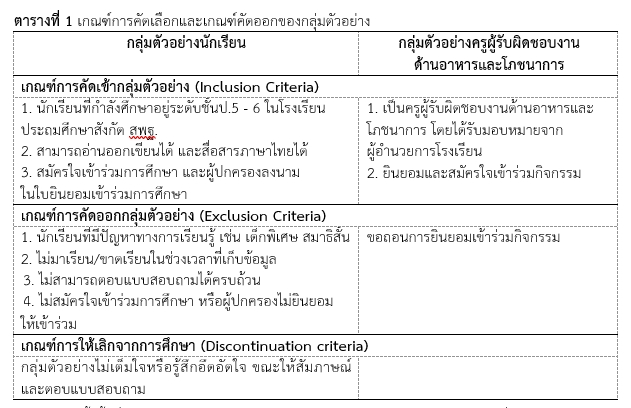
ความชุกของภาวะทุพโภชนาการในเด็กวัยเรียนมีแนวโน้มเพิ่มขึ้นต่อเนื่อง โดยเฉพาะภาวะเริ่มอ้วนและอ้วน ส่งผลกระทบต่อพัฒนาการและเพิ่มความเสี่ยงต่อการเกิดโรคไม่ติดต่อเรื้อรัง การปรับเปลี่ยนสภาพสิ่งแวดล้อมด้านอาหารของโรงเรียนจึงเป็นกลยุทธ์สำคัญในการส่งเสริมพฤติกรรมการบริโภคที่เหมาะสม และแก้ไขปัญหาภาวะโภชนาการ การศึกษานี้มีวัตถุประสงค์เพื่อศึกษาความสัมพันธ์ระหว่างปัจจัยสิ่งแวดล้อมด้านอาหารของโรงเรียนต่อพฤติกรรมการบริโภคอาหารและภาวะโภชนาการของเด็กวัยเรียนในโรงเรียนประถมศึกษา โดยใช้วิธีการวิจัยเชิงพรรณนาแบบภาคตัดขวาง เก็บรวบรวมข้อมูลด้วยแบบสอบถาม แบบสัมภาษณ์ และแบบสำรวจในนักเรียนชั้นประถมศึกษาปีที่ 5 - 6 จำนวน 958 คน และครูผู้รับผิดชอบโครงการอาหารกลางวัน จำนวน 30 คน ในโรงเรียนประถมสังกัดสำนักงานคณะกรรมการการศึกษาขั้นพื้นฐาน (สพฐ.) จำนวน 30 โรงเรียน ในช่วงเดือนมิถุนายนถึงสิงหาคม 2566 วิเคราะห์ข้อมูลด้วยสถิติพรรณนาและการถดถอยโลจิสติก
ผลการศึกษาพบว่า ปัจจัยสิ่งแวดล้อมด้านอาหารของโรงเรียนทางนโยบาย ได้แก่ การมีนโยบายด้านอาหารครบถ้วนตามประกาศ สพฐ. ว่าด้วยการจำหน่ายอาหารและเครื่องดื่มที่ส่งเสริมสุขภาพของสถานศึกษา มีความสัมพันธ์กับพฤติกรรมบริโภคอาหารแปรรูปประเภทเนื้อสัตว์และน้ำอัดลม (OR 0.457, 95% CI 0.224-0.935, OR 0.514, 95% CI 0.250-1.057 ตามลำดับ) การมีมาตรการควบคุมการจัดบริการหรือจำหน่ายอาหารที่ไม่ดีต่อสุขภาพในโรงเรียนมีความสัมพันธ์กับพฤติกรรมการบริโภคผัก (OR 6.500, 95% CI 1.542-27.398) และการมีมาตรการควบคุมการจำหน่ายอาหารที่ไม่ดีต่อสุขภาพรอบรั้วโรงเรียนมีความสัมพันธ์กับภาวะสมส่วนและภาวะเริ่มอ้วน (OR 0.590, 95% CI 0.386-0.902, OR 2.348, 95% CI 1.169-4.717 ตามลำดับ) ปัจจัยทางเศรษฐกิจ การมีงบประมาณอาหารกลางวันเพียงพอมีความสัมพันธ์กับพฤติกรรมบริโภคอาหารแปรรูปประเภทเนื้อสัตว์ (OR 2.951, 95% CI 1.091-7.982) และภาวะโภชนาการต่ำกว่าเกณฑ์ (OR 13.708, 95% CI 2.083-90.202) ด้านปัจจัยทางกายภาพ ได้แก่ การจำกัดพื้นที่จำหน่ายอาหารและเครื่องดื่มเฉพาะภายในโรงอาหาร มีความสัมพันธ์กับพฤติกรรมการบริโภคขนมที่มีรสหวาน (OR 0.352, 95% CI 0.145-0.856) ขณะที่การไม่มีการจำหน่ายอาหารว่างและเครื่องดื่มรอบรั้วโรงเรียนมีความสัมพันธ์กับภาวะอ้วน (OR 0.069, 95% CI 0.008-0.600) และการจัดอาหารกลางวันที่มีคุณภาพมีความสัมพันธ์กับภาวะโภชนาการต่ำกว่าเกณฑ์ (OR 0.066, 95% CI 0.007-0.602) ส่วนปัจจัยทางสังคมและวัฒนธรรม ได้แก่ การมีกิจกรรมส่งเสริมความรู้ และทักษะด้านโภชนาการมีความสัมพันธ์กับพฤติกรรมการบริโภคน้ำอัดลม (OR 0.546, 95% CI 0.302-0.985) และการมีผู้กำหนดอาหารกลางวันผ่านการอบรมมีความสัมพันธ์กับพฤติกรรมการบริโภคอาหารไขมันสูง (OR 16.437, 95% CI 1.226-220.302) และภาวะอ้วน (OR 0.002, 95% CI 0.000-0.745)
โดยสรุป ผลการศึกษาชี้ให้เห็นว่า การจัดสิ่งแวดล้อมด้านอาหารของโรงเรียนที่เหมาะสมช่วยส่งเสริมพฤติกรรมการบริโภคอาหารและภาวะโภชนาการที่ดีของเด็กวัยเรียน ดังนั้น หน่วยงานที่เกี่ยวข้องควรยกระดับ และบังคับใช้มาตรการควบคุมอาหารและเครื่องดื่มในโรงเรียนอย่างจริงจัง ควบคู่กับการสนับสนุนงบประมาณที่เพียงพอ การพัฒนาศักยภาพบุคลากร และส่งเสริมการเรียนรู้ด้านโภชนาการแก่นักเรียนอย่างต่อเนื่อง
เอกสารอ้างอิง
กมลพัฒน์ มากแจ้ง, อรทัย วลีวงศ์, ศิริวรรณ พิทยรังสฤษฏ์, พเยาว์ ผ่อนสุข, ณัฎฐณิชา แปงการิยา, และสรศักดิ์ เจริญสิทธิ์. (2565). การทบทวนข้อแนะนำเชิงนโยบายด้านอาหารและโภชนาการในโรงเรียนจากองค์การระหว่างประเทศและการดำเนินงานของประเทศไทย. วารสารวิจัยระบบสาธารณสุข, 16(2), 215–248.
ณัฎฐณิชา แปงการิยา, กัณณพนต์ ภักดีเศรษฐกุล, พเยาว์ ผ่อนสุข, อรทัย วลีวงศ์, และศิริวรรณ พิทยรังสฤษฏ์. (2563). รายงานฉบับสมบูรณ์ ถอดบทเรียนความสำเร็จเพื่อขยายผล กรณีศึกษาโรงเรียนประถมศึกษาและขยายโอกาสที่มีพัฒนาการในการจัดการอาหารและโภชนาการที่ดี. สำนักวิจัยนโยบายสร้างเสริมสุขภาพ มูลนิธิเพื่อการพัฒนานโยบายสุขภาพระหว่างประเทศ.
นันทวัฒน์ พฤกษ์สรนันทน์. (2568). โครงการอาหารกลางวันกับปัญหาภาวะทุพโภชนาการของนักเรียนในประเทศไทย. Procedia of Multidisciplinary Research, 3(5).
แผนงานวิจัยนโยบายอาหารและโภชนาการเพื่อการสร้างเสริมสุขภาพ มูลนิธิเพื่อการพัฒนานโยบายสุขภาพระหว่างประเทศ. (2563). รายงานฉบับสมบูรณ์โครงการการสำรวจสภาพแวดล้อมทางด้านอาหารและการจัดการอาหารในโรงเรียนและรอบรั้วโรงเรียน ภาวะโภชนาการของเด็กวัยเรียนและปัจจัยที่เกี่ยวข้อง.
วิชัย เอกพลากร. (2566). รายงานการสำรวจสุขภาพประชาชนไทยโดยการตรวจร่างกายครั้งที่ 6 พ.ศ. 2562–2563: สุขภาพเด็ก. คณะแพทยศาสตร์โรงพยาบาลรามาธิบดี มหาวิทยาลัยมหิดล.
สำนักงานคณะกรรมการการศึกษาขั้นพื้นฐาน. (2564). ประกาศสำนักงานคณะกรรมการการศึกษาขั้นพื้นฐานว่าด้วยการจำหน่ายอาหารและเครื่องดื่มที่ส่งเสริมสุขภาพของสถานศึกษา พ.ศ. 2564.
สำนักงานสถิติแห่งชาติ, กระทรวงดิจิทัลเพื่อเศรษฐกิจและสังคม. (2564). การสำรวจพฤติกรรมด้านสุขภาพของประชากร พ.ศ. 2564. สำนักงานสถิติแห่งชาติ.
สำนักโภชนาการ กรมอนามัย กระทรวงสาธารณสุข. (2558). คู่มือการดำเนินงานส่งเสริมสุขภาพด้านโภชนาการในเด็กวัยเรียนสำหรับบุคลากรสาธารณสุข.
สำนักโภชนาการ กรมอนามัย กระทรวงสาธารณสุข. (2564). คู่มือการใช้เกณฑ์อ้างอิงการเจริญเติบโตของเด็กอายุ 6–19 ปี.
Anttila, J., Rytkönen, T., Kankaanpää, R., Tolvanen, M., & Lahti, S. (2015). Effect of national recommendation on sweet selling as an intervention for a healthier school environment. Scandinavian Journal of Public Health, 43(1), 27–34. from https://doi.org/10.1177/1403494814558150
Azeredo, C. M., de Rezende, L. F., Canella, D. S., Claro, R. M., Peres, M. F., Odo, C. L., França-Junior, I., Kinra, S., Hawkesworth, S., & Levy, R. B. (2016). Food environments in schools and in the immediate vicinity are associated with unhealthy food consumption among Brazilian adolescents. Preventive Medicine, 88, 73–79. from https://doi.org/10.1016/j.ypmed.2016.03.026
Best, C., Neufingerl, N., van Geel, L., van den Briel, T., & Osendarp, S. (2010). The nutritional status of school-aged children: Why should we care? Food and Nutrition Bulletin, 31(3), 400–417. from https://doi.org/10.1177/156482651003100303
Bonomo, T., & Schanzenbach, D. W. (2024). Trends in the school lunch program: Changes in selection, nutrition, and health. Food Policy, 124, 102608. from https://doi.org/10.1016/j.foodpol.2024.102608
Briefel, R. R., Wilson, A., & Gleason, P. M. (2009). Consumption of low-nutrient, energy-dense foods and beverages at school, home, and other locations among school lunch participants and nonparticipants. Journal of the American Dietetic Association, 109(2 Suppl), S79–S90. from https://doi.org/10.1016/j.jada.2008.10.064
Brown, C. L., Halvorson, E. E., Cohen, G. M., Lazorick, S., & Skelton, J. A. (2015). Addressing childhood obesity: Opportunities for prevention. Pediatric Clinics of North America, 62(5), 1241–1261. from https://doi.org/10.1016/j.pcl.2015.05.013
Chriqui, J. F., Lin, W., Leider, J., Shang, C., & Perna, F. M. (2020). The harmonizing effect of Smart Snacks on the association between state snack laws and high school students’ fruit and vegetable consumption, United States, 2005–2017. Preventive Medicine, 139, 106093. from https://doi.org/10.1016/j.ypmed.2020.106093
Cochran, W. G. (1977). Sampling techniques (3rd ed.). New York, NY: John Wiley & Sons.
Cohen, J. F. W., Rimm, E. B., Austin, S. B., Hyatt, R. R., Kraak, V. I., & Economos, C. D. (2014). A food service intervention improves whole grain access at lunch in rural elementary schools. Journal of School Health, 84(3), 212–219. from https://doi.org/10.1111/josh.12133
da Costa Peres, C. M., Gardone, D. S., Costa, B. V. L., Duarte, C. K., Pessoa, M. C., & Mendes, L. L. (2020). Retail food environment around schools and overweight: A systematic review. Nutrition Reviews, 78(10), 841–856. from https://doi.org/10.1093/nutrit/nuz110
Datar, A., & Nicosia, N. (2017). The effect of state competitive food and beverage regulations on childhood overweight and obesity. Journal of Adolescent Health, 60(5), 520–527. from https://doi.org/10.1016/j.jadohealth.2016.09.003
de Assis, M. M., Gratão, L. H. A., da Silva, T. P. R., Cordeiro, N. G., do Carmo, A. S., de Freitas Cunha, C., de Oliveira, T., Rocha, L. L., & Mendes, L. L. (2022). School environment and obesity in adolescents from a Brazilian metropolis: Cross-sectional study. BMC Public Health, 22(1), 1229. from https://doi.org/10.1186/s12889-022-13592-0
Domitrovich, C. E., Bradshaw, C. P., Poduska, J. M., Hoagwood, K., Buckley, J. A., Olin, S., Romanelli, L. H., Leaf, P. J., Greenberg, M. T., & Ialongo, N. S. (2008). Maximizing the implementation quality of evidence-based preventive interventions in schools: A conceptual framework. Advances in School Mental Health Promotion, 1(3), 6–28. from https://doi.org/10.1080/1754730X.2008.9715730
Driessen, C. E., Cameron, A. J., Thornton, L. E., Lai, S. K., & Barnett, L. M. (2014). Effect of changes to the school food environment on eating behaviours and/or body weight in children: A systematic review. Obesity Reviews, 15(12), 968–982. from https://doi.org/10.1111/obr.12224
Filgueiras, M. S., Pessoa, M. C., Bressan, J., Vegi, A. S. F., do Carmo, A. S., Albuquerque, F. M., Gardone, D. S., & Novaes, J. F. (2023). Characteristics of the obesogenic environment around schools are associated with body fat and low-grade inflammation in Brazilian children. Public Health Nutrition, 26(11), 2407–2417. from https://doi.org/10.1017/S1368980023001696
Flure, L., Prescott, M. P., Ajie, W., Allison, T., & McCaffrey, J. (2021). Training preferences of school food service staff vary by role in the school nutrition program. International Journal of Environmental Research and Public Health, 18(1), 50. https://doi.org/10.3390/ijerph18010050
Food and Agriculture Organization of the United Nations. (2019). School food and nutrition framework. from https://www.fao.org/3/ca4091en/CA4091EN.pdf
França, F. C. O., Andrade, I. S., Zandonadi, R. P., Sávio, K. E., & Akutsu, R. C. C. A. (2022). Food environment around schools: A systematic scope review. Nutrients, 14(23), 5090. from https://doi.org/10.3390/nu14235090
Gonçalves, V. S. S., Figueiredo, A., Silva, S. A., Silva, S. U., Ronca, D. B., Dutra, E. S., & Carvalho, K. M. B. (2021). The food environment in schools and their immediate vicinities associated with excess weight in adolescence: A systematic review and meta-analysis. Health & Place, 71, 102664. from https://doi.org/10.1016/j.healthplace.2021.102664
Grigsby-Duffy, L., Brooks, R., Boelsen-Robinson, T., Blake, M. R., Backholer, K., Palermo, C., & Peeters, A. (2022). The impact of primary school nutrition policy on the school food environment: A systematic review. Health Promotion International, 37(5), daac084. from https://doi.org/10.1093/heapro/daac084
Kreft, I. G. G. (1996). Are multilevel techniques necessary? An overview, including simulation studies. Unpublished manuscript, California State University, Los Angeles.
Lebel, A., Morin, P., Robitaille, É., Lalonde, B., Fratu, R. F., & Bisset, S. (2016). Sugar-sweetened beverage consumption among primary school students: Influence of the schools’ vicinity. Journal of Environmental and Public Health, 2016, 1416384. from https://doi.org/10.1155/2016/1416384
Lehmann, F., Varnaccia, G., Zeiher, J., Lange, C., & Jordan, S. (2020). Influencing factors of obesity in school-age children and adolescents: A systematic review in the context of obesity monitoring. Journal of Health Monitoring, 5(Suppl 2), 2–23. from https://doi.org/10.25646/6729
Medeiros, G. C. B. S., Azevedo, K. P. M., Garcia, D., Oliveira Segundo, V. H., Mata, Á. N. S., Fernandes, A. K. P., Santos, R. P., Trindade, D. D. B. B., Moreno, I. M., Guillén Martínez, D., & Piuvezam, G. (2022). Effect of school-based food and nutrition education interventions on the food consumption of adolescents: A systematic review and meta-analysis. International Journal of Environmental Research and Public Health, 19(17), 10522. from https://doi.org/10.3390/ijerph191710522
Micha, R., Karageorgou, D., Bakogianni, I., Trichia, E., Whitsel, L. P., Story, M., Peñalvo, J. L., & Mozaffarian, D. (2018). Effectiveness of school food environment policies on children’s dietary behaviors: A systematic review and meta-analysis. PLoS ONE, 13(3), e0194555. from https://doi.org/10.1371/journal.pone.0194555
Millimet, D. L., Tchernis, R., & Husain, M. (2010). School nutrition programs and the incidence of childhood obesity. Journal of Human Resources, 45(3), 640–654. from https://www.jstor.org/stable/25703471
Nonboonyawat, T., Pusanasuwannasri, W., Chanrat, N., Wongthanavimok, N., Tubngern, D., Panutrakul, P., Mungthin, M., Nivesvivat, T., Hatthachote, P., Rangsin, R., & Piyaraj, P. (2019). Prevalence and associates of obesity and overweight among school-age children in a rural community of Thailand. Korean Journal of Pediatrics, 62(5), 179–186. from https://doi.org/10.3345/kjp.2018.06499
Park, S., Choi, B. Y., Wang, Y., Colantuoni, E., & Gittelsohn, J. (2013). School and neighborhood nutrition environment and their association with students’ nutrition behaviors and weight status in Seoul, South Korea. Journal of Adolescent Health, 53(5), 655–662. from https://doi.org/10.1016/j.jadohealth.2013.06.002
Pineda, E., Bascunan, J., & Sassi, F. (2021). Improving the school food environment for the prevention of childhood obesity: What works and what doesn’t. Obesity Reviews, 22(2), e13176. from https://doi.org/10.1111/obr.13176
Singh, A., Park, A., & Dercon, S. (2014). School meals as a safety net: An evaluation of the midday meal scheme in India. Economic Development and Cultural Change, 62(2), 275–306. from https://doi.org/10.1086/674097
Swinburn, B. A., Kraak, V. I., Allender, S., et al. (2019). The global syndemic of obesity, undernutrition, and climate change: The Lancet Commission report. The Lancet, 393(10173), 791–846. from https://doi.org/10.1016/S0140-6736(18)32822-8
Swinburn, B., Egger, G., & Raza, F. (1999). Dissecting obesogenic environments: The development and application of a framework for identifying and prioritizing environmental interventions for obesity. Preventive Medicine, 29(6 Pt 1), 563–570. from https://doi.org/10.1006/pmed.1999.0585
Swinburn, B., Sacks, G., Vandevijvere, S., et al. (2013). INFORMAS: Overview and key principles. Obesity Reviews, 14(Suppl 1), 1–12. from https://doi.org/10.1111/obr.12087
Williams, J., Scarborough, P., Matthews, A., Cowburn, G., Foster, C., Roberts, N., & Rayner, M. (2014). A systematic review of the influence of the retail food environment around schools on obesity-related outcomes. Obesity Reviews, 15(5), 359–374. from https://doi.org/10.1111/obr.12142
World Health Organization. (2020). WHO guidelines on physical activity and sedentary behaviour. World Health Organization. from https://www.who.int/publications/i/item/9789240015128
World Health Organization. (2021). Implementing school food and nutrition policies: A review of contextual factors. World Health Organization. from https://apps.who.int/iris/
ดาวน์โหลด
เผยแพร่แล้ว
รูปแบบการอ้างอิง
ฉบับ
ประเภทบทความ
สัญญาอนุญาต
ลิขสิทธิ์ (c) 2025 วารสารการส่งเสริมสุขภาพและอนามัยสิ่งแวดล้อม ศูนย์อนามัยที 8 อุดรธานี

อนุญาตภายใต้เงื่อนไข Creative Commons Attribution-NonCommercial-NoDerivatives 4.0 International License.
บทความในวารสารนี้มีลิขสิทธิ์โดยและเผยแพร่ภายใต้สัญญาอนุญาต Creative Commons แบบแสดงที่มา-ไม่ใช้เพื่อการค้า-ไม่ดัดแปลง 4.0 ระหว่างประเทศ (CC BY-NC-ND 4.0)
สามารถอ่านและนำไปใช้เพื่อวัตถุประสงค์ทางวิชาการ เช่น การสอน การวิจัย หรือการอ้างอิง โดยให้เครดิตแก่ผู้เขียนและวารสารอย่างเหมาะสม
ห้ามใช้หรือดัดแปลงบทความโดยไม่ได้รับอนุญาต
ข้อความที่ปรากฏในบทความเป็นความคิดเห็นของผู้เขียนแต่เพียงผู้เดียว
ผู้เขียนต้องรับผิดชอบต่อเนื้อหาและความถูกต้องของบทความของตนทั้งหมด
การนำไปใช้ซ้ำหรือเผยแพร่ซ้ำในรูปแบบอื่นต้องได้รับอนุญาตจากวารสาร



