
ความสัมพันธ์ระหว่างภาวะโภชนาการกับพัฒนาการของเด็กปฐมวัย เขตสุขภาพที่ 8
คำสำคัญ:
ภาวะโภชนาการ, พัฒนาการ, เด็กปฐมวัย, เขตสุขภาพที่ 8บทคัดย่อ
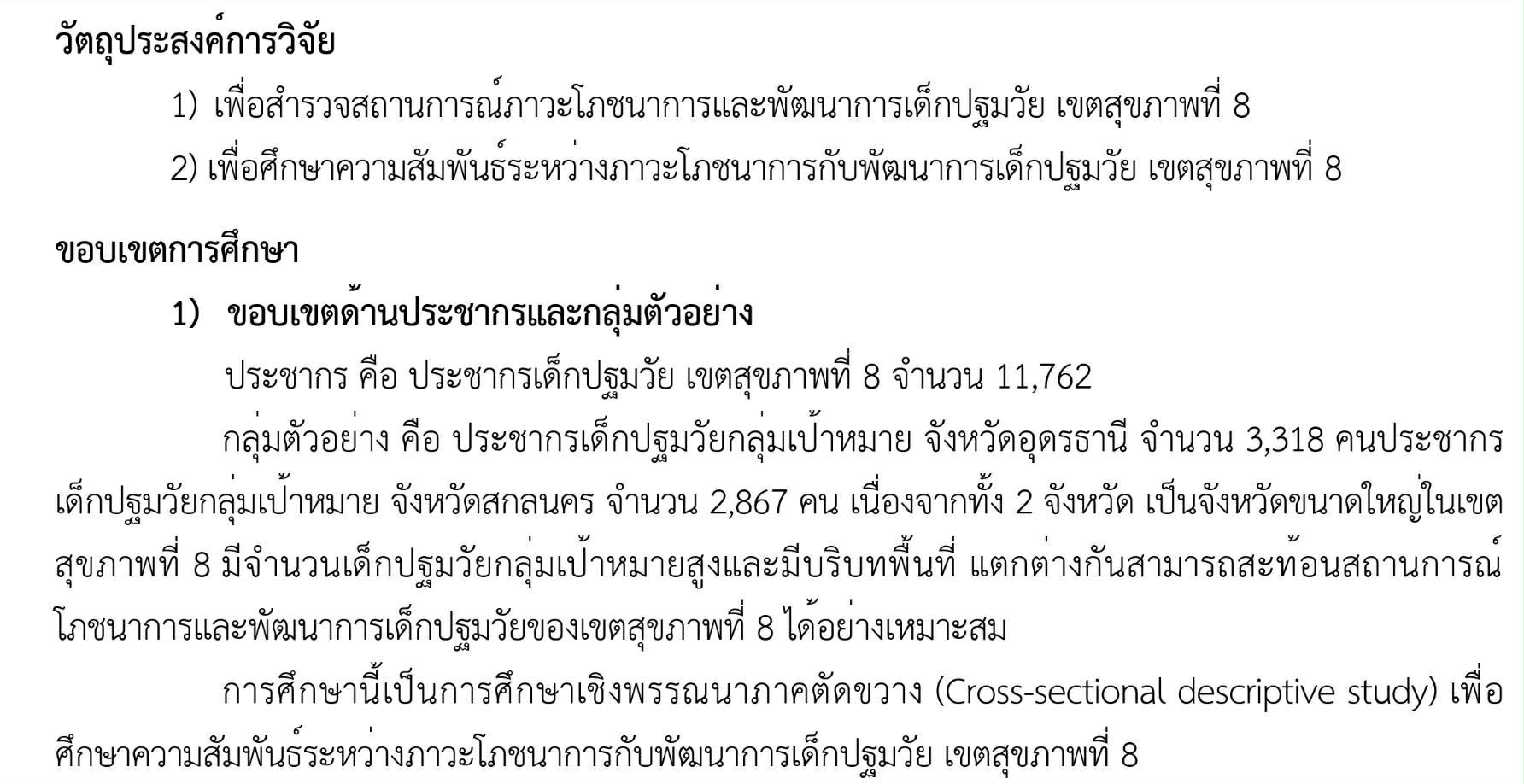
การศึกษานี้เป็นการศึกษาเชิงพรรณนาภาคตัดขวาง (Cross-sectional descriptive study) มีวัตถุประสงค์ เพื่อศึกษาสถานการณ์ภาวะโภชนาการ พัฒนาการ และความสัมพันธ์ระหว่างภาวะโภชนาการกับพัฒนาการเด็กปฐมวัย เขตสุขภาพที่ 8 กลุ่มตัวอย่างคือเด็กปฐมวัยในเขตสุขภาพที่ 8 จำนวน 276 คน คัดเลือกโดยวิธีการแบบเฉพาะเจาะจง (Purposive Sampling) เครื่องมือที่ใช้ในการศึกษาเป็นแบบสัมภาษณ์ผู้เลี้ยงดูเด็ก ที่ผู้วิจัยประยุกต์ขึ้นจากแบบสอบถามโครงการสถานการณ์และรูปแบบการส่งเสริมพัฒนาการเด็กปฐมวัยภายใต้การถ่ายโอนภารกิจสู่องค์การบริหารส่วนจังหวัด เก็บรวบรวมข้อมูล เดือนตุลาคม 2567 - เดือนเมษายน 2568 การวิเคราะห์ข้อมูลใช้สถิติเชิงพรรณนา การวิเคราะห์ความสัมพันธ์โดยใช้ Chi-square test และ Odds Ratio (OR) ที่ระดับนัยสำคัญทางสถิติ 0.05
ผลการศึกษาพบว่า เด็กส่วนใหญ่เป็นเพศชาย ร้อยละ 51.81 มีน้ำหนักแรกคลอดปกติ ร้อยละ 88.04 ไม่มีโรคประจำตัว ร้อยละ 89.49 และได้รับนมแม่ ร้อยละ 85.87 ครอบครัวส่วนใหญ่มีรายได้ 15,001–25,000 บาทต่อเดือน ร้อยละ 46.74 ผู้เลี้ยงดูหลักเป็นมารดา ร้อยละ 49.64 ซึ่งมีความรู้ด้านโภชนาการในระดับสูง ร้อยละ 52.54; ค่าเฉลี่ย 9.06 ± 1.96 คะแนน เด็กส่วนใหญ่ได้รับคู่มือ DSPM ร้อยละ 68.48 และมีพัฒนาการอยู่ในเกณฑ์ปกติ ร้อยละ 71.38 โดยพบล่าช้าด้านภาษาเป็นหลัก ภาวะโภชนาการส่วนใหญ่ปกติ แต่มีแนวโน้มท้วม ร้อยละ 59.42 ผลการวิเคราะห์ความสัมพันธ์ระหว่างภาวะโภชนาการกับพัฒนาการเด็กปฐมวัย พบว่าส่วนสูงตามเกณฑ์อายุมีความสัมพันธ์กับพัฒนาการอย่างมีนัยสำคัญทางสถิติ (p = 0.021, Crude OR = 2.22, 95% CI: 1.12–4.41) โดยเด็กที่เตี้ยมีแนวโน้มพัฒนาการล่าช้าสูงกว่าเด็กที่มีส่วนสูงปกติ 2.22 เท่า จากผลการศึกษานี้ ควรมุ่งป้องกันภาวะเด็กเตี้ยตั้งแต่ระยะต้น โดยส่งเสริมโภชนาการที่เหมาะสมตามวัย การดูแลสุขภาพแม่และเด็กอย่างต่อเนื่อง การติดตามการเจริญเติบโตและพัฒนาการอย่างสม่ำเสมอ ส่งเสริมพัฒนาการเด็กปฐมวัยอย่างบูรณาการ ทั้งในระดับครอบครัวและระบบสาธารณสุข โดยเฉพาะด้านภาษา ผ่านการใช้คู่มือ DSPM อย่างถูกต้องและต่อเนื่อง ควบคู่กับการให้ความรู้ผู้ปกครองเรื่องโภชนาการที่เหมาะสม ลดความเสี่ยงของเด็กที่สงสัยพัฒนาการล่าช้า เพื่อใช้เป็นข้อมูลวางแผนนโยบายสุขภาพและส่งเสริมศักยภาพเด็กปฐมวัยของเขตสุขภาพที่ 8 ต่อไป
เอกสารอ้างอิง
กัลยา นาคเพ็ชร, จุไร อภัยจิรรัตน์, และสมพิศ ใยสุ่น. (2548). จิตวิทยาพัฒนาการสำหรับพยาบาล (2nd ed.). วิทยาลัยพยาบาลสภากาชาดไทย.
ช่อทิพย์ โกมลวาทิน. (2563). ปัจจัยที่มีความสัมพันธ์กับภาวะโภชนาการและพัฒนาการเด็กปฐมวัย ในศูนย์ พัฒนาเด็กเล็ก เขตพื้นที่อำเภอแก่งหางแมว จังหวัดจันทบุรี. สืบค้นเมื่อ 10 ตุลาคม 2567 จาก https://ir.stou.ac.th/handle/123456789/10926
นพร อึ่งอาภรณ์. (2555). ความสัมพันธ์ระหว่างภาวะโภชนาการกับพัฒนาการของเด็กปฐมวัย ในพื้นที่ตำบล รอบมหาวิทยาลัยเทคโนโลยีสุรนารี. วารสารราชพฤกษ์, 9(3), 13–17. สืบค้นเมื่อ 11 พฤศจิกายน 2568 จาก https://mis.nrru.ac.th/gradjournal/uploadify/uploads/Test/1%2003-11- 14%2010-29-07.pdf
บุญชอบ เกษโกวิท. (2560). ภาวะโภชนาการและพัฒนาการของเด็กอายุ 3–5 ปี ในเขตศูนย์อนามัยที่ 4. วารสารโภชนาการ, 52(2), 1-15 จาก https://he01.tcithaijo.org/index.php/JNAT/article/view/116094
เปรมยุดา นาครัตน์, สุวณีย์ จอกทอง, และถาวร พุ่มเอี่ยม. (2564). ผลการดำเนินงานส่งเสริมพัฒนาการเด็ก ปฐมวัยด้วยคู่มือเฝ้าระวังและส่งเสริมพัฒนาการเด็กปฐมวัย ในเขตสุขภาพที่ 11. วารสารศาสตร์ สุขภาพและการศึกษา, 1(1), 40–49.
วัลลภ ไทยเหนือ. (2562). สถานการณ์ปัญหาทุพโภชนาการในประเทศไทย. ใน ประชุมเชิงปฏิบัติการเรื่องการ แลกเปลี่ยนเรียนรู้การดำเนินงานเฝ้าระวังด้านโภชนาการในระดับประชาคมอาเซียน (หน้าไม่ระบุ). กรุงเทพมหานคร: โรงแรมมิราเคิล แกรนด์ คอนเวนชั่น.
สถาบันพัฒนาอนามัยเด็กแห่งชาติ. (2567). รายงานสถานการณ์พัฒนาการเด็กปฐมวัย ปีงบประมาณ 2567. สืบค้นเมื่อ 31 กันยายน 2567, จาก https://nich.anamai.moph.go.th/
สถาบันวิจัยประชากรและสังคม มหาวิทยาลัยมหิดล. (2561). สุขภาพคนไทย 2561. สืบค้นเมื่อ 8 พฤศจิกายน 2567, จาก http://thaihealthealthreport/file_book/din-main-61.pdf
สำนักงานสถิติแห่งชาติ และองค์การยูนิเซฟ ประเทศไทย. (2566). การสำรวจสถานการณ์เด็กและสตรีใน ประเทศไทย พ.ศ. 2565 (MICS7). สืบค้นเมื่อ 19 กันยายน 2567, จาก https://unicef.org/thailand
สถาบันวิจัยประชากรและสังคม มหาวิทยาลัยมหิดล. (2561). สุขภาพคนไทย 2561. สืบค้นเมื่อ 8 พฤศจิกายน 2567, จาก http://www.thaihealthreport.com/file_book/din-main-61.pdf
Black, M. M., Walker, S. P., Fernald, L. C. H., Andersen, C. T., DiGirolamo, A. M., & Lu, C. (2017). Early childhood development coming of age: Science through the life course. The Lancet, 389(10064), 77–90. https://doi.org/10.1016/S0140-6736(16)31389-7
Grantham-McGregor, S., Cheung, Y. B., Cueto, S., Glewwe, P., Richter, L., & Strupp, B. (2007). Developmental potential in the first 5 years for children in developing countries. The Lancet, 369(9555), 60–70. https://doi.org/10.1016/S0140-6736(07)60032-4
James, S. R., Nelson, K. A., & Ashwill, J. W. (2013). Nursing care of children: Principles & practice (4th ed.). Elsevier Saunders. ISBN 9781455703661. Available at https://www.uk.elsevierhealth.com/nursing-care-of-children-9781455703661.html
World Health Organization. (2024). Global nutrition targets 2025: Stunting policy brief. from https://www.who.int/publications/i/item/WHO-NMH-NHD-14.3
ดาวน์โหลด
เผยแพร่แล้ว
รูปแบบการอ้างอิง
ฉบับ
ประเภทบทความ
สัญญาอนุญาต
ลิขสิทธิ์ (c) 2025 วารสารการส่งเสริมสุขภาพและอนามัยสิ่งแวดล้อม ศูนย์อนามัยที 8 อุดรธานี

อนุญาตภายใต้เงื่อนไข Creative Commons Attribution-NonCommercial-NoDerivatives 4.0 International License.
บทความในวารสารนี้มีลิขสิทธิ์โดยและเผยแพร่ภายใต้สัญญาอนุญาต Creative Commons แบบแสดงที่มา-ไม่ใช้เพื่อการค้า-ไม่ดัดแปลง 4.0 ระหว่างประเทศ (CC BY-NC-ND 4.0)
สามารถอ่านและนำไปใช้เพื่อวัตถุประสงค์ทางวิชาการ เช่น การสอน การวิจัย หรือการอ้างอิง โดยให้เครดิตแก่ผู้เขียนและวารสารอย่างเหมาะสม
ห้ามใช้หรือดัดแปลงบทความโดยไม่ได้รับอนุญาต
ข้อความที่ปรากฏในบทความเป็นความคิดเห็นของผู้เขียนแต่เพียงผู้เดียว
ผู้เขียนต้องรับผิดชอบต่อเนื้อหาและความถูกต้องของบทความของตนทั้งหมด
การนำไปใช้ซ้ำหรือเผยแพร่ซ้ำในรูปแบบอื่นต้องได้รับอนุญาตจากวารสาร



