
การประเมินประสิทธิผลโครงการเมืองสุขภาพดีและปัจจัยที่สัมพันธ์กับการรับรู้ของประชาชน ในพื้นที่องค์กรปกครองส่วนท้องถิ่น เขตสุขภาพที่ 9
คำสำคัญ:
ประสิทธิผล, เมืองสุขภาพดี, องค์กรปกครองส่วนท้องถิ่นบทคัดย่อ
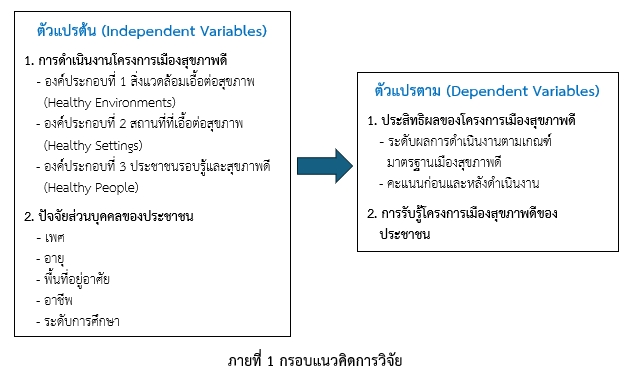
การวิจัยครั้งนี้มีวัตถุประสงค์เพื่อประเมินประสิทธิผลโครงการเมืองสุขภาพดีขององค์กรปกครองส่วนท้องถิ่นและศึกษาปัจจัยที่มีความสัมพันธ์กับการรับรู้โครงการของประชาชน โดยเป็นการวิจัยเชิงประเมินผล (Evaluation research) ที่ใช้การเปรียบเทียบผลก่อนและหลังการดำเนินงาน (Pre–post comparison) กลุ่มตัวอย่างประกอบด้วยองค์กรปกครองส่วนท้องถิ่น จำนวน 74 แห่ง และประชาชน จำนวน 109 คน เครื่องมือที่ใช้ในการวิจัย ได้แก่ แบบประเมินมาตรฐานเมืองสุขภาพดีและแบบสอบถามการรับรู้โครงการ ซึ่งมีค่าความเชื่อมั่นเท่ากับ 0.87 วิเคราะห์ข้อมูลโดยใช้สถิติเชิงพรรณนา ได้แก่ ความถี่ ร้อยละ ค่าเฉลี่ย และส่วนเบี่ยงเบนมาตรฐาน และสถิติเชิงอนุมาน ได้แก่ Paired t-test, Pearson's Chi-square test และ Fisher's Exact Test โดยกำหนดระดับนัยสำคัญทางสถิติที่ 0.05
ผลการวิจัยพบว่า ภาพรวมการดำเนินงานโครงการเมืองสุขภาพดีหลังดำเนินงานมีค่าเฉลี่ยสูงกว่าก่อนดำเนินงานอย่างมีนัยสำคัญทางสถิติ (p < 0.001) โดยคะแนนเฉลี่ยเพิ่มขึ้นจาก 31.81 (SD = 11.67) เป็น 37.70 (SD = 12.34) จากระดับน้อยเป็นระดับปานกลาง เมื่อพิจารณารายองค์ประกอบ พบว่า ด้านสิ่งแวดล้อมเอื้อต่อสุขภาพและด้านสถานที่ที่เอื้อต่อสุขภาพ มีค่าเฉลี่ยเพิ่มขึ้นอย่างมีนัยสำคัญทางสถิติ (p < 0.001) และอยู่ในระดับปานกลางถึงมาก ขณะที่ด้านประชาชนรอบรู้และสุขภาพดี แม้ว่าค่าเฉลี่ยจะเพิ่มขึ้นอย่างมีนัยสำคัญทางสถิติ (p < 0.001) แต่ยังคงอยู่ในระดับน้อย สำหรับปัจจัยที่มีความสัมพันธ์กับการรับรู้โครงการเมืองสุขภาพดี พบว่า พื้นที่ที่อยู่อาศัยและระดับการศึกษามีความสัมพันธ์อย่างมีนัยสำคัญทางสถิติ (p < 0.05) ในขณะที่เพศ อายุ และอาชีพไม่พบความสัมพันธ์อย่างมีนัยสำคัญทางสถิติ
การดำเนินงานโครงการเมืองสุขภาพดีมีส่วนช่วยยกระดับผลการดำเนินงานขององค์กรปกครองส่วนท้องถิ่นอย่างมีนัยสำคัญ อย่างไรก็ตาม ควรให้ความสำคัญกับการพัฒนาความรอบรู้ด้านสุขภาพของประชาชน ควบคู่กับการพัฒนาปัจจัยด้านสิ่งแวดล้อมพื้นฐาน เช่น การจัดการสิ่งปฏิกูลและการพัฒนาคุณภาพน้ำบริโภค เพื่อให้การพัฒนาเมืองสุขภาพดีเกิดความยั่งยืน
เอกสารอ้างอิง
กรมควบคุมโรค. (2565). รายงานสถานการณ์โรคและภัยสุขภาพจากสิ่งแวดล้อมในประเทศไทย. กระทรวงสาธารณสุข.
กรมอนามัย. (2566). แนวทางการพัฒนาเมืองสุขภาพดี (Healthy City) ของประเทศไทย. กระทรวงสาธารณสุข.
ศุภลักษณ์ ธนธรรมสถิต, นิสิต อินลี, และ สุทธิดา สืบทรัพย์. (2569). รูปแบบการพัฒนาองค์กรปกครองส่วนท้องถิ่นในเขตสุขภาพที่ 10 สู่การเป็นเมืองสุขภาพดีด้วยกลยุทธ์ PIRAB. วารสารการส่งเสริมสุขภาพและอนามัยสิ่งแวดล้อมล้านนา, 16(1), 56–70. สืบค้นจาก https://he01.tci-thaijo.org/index.php/lannaHealth/article/view/283495
Cochran, W. G. (1977). Sampling techniques (3rd ed.). John Wiley & Sons.
Green, L. W., & Kreuter, M. W. (2005). Health program planning: An educational and ecological approach (4th ed.). McGraw-Hill.
Harpham, T., Burton, S., & Blue, I. (2001). Healthy city projects in developing countries: The first evaluation. Health Promotion International, 16(2), 111–125. https://doi.org/10.1093/heapro/16.2.111
Krejcie, R. V., & Morgan, D. W. (1970). Determining sample size for research activities. Educational and Psychological Measurement, 30(3), 607–610. https://doi.org/10.1177/001316447003000308
Iamtrakul, P., & Chayphong, S. (2023). Factors affecting the development of a healthy city in suburban areas, Thailand. Journal of Urban Management, 12(2), 208–220. https://doi.org/10.1016/j.jum.2023.04.002
Lim, N. H. H., Hasnan, L., Zainal Abidin, N., Chowdhury, M. S., Abdul Jalil, N. A. S., & Hassan, L. S. (2023). Exploring the relationship between the perceived importance of healthy city indicators and satisfaction levels towards the local government in shaping a healthy city. Planning Malaysia, 21(29), 414–431. https://doi.org/10.21837/pm.v21i29.1380
Lwanga, S. K., & Lemeshow, S. (1991). Sample size determination in health studies: A practical manual. World Health Organization.
Nutbeam, D. (2000). Health literacy as a public health goal: A challenge for contemporary health education and communication strategies into the 21st century. Health Promotion International, 15(3), 259–267. https://doi.org/10.1093/heapro/15.3.259
Nutbeam, D. (2008). The evolving concept of health literacy. Social Science & Medicine, 67(12), 2072–2078. https://doi.org/10.1016/j.socscimed.2008.09.050
Putnam, R. D. (2000). Bowling alone: The collapse and revival of American community. Simon & Schuster.
World Health Organization. (2021). WHO global air quality guidelines. https://www.who.int/publications/i/item/9789240034228
Santa, S. L. B., Dias, F. T., Soares, T. C., Souza e Silva, R. S. M. de, Basil, D. G., & Andrade Guerra, J. B. S. O. de. (2023). Measurement model of healthy and sustainable cities: The perception regarding the Sustainable Development Goals. Sustainability, 15(20), Article 15004. https://doi.org/10.3390/su152015004
United Nations. (2015). Transforming our world: The 2030 agenda for sustainable development. https://sdgs.un.org/2030agenda
van Dijk, J. A. G. M. (2006). Digital divide research, achievements and shortcomings. Poetics, 34(4–5), 221–235. https://doi.org/10.1016/j.poetic.2006.05.004
World Health Organization. (1986). Ottawa charter for health promotion. https://www.who.int/publications/i/item/ottawa-charter-for-health-promotion
World Health Organization. (2016). Global report on urban health: Equitable healthier cities for sustainable development. https://www.who.int/publications/i/item/9789241565271
World Health Organization. (2021). WHO global air quality guidelines. https://www.who.int/publications/i/item/9789240034228
ดาวน์โหลด
เผยแพร่แล้ว
รูปแบบการอ้างอิง
ฉบับ
ประเภทบทความ
สัญญาอนุญาต
ลิขสิทธิ์ (c) 2026 วารสารการส่งเสริมสุขภาพและอนามัยสิ่งแวดล้อม ศูนย์อนามัยที 8 อุดรธานี

อนุญาตภายใต้เงื่อนไข Creative Commons Attribution-NonCommercial-NoDerivatives 4.0 International License.
บทความในวารสารนี้มีลิขสิทธิ์โดยและเผยแพร่ภายใต้สัญญาอนุญาต Creative Commons แบบแสดงที่มา-ไม่ใช้เพื่อการค้า-ไม่ดัดแปลง 4.0 ระหว่างประเทศ (CC BY-NC-ND 4.0)
สามารถอ่านและนำไปใช้เพื่อวัตถุประสงค์ทางวิชาการ เช่น การสอน การวิจัย หรือการอ้างอิง โดยให้เครดิตแก่ผู้เขียนและวารสารอย่างเหมาะสม
ห้ามใช้หรือดัดแปลงบทความโดยไม่ได้รับอนุญาต
ข้อความที่ปรากฏในบทความเป็นความคิดเห็นของผู้เขียนแต่เพียงผู้เดียว
ผู้เขียนต้องรับผิดชอบต่อเนื้อหาและความถูกต้องของบทความของตนทั้งหมด
การนำไปใช้ซ้ำหรือเผยแพร่ซ้ำในรูปแบบอื่นต้องได้รับอนุญาตจากวารสาร



