
Impact of advance care planning on the End-of-Life Care in the inpatient ward, Sam Roi Yod Hospital, Sam Roi Yod District, Prachuap Khiri Khan Province
Keywords:
advance care planning, terminally ill patients, satisfaction, quality of lifeAbstract
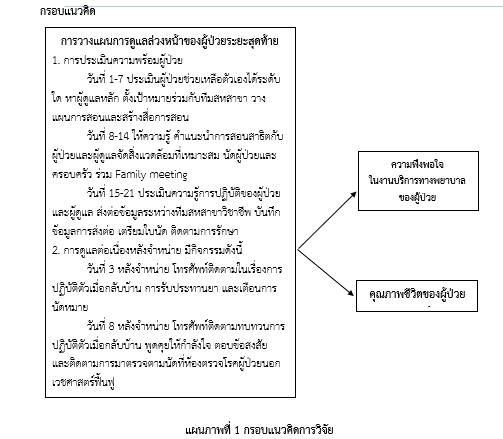
This research is a quasi-experimental research using a posttest-only design with nonequivalent groups to compare satisfaction with services. And compare the quality of life of terminally ill patients before and after using the integrated end-of-life care model. The results were measured once 2 weeks after the planned discharge. Compare before and after the experiment using Independent t-test statistics and compare the difference in mean scores. The sample group totaled 30 people, consisting of a pre-experiment group and a post-experiment group of 15 people each.
The results of the study found that average score of overall nursing service satisfaction between before and after using the integrated end-of-life care model The group before the experiment had different mean scores than after the experiment. Statistically significant (p-value 0.001; 95%CI: -26.53 to -19.61) mean post-discharge quality of life score for overall quality of life. Between before and after using the integrated end-of-life care model, it was found that the pre-experiment group had different mean scores than after the experiment. Statistically significant (p-value 0.001; 95%CI: -47.56 to -26.57) it can be seen that advance care planning affects care at the end of life in this ward. It can increase service satisfaction and improve the quality of life of patients.
Downloads
Published
How to Cite
Issue
Section
License
Copyright (c) 2024 https://www.tci-thaijo.org/Articles in this journal are copyrighted by the published under the Creative Commons Attribution-NonCommercial-NoDerivatives 4.0 International (CC BY-NC-ND 4.0) license.
may be read and used for academic purposes, such as teaching, research, or citation, with proper credit given to the author and the journal.
use or modification of the articles is prohibited without permission.
statements expressed in the articles are solely the opinions of the authors.
authors are fully responsible for the content and accuracy of their articles.
other reuse or republication requires permission from the journal."



