
Development of a consultation model for deciding on kidney replacement therapy under the Gold Card system for patients with end-stage renal disease. Kumphawapi Hospital
Keywords:
Counseling, kidney replacement therapy, gold card system, patient with end-stage renal diseaseAbstract
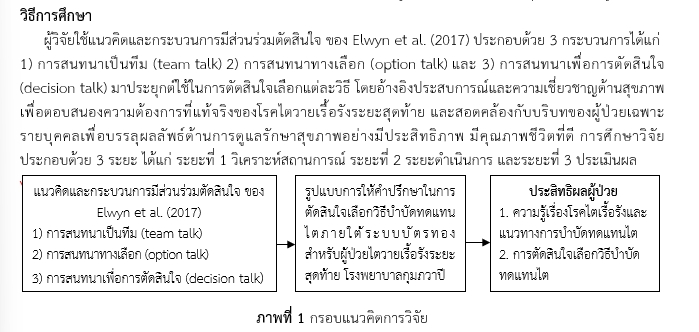
This research is a research and development study aimed at examining the situation and challenges in making decisions regarding renal replacement therapy under the gold patent system card system for patients with end-stage chronic kidney disease. The objective is to develop a consultation model and evaluate its effectiveness in decision-making for renal replacement therapy under the Universal Coverage Scheme for end-stage chronic kidney disease patients at Kumphawapi Hospital. The study applies the concept and process of shared decision-making by Elwyn et al. (2017) which consists of three key processes: 1) Team Talk 2) Option Talk and 3) Decision Talk. These processes are applied to assist patients in choosing their treatment method based on their experiences and healthcare expertise. The results indicate that after implementing the consultation model, the average knowledge score of the sample group significantly increased at a statistical significance level of 0.05. Prior to using the model, only 6.67% of patients opted for peritoneal dialysis. After implementation, the proportion increased to 23.53% for hemodialysis and 17.65% for peritoneal dialysis. However, it was found that most still refused kidney replacement therapy. Request palliative care which is caused by hidden expenses incurred from travel expenses Various personal expenses, lack of primary caregiver and don't want to be a burden on our caregiver. The consultation model for decision-making regarding renal replacement therapy under the Universal Coverage Scheme for end-stage chronic kidney disease patients at Kumphawapi Hospital can be utilized by healthcare personnel to provide guidance and counseling to patients, caregivers, and families. This enables patients to make informed decisions or plan long-term renal replacement therapy. Additionally, this model can be applied at the early stages of chronic kidney disease (Stage 4) to give patients and their families sufficient time to plan and carefully make decisions before reaching the final stage. This approach can help mitigate complications associated with end-stage kidney disease and reduce the severity of its impact.
Downloads
Published
How to Cite
Issue
Section
License
Articles in this journal are copyrighted by the published under the Creative Commons Attribution-NonCommercial-NoDerivatives 4.0 International (CC BY-NC-ND 4.0) license.
may be read and used for academic purposes, such as teaching, research, or citation, with proper credit given to the author and the journal.
use or modification of the articles is prohibited without permission.
statements expressed in the articles are solely the opinions of the authors.
authors are fully responsible for the content and accuracy of their articles.
other reuse or republication requires permission from the journal."



