
Effects of a Nutrition Literacy Promotion Program for Parents of Overweight School-Aged Children in Remote Schools in Health Region 4
Keywords:
Nutrition literacy, Health behavior, Overweight, Remote schoolsAbstract
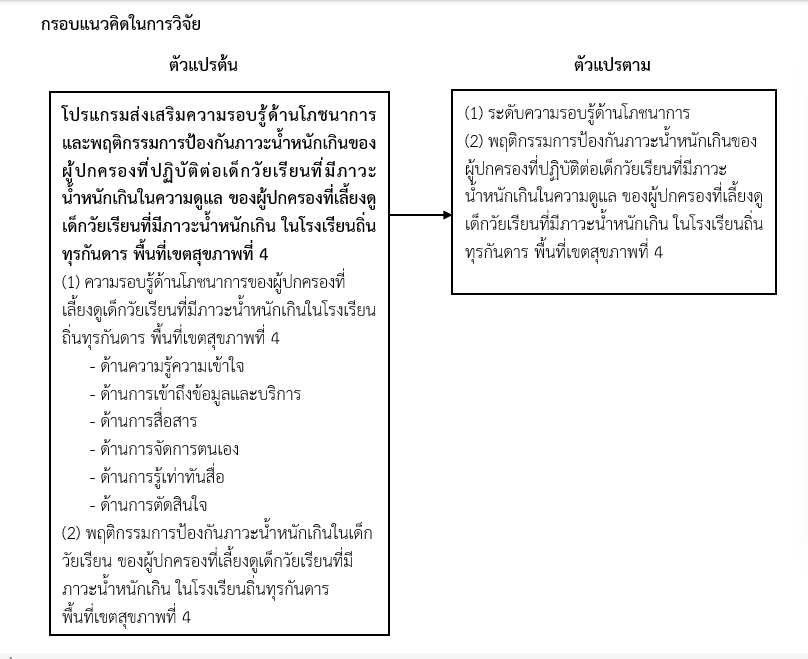
This study was a quasi-experimental one-group pretest–posttest design. The objectives were to evaluate the level of nutrition literacy, to assess preventive behaviors against overweight, and to study the effect of the level of nutrition literacy on preventive behaviors against overweight of parents in remote schools in Health Region 4. The sample consisted of parents of school-aged children with overweight in remote schools in Health Region 4, totaling 96 persons. The study was conducted using a nutrition literacy and overweight prevention promotion program. Data were collected using questionnaires. The data were analyzed by comparing pretest and posttest scores with inferential statistics Paired t-test, and the relationship between literacy and behaviors was analyzed using Pearson correlation.
The results showed that after participating in the program, the average nutrition literacy score increased from 52.4% to 76.7%, particularly media literacy which increased by 35.0% and self-management which increased by 29.3%. Preventive behaviors against overweight increased from 54.4% to 79.3%, which was statistically significant. The analysis of behavioral change found that 78.1% of parents improved preventive behaviors against overweight in children. Nutrition literacy was positively correlated with preventive behaviors against overweight at a moderate level (r = 0.52, p < 0.001), with media literacy and self-management being the most important factors.
It can be concluded that the nutrition literacy promotion program could increase both knowledge level and behaviors of parents, and is an important approach in preventing overweight and non-communicable diseases in school-aged children.
References
กัลยา เจริญสุข. (2562). ความรอบรู้ด้านโภชนาการและพฤติกรรมการบริโภคอาหารของผู้ปกครองเด็กวัยเรียนในชนบท. วารสารวิจัยทางการพยาบาล, 37(2), 45–57.
กรมอนามัย กระทรวงสาธารณสุข. (2565). รายงานประจำปี เฝ้าระวังทางโภชนาการ 2565 [ออนไลน์]. สำนักโภชนาการ, กรมอนามัย. สืบค้นเมื่อ 26 ธันวาคม 2568 จาก https://nutrition2.anamai.moph.go.th/th/ebnutritionsurveillance/4261#wow-book/
กรมอนามัย กระทรวงสาธารณสุข. (2567). แผนปฏิบัติราชการรายปี (พ.ศ. 2567) ของกรมอนามัย: มุ่งเน้นให้ประชาชนทุกกลุ่มวัยมีคุณภาพชีวิตที่ดี ภายใต้การจัดการสภาพแวดล้อมที่เอื้อต่อการมีสุขภาพดี โดยมีความรอบรู้ทางสุขภาพ สามารถจัดการตนเองได้. สืบค้นจาก https://planning.anamai.moph.go.th/th/government-action-plan/download?did=28679&id=114045&lang=th&mid=35347&mkey=m_document
กองสุขศึกษา กรมสนับสนุนบริการสุขภาพ. (2557). คู่มือประเมินความรอบรู้ด้านสุขภาพสำหรับเด็กและเยาวชนไทยที่มีภาวะน้ำหนักเกิน. กระทรวงสาธารณสุข. สืบค้นจาก https://hed.hss.moph.go.th/wp-content/uploads/2024/06/คู่มือประเมินความรอบรู้ด้านสุขภาพสำหรับเด็กและเยาวชนไทยที่มีภาวะน้ำหนักเกิน.pdf
สำนักงานโครงการสมเด็จพระเทพรัตนราชสุดาฯ สยามบรมราชกุมารี. (2560). แผนพัฒนาเด็กและเยาวชนในถิ่นทุรกันดารตามพระราชดำริ ฉบับที่ 5 พ.ศ. 2560–2569. สำนักพระราชวัง สวนจิตรลดา. จาก https://ayo.moph.go.th/health/file_upload/subblocks/...ฉบับที่%205.pdf
สุนีย์ แสงทอง. (2564). ผลของการส่งเสริมทักษะการจัดการตนเองของผู้ปกครองต่อภาวะโภชนาการในประเด็นประถมศึกษา. วารสารสุขภาพชุมชน, 49(3), 112–125.
National Health Commission Office. (2020). Thailand NCD prevention and control plan 2020–2025. National Health Commission Office.
Nutbeam, D. (2008). The evolving concept of health literacy. Social Science & Medicine, 67(12), 2072–2078. from https://doi.org/10.1016/j.socscimed.2008.09.050
Sørensen, K., Van den Broucke, S., Fullam, J., Doyle, G., Pelikan, J., Slonska, Z., & Brand, H. (2012). Health literacy and public health: A systematic review and integration of definitions and models. BMC Public Health, 12, Article 80. from https://doi.org/10.1186/1471-2458-12-80
World Health Organization. (1998). Health promotion glossary (WHO/HPR/HEP/98.1). World Health Organization. from https://apps.who.int/iris/bitstream/handle/10665/64546/WHO_HPR_HEP_98.1.pdf?sequence=1
World Health Organization. (2017). Global overview child malnutrition. World Health Organization. from https://www.who.int/data/gho/data/themes/topics/joint-child-malnutrition-estimates-unicef-who-wb
Downloads
Published
How to Cite
Issue
Section
License
Copyright (c) 2025 Journal of Health Promotion and Environmental Health Research Health Promotion Centre 8 Udon Thani

This work is licensed under a Creative Commons Attribution-NonCommercial-NoDerivatives 4.0 International License.
Articles in this journal are copyrighted by the published under the Creative Commons Attribution-NonCommercial-NoDerivatives 4.0 International (CC BY-NC-ND 4.0) license.
may be read and used for academic purposes, such as teaching, research, or citation, with proper credit given to the author and the journal.
use or modification of the articles is prohibited without permission.
statements expressed in the articles are solely the opinions of the authors.
authors are fully responsible for the content and accuracy of their articles.
other reuse or republication requires permission from the journal."



