
The model development on prediction and surveillance system from landfill fire emergency crisis
Keywords:
A system for forecasting, assessing risk, monitoring, identifying risk factors associated with landfill firesAbstract
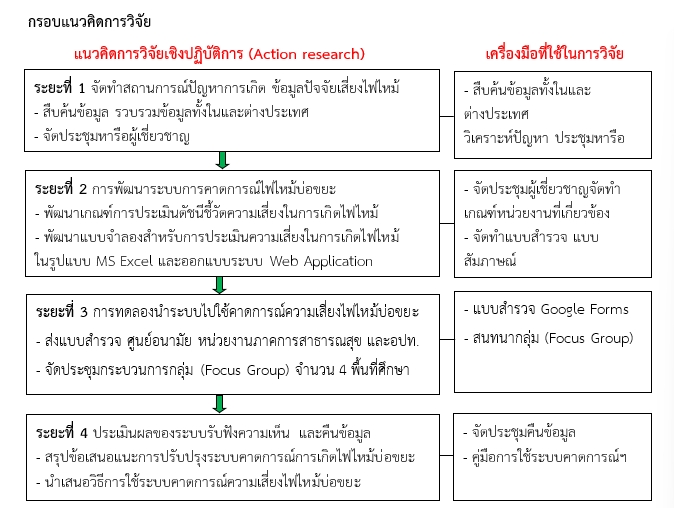
This study on developing a forecasting and risk assessment system for landfill fires, enhancing surveillance to reduce public health risks, aims to: 1. Develop a forecasting and risk assessment system; 2. Identify risk factors linked to landfill fires; and 3. Develop a model and mechanism for the forecasting and risk assessment system. The research was conducted as an action research project in four phases: Phase 1: Analyzing the landfill fire problem; Phase 2: Developing the forecasting system; Phase 3: Piloting the system; and Phase 4: Evaluating the system and gathering feedback. The study was conducted between September 2023 and September 2025. Statistical analysis included descriptive statistics, frequency distribution, percentages, means, content analysis, and thematic analysis.
The results showed that: Phase 1 identified risk factors for landfill fires as: 1. Physical factors and landfill management; and 2. Factors related to landfill regulation and control. Phase 2 involved developing a landfill fire forecasting system using MS Excel and designing a web application. Phase 3 involved piloting the landfill fire risk forecasting system and surveying landfill fire risk data for local administrative organizations, with suggestions for further tool development. The research was conducted in five phases: Phase 1 involved five stages: Phase 1: 1) Questions in the risk assessment tool; Phase 2: Interpretation of results after assessment; Phase 3: Tools or systems used; Phase 4: Training and capacity building for staff; and Phase 5: Coordination and management after using the risk assessment tool. Phase 2 involved focus group discussions in four provinces (Pathum Thani, Nakhon Pathom, Phra Nakhon Si Ayutthaya, and Prachuap Khiri Khan). The main causes of landfill fires were identified as stemming from environmental factors conducive to ignition, such as dryness and highly flammable waste, as well as human behavior, such as intentionally burning waste or unintentionally disposing of flammable materials. Many landfills lack access control systems, fences, sanitary burial practices, and continuous management. This aligns with literature reviews and concepts related to waste management and health in emergencies, particularly regarding fires caused by the accumulation of methane gas and chemical reactions in waste piles (which occur naturally), as well as illegal burning by outsiders. Phase 3 involved feedback and consultation, including presentations of research findings, basic knowledge about landfill fires, the development of a system for predicting and assessing landfill fire risk, and practical training in using the system. Enhance surveillance to reduce public health risks.
References
กระทรวงดิจิทัลเพื่อเศรษฐกิจและสังคม. (2566). รัฐมนตรี DE ร่วมกับ กสทช. ทำทันที การแจ้งเตือนภัยแบบเจาะจงด้วยเทคโนโลยี cell broadcast . สืบค้นเมื่อ 30 เมษายน 2567, จาก https://www.mdes.go.th/news/detail/7449
กรมควบคุมมลพิษ. (2555). คู่มือแนวทางการระงับเหตุไฟไหม้ในสถานที่กำจัดขยะมูลฝอย. กรุงเทพฯ: ส่วนขยะและสิ่งปฏิกูล สำนักจัดการกากของเสียและสารอันตราย กรมควบคุมมลพิษ.
กรมควบคุมมลพิษ. (2566). คพ. เตือนไฟไหม้บ่อขยะบ่อยครั้ง. สืบค้นเมื่อ 30 เมษายน 2567, จาก https://www.pcd.go.th/pcd_news/28570
กรมควบคุมโรค. (2559). แนวทางการเตรียมความพร้อมโต้ตอบภาวะฉุกเฉินด้านสาธารณสุข: กรณีไฟไหม้บ่อขยะ. กรุงเทพฯ: กระทรวงสาธารณสุข.
กรมป้องกันและบรรเทาสาธารณภัย. (2566). 4 แอปพลิเคชันแจ้งเตือนภัย ติดตามข้อมูล และขอความช่วยเหลือฉุกเฉิน. สืบค้นเมื่อ 15 พฤษภาคม 2567, จาก https://relation.disaster.go.th/PRDPM/cms/6284?id=96468
กรมป้องกันและบรรเทาสาธารณภัย. (2567). ข่าวสาธารณภัย. สืบค้นเมื่อ 10 พฤษภาคม 2567, จาก https://dpmreporter.disaster.go.th/portal/disaster-news
ชำนาญ พฤฒิพงศ์พิบูลย์. (2562). การศึกษาความเป็นไปได้ในการลงทุนสร้างระบบเฝ้าระวังเหตุอัคคีภัยด้วยเทคโนโลยีอินเทอร์เน็ตของสรรพสิ่ง: กรณีศึกษาโรงงานผลิตเครื่องประดับ (วิทยานิพนธ์ปริญญามหาบัณฑิต). ปทุมธานี: มหาวิทยาลัยธรรมศาสตร์.
พัทธยาพร อุ่นโรจน์, และ สุจิตรา วาสนาดำรงดี. (2565). กระจายอำนาจสู่ชุมชน: หนทางสู่การจัดการขยะอย่างยั่งยืน กรณีศึกษาเทศบาลนครขอนแก่นและเทศบาลตำบลเวียงเทิง, 26(4), 1–8.
ระบบสารสนเทศด้านการจัดการขยะมูลฝอยของชุมชน. (2566). ข้อมูลสถานการณ์ขยะมูลฝอยของประเทศ. สืบค้นเมื่อ 30 เมษายน 2567, จาก https://thaimsw.pcd.go.th/
ริเรืองรอง รัตนวิไลสกุล, วิภาวี เอี่ยมวรเมธ, ภาสนันทน์ อัศวรักษ์, และคณะ. (2557). บ่อขยะแพรกษา: มาตรการทางกฎหมายเกี่ยวกับการควบคุมดูแลบ่อขยะขององค์กรปกครองส่วนท้องถิ่นและการเยียวยาประชาชนผู้ได้รับผลกระทบจากไฟไหม้บ่อขยะจังหวัดสมุทรปราการ, (43), 43–54.
สุชาติ เดชพิทักษ์. (2561). ปัญหากฎหมายในการจัดการขยะในลักษณะเปิด: กรณีศึกษาไฟไหม้บ่อขยะ (วิทยานิพนธ์ปริญญามหาบัณฑิต). ชลบุรี: มหาวิทยาลัยบูรพา.
สัจจพล พงษ์ภมร, และ สุรชัย โชคครรชิตไชย. (2557). ปัญหามลพิษที่เกิดจากขยะ, 4(3), 252–260.
Blackstone Environmental. (2020). Landfill fires increase: Know the risks. Retrieved July 5, 2024, from https://blackstone-env.com/landfill-fires-increase-know-risks/
Chemtrack. (2023). Chemical accident statistics. Retrieved May 30, 2024, from http://www.chemtrack.org/stat-accident-list.asp
Dampage, U., Bandaranayake, L., Wanasinghe, R., Kottahachchi, K., & Jayasanka, B. (2022). Forest fire detection system using wireless sensor networks and machine learning. Scientific Reports, 12, 46. https://doi.org/10.1038/s41598-021-03882-9
Institute for Sustainable Futures. (2016). Waste fires in Australia: Cause for concern?
International Journal of Disaster Risk Reduction. (2023). Forest fire detection. retrieved May 30, 2024, from https://www.sciencedirect.com/topics/earth-and-planetary-sciences/forest-fire-detection
Line ประเทศไทย. (2565). LINE ALERT ระบบแจ้งเตือนภัยพิบัติ. สืบค้นเมื่อ 15 กรกฎาคม 2567, จาก https://linecorp.com/th/pr/news/th/2022/4368
Rabrin, S. (2018). Development of a subsurface landfill fire risk-index (Master’s thesis). Rowan University. Retrieved from https://rdw.rowan.edu/etd/2599
Sathishkumar, V. E., Cho, J., Subramanian, M., & Naren, O. S. (2023). Forest fire and smoke detection using deep learning. Fire Ecology, 19, 9. https://doi.org/10.1186/s42408-022-00165-0
Saleh, A., Zulkifley, M. A., Harun, H. H., Gaudreault, F., Davison, I., & Spraggon, M. (2024). Forest fire surveillance systems: A review of deep learning methods. Heliyon, 10(1), e23127. https://doi.org/10.1016/j.heliyon.2023.e23127
Theisaander. (2566). ปี 62 แค่ 4 เดือน ไฟไหม้บ่อขยะแล้ว 15 ครั้ง. สืบค้นเมื่อ 30 สิงหาคม 2567, จาก https://www.theisaander.com/post/190501burntrash
U.S. Fire Administration. (2001). Landfill fires (Vol. 1, Issue 18).
Downloads
Published
How to Cite
Issue
Section
License
Copyright (c) 2026 Journal of Health Promotion and Environmental Health Research Health Promotion Centre 8 Udon Thani

This work is licensed under a Creative Commons Attribution-NonCommercial-NoDerivatives 4.0 International License.
Articles in this journal are copyrighted by the published under the Creative Commons Attribution-NonCommercial-NoDerivatives 4.0 International (CC BY-NC-ND 4.0) license.
may be read and used for academic purposes, such as teaching, research, or citation, with proper credit given to the author and the journal.
use or modification of the articles is prohibited without permission.
statements expressed in the articles are solely the opinions of the authors.
authors are fully responsible for the content and accuracy of their articles.
other reuse or republication requires permission from the journal."



