
Factors Associated with 3Aor 2Sor Health-Promoting Behaviors among Village Health Volunteers in Chao Chet Sub-district, Sena District, Phra Nakhon Si Ayutthaya Province
Abstract
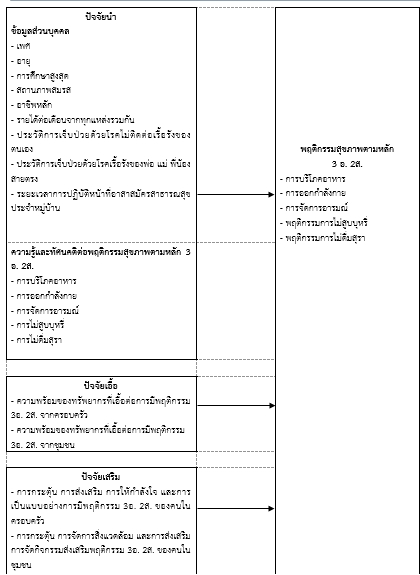
This cross-sectional descriptive study aimed to investigate the factors associated with health behaviors based on the 3Aor 2Sor principle (Eating, Exercise, Emotion, Smoking cessation, and Alcohol reduction) among Village Health Volunteers (VHVs) in Chao Chet Sub-district, Sena District, Phra Nakhon Si Ayutthaya Province. The sample consisted of 73 VHVs, selected through purposive sampling. Data were collected using a multiple-choice questionnaire, which was validated for Content Validity by three experts (IOC: 0.67 – 1.00). The instrument’s reliability was tested with 30 individuals with characteristics similar to the study sample.The knowledge questionnaire demonstrated acceptable reliability with a KR-20 coefficient of 0.76. The questionnaires assessing attitudes, enabling factors, reinforcing factors, and health behaviors were analyzed using Cronbach’s alpha coefficient, yielding an overall reliability of 0.87. Data analysis was performed using descriptive statistics,while relationships between variables were examined using the Chi-square test and Fisher’s exact test in cases where more than 20% of the expected cell counts were less than 5. The results revealed that the majority of the participants were female (86.30%) and primarily elderly (58.90%). Two-thirds of the sample suffered from non-communicable diseases (NCDs) (68.49%). Most participants demonstrated high levels of knowledge (69.86%) and positive attitudes (79.54%). Regarding external factors, enabling factors were reported at a moderate level (49.32%), while reinforcing factors were at a high level (72.60%). More than half of the participants (57.53%) exhibited overall health behaviors based on the 3Aor 2Sor principle at a moderate level. When categorized by dimension, the highest-rated behaviors were emotional management (84.93%), followed by alcohol avoidance (64.38%) and smoking cessation (60.27%). The analysis revealed that predisposing factors, including gender, presence of non-communicable diseases, and level of knowledge, as well as reinforcing factors, were significantly associated with health behaviors based on the 3A 2S principles (p < 0.05)
The findings reflect that knowledge management models must account for gender differences and health status. Crucially, reinforcing factors from families, communities, and society play a vital role in shaping individuals' attitudes and behaviors. Consequently, Sub-District Health-Promoting Hospitals alone cannot effectively drive communities toward a healthy society. It is imperative to engage families and communities in promoting health behaviors to foster positive motivation. This engagement establishes social norms that transform health maintenance from a perceived burden into a collective recreational activity. Notably, health promotion among Village Health Volunteers must account for gender differences, literacy levels, and individual health statuses, alongside strengthening support from families, communities, and the healthcare system. Such a multi-dimensional approach is essential for achieving appropriate and sustainable behavioral changes.
References
กรมสนับสนุนบริการสุขภาพ. (2556). คู่มือ อสม. นักจัดการสุขภาพชุมชน. กรุงเทพฯ: กระทรวงสาธารณสุข.
กรมสนับสนุนบริการสุขภาพ. (2568). คู่มือการฝึกอบรมสำหรับครูฝึกอบรมอาสาสมัครสาธารณสุขประจำหมู่บ้าน (อสม.) ในการส่งเสริมสุขภาพประชาชนห่างไกลโรคไม่ติดต่อเรื้อรัง (NCDs) (Ver. 16 Jan. 2025). กรุงเทพฯ: กระทรวงสาธารณสุข.
กิติพงษ์ เรือนเพ็ชร, สุภิศา ขําเอนก, อภิสรากรณ์ หิรัณย์วิชญกุล, สุวรัตน์ ธีระสุต, และศิริลักษณ์ สุวรรณวงษ์. (2566). ความรอบรู้ด้านสุขภาพและพฤติกรรมสุขภาพ 3อ. 2ส. ของนิสิตพยาบาลมหาวิทยาลัยเอกชนแห่งหนึ่งในจังหวัดบุรีรัมย์. วารสารศูนย์อนามัยที่ 9, 17(1), 1–12.
เกียรติพงษ์ อุดมธนะธีระ. (2565). ปิรามิดความรู้ (Knowledge Pyramid). Iok2u. [ออนไลน์] สืบค้นเมื่อ 22 กรกฎาคม 2568, จาก https://www.iok2u.com/article/business-administrator/knowledge-pyramid
จงรัก เพ็งชัย. (2566). ปัจจัยที่มีผลต่อพฤติกรรมสุขภาพตามหลัก 3อ. 2ส. 1ย. ของผู้ป่วยโรคเบาหวานชนิดที่ 2 อำเภอขาณุวรลักษบุรี จังหวัดกำแพงเพชร [วิทยานิพนธ์ปริญญามหาบัณฑิต, มหาวิทยาลัยนเรศวร]. สืบค้นเมื่อ 22 กรกฎาคม 2568, จาก https://nuir.lib.nu.ac.th/dspace/handle/123456789/6137
นพมาศ โกศล, ประนอม อุบลกาญจน์, เชาวลิต ลิ่มวิจิตรวงศ์, และนิติยา ศิริแก้ว. (2562). ความรอบรู้ด้านสุขภาพและพฤติกรรมสุขภาพ 3อ. 2ส. ของกลุ่มวัยทำงาน สำหรับหมู่บ้านจัดการสุขภาพ: กรณีศึกษาชุมชนบ้านวังหิน อำเภอทุ่งใหญ่ จังหวัดนครศรีธรรมราช. ใน รายงานสืบเนื่องจากการประชุมหาดใหญ่วิชาการระดับชาติและนานาชาติครั้งที่ 10 (น. 1600–1611). มหาวิทยาลัยหาดใหญ่.
นรลักขณ์ เอื้อกิจ และลัดดาวัลย์ เพ็ญศรี. (2566). การประยุกต์ใช้แนวคิด PRECEDE MODEL ในการสร้างเสริมสุขภาพ. วารสารพยาบาลสภากาชาดไทย, 12(1), 38–48.
นิธินันท์ เจริญบัณฑิตย์. (2559). ปัจจัยที่มีความสัมพันธ์กับพฤติกรรมการสร้างเสริมสุขภาพของอาสาสมัครสาธารณสุขประจำหมู่บ้าน (อสม.) อำเภอบ้านค่าย จังหวัดระยอง [วิทยานิพนธ์ปริญญามหาบัณฑิต, มหาวิทยาลัยบูรพา].
โรงพยาบาลส่งเสริมสุขภาพตำบลเจ้าเจ็ด. (2568). โปรแกรมระบบข้อมูลข่าวสารสาธารณสุข (HOSxP PCU) [ซอฟต์แวร์].
วิชัย เอกพลากร. (2564). การสำรวจสุขภาพประชาชนไทยโดยการตรวจร่างกาย ครั้งที่ 6 ปี พ.ศ. 2562–2563. กรุงเทพฯ: อักษรกราฟฟิกแอนด์ดีไซน์.
วิวัฒน์ โรจนพิทยากร. (2564). ความรอบรู้ทางสุขภาพ สอนอย่างไรให้จำ. วารสารวิชาการสาธารณสุข, 30(2), 195–196.
ศูนย์วิจัยและสนับสนุนเป้าหมายการพัฒนาที่ยั่งยืน. (ม.ป.ป.). ข้อมูลเบื้องต้นเกี่ยวกับ SDGs. SDG Move. สืบค้นเมื่อ 22 กรกฎาคม 2568, จาก https://www.sdgmove.com/intro-to-sdgs/
สมจิตร จาอินต๊ะ. (2560). ปัจจัยที่มีความสัมพันธ์กับพฤติกรรมสุขภาพของอาสาสมัครสาธารณสุขประจำหมู่บ้านตำบลป่าซาง อำเภอแม่จัน จังหวัดเชียงราย. วารสารสุขภาพภาคประชาชน, 12(1), 30–35.
สุชาดา สุรางค์กุล. (2563). การจัดการความรู้ (Knowledge Management). คณะศิลปะศาสตร์ มหาวิทยาลัยกาฬสินธุ์.
สำนักงานสาธารณสุขจังหวัดพระนครศรีอยุธยา. (2568). ระบบคลังข้อมูลด้านการแพทย์และสาธารณสุข. สืบค้นเมื่อ 22 กรกฎาคม 2568, จาก https://hdc.moph.go.th/aya/public/standard-report-detail/13ab7a06119fac83195261fb634ac369
อารีย์ แร่ทอง. (2562). ความรอบรู้ด้านสุขภาพและพฤติกรรมสุขภาพ 3อ. 2ส. ของอาสาสมัครสาธารณสุขประจำหมู่บ้าน กรณีศึกษาตำบลหินตก อำเภอร่อนพิบูลย์ จังหวัดนครศรีธรรมราช. วารสารวิชาการกรมสนับสนุนบริการสุขภาพ, 15(3), 62–70.
Best, J. W. (1977). Research in education (3rd ed.). Englewood Cliffs, NJ: Prentice-Hall.
Bloom, B. S. (1976). Human characteristics and school learning. New York: McGraw-Hill.
World Health Organization. (2024). Noncommunicable diseases. [ออนไลน์] Retrieved August 2, 2025, from https://www.who.int/news-room/fact-sheets/detail/noncommunicable-diseases
Downloads
Published
How to Cite
Issue
Section
License
Copyright (c) 2026 Journal of Health Promotion and Environmental Health Research Health Promotion Centre 8 Udon Thani

This work is licensed under a Creative Commons Attribution-NonCommercial-NoDerivatives 4.0 International License.
Articles in this journal are copyrighted by the published under the Creative Commons Attribution-NonCommercial-NoDerivatives 4.0 International (CC BY-NC-ND 4.0) license.
may be read and used for academic purposes, such as teaching, research, or citation, with proper credit given to the author and the journal.
use or modification of the articles is prohibited without permission.
statements expressed in the articles are solely the opinions of the authors.
authors are fully responsible for the content and accuracy of their articles.
other reuse or republication requires permission from the journal."



