
Evaluation of Food Poisoning Prevention Performance in Schools
Keywords:
School , Food Poisoning, Evaluation, CIPP modelAbstract
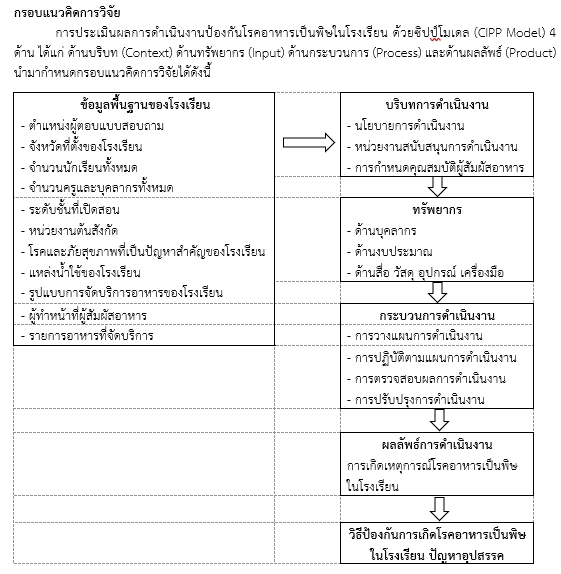
This evaluation study employed the CIPP Model to assess the implementation of food poisoning prevention programs in schools across four dimensions: context, input, process, and product, as well as to examine stakeholders’ opinions. The study sample comprised schools under the Office of the Basic Education Commission, the Office of the Private Education Commission, the Bangkok Metropolitan Administration, and the Department of Local Administration. A convenience sampling method was employed, resulting in a total of 9,996 schools. Data were collected using a structured questionnaire consisting of multiple-choice and open-ended items. Content validity was assessed by three experts (IOC: 0.67 – 1.00). The questionnaire was pilot-tested in 30 schools in Sa Kaeo Province. Reliability was assessed using Cronbach’s alpha, yielding a coefficient of 0.92 for the context, input, and process components. Quantitative data were analyzed using descriptive statistics, while qualitative opinion data were analyzed through content analysis and thematic categorization. The findings indicated that most schools were small (56.59%) and affiliated with the Office of the Basic Education Commission (72.54%). Respiratory diseases were identified as the most significant health problem (48.57%). The overall performance evaluation using the CIPP Model was at a high level (= 2.57). When considering individual components, the input dimension yielded the highest mean score (
= 2.61), followed by the context dimension (
= 2.59), and the process dimension (
= 2.50), respectively. Regarding outcomes over the past year, the occurrence of food poisoning incidents in schools was low (4.24%). The primary causes of illness were attributed to improper health behaviors among students, teachers, or school personnel (37.03%). Regarding preventive measures, approximately one-fifth of respondents (21.92%) reported not knowing how to prevent food poisoning, indicating a knowledge gap among teachers and school staff. Therefore, the Department of Disease Control should collaborate with relevant public health agencies and educational institutions to develop clear, user-friendly, practical guidelines that enable personnel at all levels to effectively implement surveillance and prevention measures in a concrete, sustainable manner.
References
กรมควบคุมโรค กองระบาดวิทยา. (2568). โปรแกรมเฝ้าระวังเหตุการณ์โรคและภัยสุขภาพ. สืบค้น 27 มกราคม 2568, จาก https://mebs-ddce.ddc.moph.go.th/auth/login
กรมอนามัย กระทรวงสาธารณสุข. (2563). คู่มือมาตรฐานการสุขาภิบาลอาหารในสถานศึกษา. นนทบุรี: สำนักสุขาภิบาลอาหารและน้ำ กรมอนามัย.
กองโรคติดต่อทั่วไป กรมควบคุมโรค. (2563). คู่มือแนวทางสำหรับครู เรื่องการป้องกันควบคุมโรคอาหารเป็นพิษในโรงเรียน (ฉบับปรับปรุงครั้งที่ 3, พิมพ์ครั้งที่ 1). นนทบุรี: ทีเอส อินเตอร์พริ้นท์.
กิตติยา สุวรรณสิงห์ และคณะ. (2563). การประเมินโครงการส่งเสริมความรอบรู้ด้านสุขาภิบาลอาหารและน้ำในโรงเรียนประถมศึกษา. วารสารอนามัยสิ่งแวดล้อมและสุขภาพชุมชน, 5(2), 45–58.
กุสุมา ผิวขาว. (2561). การประเมินโครงการโรงเรียนส่งเสริมสุขภาพและความปลอดภัยด้านอาหารโดยใช้ซิปป์โมเดล. รายงานการวิจัยและพัฒนาโรงเรียนปลอดภัย, 12(1), 112–125.
ประกาศกระทรวงสาธารณสุข เรื่อง หลักเกณฑ์ และวิธีการจัดการอบรมผู้ประกอบกิจการและผู้สัมผัสอาหาร พ.ศ. 2561. (2561, 12 มิถุนายน). ราชกิจจานุเบกษา, 135(ตอนพิเศษ 135 ง), 11–20.
ประสิทธิ์ นิลมาลา. (2565). ประสิทธิผลของการเฝ้าระวังโรคอาหารเป็นพิษในสถานศึกษาเขตพื้นที่ภาคตะวันออกเฉียงเหนือ. วารสารควบคุมโรคและระบาดวิทยาภาคพื้นดิน, 10(3), 20–35.
พรสุดา ผานุการณ์, พีระยา สมชัยยานนท์, วันพร ศรีเลิศ, อินจิรา นิยมธูร, และ สายพิณ ไชยนันทน์. (2563). การพัฒนาระบบการจัดการความปลอดภัยของอาหารในโรงเรียนสังกัดกรุงเทพมหานคร. วารสารนวัตกรรมและเทคโนโลยีเพื่อการเรียนรู้, 3(2), 52–61. จาก https://foodsanitation.bangkok.go.th/document/detail/3
วิรัลพัชร มั่นจริง. (2564). ปัจจัยที่มีความสัมพันธ์กับพฤติกรรมสุขวิทยาส่วนบุคคลของผู้สัมผัสอาหารในโรงเรียนสังกัดกรุงเทพมหานคร. วารสารนวัตกรรมและการจัดการ, 6(ฉบับพิเศษ), 44–56.
ศศินา บุตรนคร และอุไรวรรณ อินทร์ม่วง. (2564). สถานการณ์สุขาภิบาลอาหารและน้ำบริโภคในโรงเรียนพื้นที่ตำบลศิลา อำเภอเมือง จังหวัดขอนแก่น. วารสารวิจัย มข. (ฉบับบัณฑิตศึกษา), 21(2), 68–79.
สำนักงานคณะกรรมการการศึกษาขั้นพื้นฐาน. (2568). ประกาศสำนักงานคณะกรรมการการศึกษาขั้นพื้นฐาน เรื่อง ขนาดสถานศึกษาสำหรับการย้ายผู้บริหารสถานศึกษา ประจำปี พ.ศ. 2568. สืบค้น 24 มีนาคม 2568, จาก https://otepc.go.th
Best, J. W. (1977). Research in education (7th ed.). Englewood Cliffs, NJ: Prentice-Hall.
Cochran, W. G. (1977). Sampling techniques (3rd ed.). John Wiley & Sons.
Fullan, M. (2016). The new meaning of educational change (5th ed.). Teachers College Press.
Julrach, P., Phupinyokul, M., & Wongtong, O. (2016). The sanitation of dessert and beverage shops and cafeterias environment in high school in Sakon Nakhon Province [Master’s thesis, Kasetsart University].
StatSmartly. (n.d.). Cochran sample size calculator. retrieved January 27, 2025, from https://statsmartly.com/Pop/Cochran.php
The School Meals Coalition. (n.d.). Scaling up healthy school meals for every child by 2030. retrieved January 27, 2025, from https://schoolmealscoalition.org/about
World Health Organization. (2021, November 16). UN agencies back bold plan to ensure every child in need gets a regular healthy meal in school by 2030. https://www.who.int/news/item/16-11-2021-un-agencies-back-bold-plan-to-ensure-every-child-in-need-gets-a-regular-healthy-meal-in-school-by-2030
World Health Organization. (2008). International health regulations (2005) (3rd ed.).
World Health Organization. (2022, October 12). WHO global strategy for food safety 2022–2030: Towards stronger food safety systems and global cooperation. retrieved January 27, 2025, from https://www.who.int/publications/i/item/9789240057685
World Health Organization. (2024a, October 4). Food safety. retrieved January 27, 2025, from https://www.who.int/news-room/fact-sheets/detail/food-safety
World Health Organization. (n.d.). Estimating the burden of foodborne diseases [ออนไลน์]. Retrieved January 27, 2025, from https://www.who.int/activities/estimating-the-burden-of-foodborne-diseases
World Health Organization. (2024b, March 7). Diarrhoeal disease. retrieved January 27, 2025, from https://www.who.int/news-room/fact-sheets/detail/diarrhoeal-disease
Downloads
Published
How to Cite
Issue
Section
License
Copyright (c) 2026 Journal of Health Promotion and Environmental Health Research Health Promotion Centre 8 Udon Thani

This work is licensed under a Creative Commons Attribution-NonCommercial-NoDerivatives 4.0 International License.
Articles in this journal are copyrighted by the published under the Creative Commons Attribution-NonCommercial-NoDerivatives 4.0 International (CC BY-NC-ND 4.0) license.
may be read and used for academic purposes, such as teaching, research, or citation, with proper credit given to the author and the journal.
use or modification of the articles is prohibited without permission.
statements expressed in the articles are solely the opinions of the authors.
authors are fully responsible for the content and accuracy of their articles.
other reuse or republication requires permission from the journal."



