
Prevalence of Palliative Care Utilization Among Eligible Patients in Intensive and Intermediate Care Units of the Department of Internal Medicine, Udonthani Hospital
Keywords:
palliative care , internal medicine , advance care planningAbstract
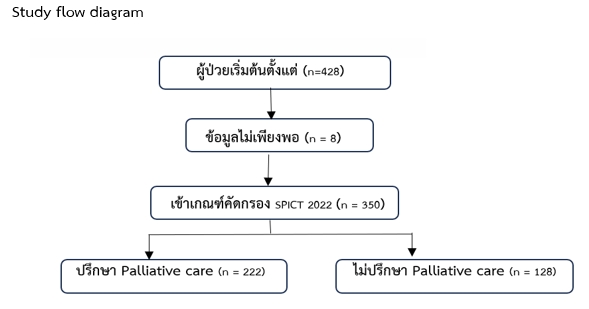
Palliative care is a holistic approach that aims to relieve suffering from both disease and non-beneficial medical interventions. It can be initiated early in the disease trajectory alongside curative treatment and continued until the end of life and facilitating a peaceful death. Previous studies have shown that critically ill patients have limited access to palliative care compared with their actual needs. This study aimed to determine the prevalence of palliative care among patients meeting the Supportive and Palliative Care Indicators Tool (SPICT) Criteria 2022 and to examine the association between palliative care and invasive interventions in intensive and intermediate care units. This study is a cross-sectional study was conducted among patients admitted on the first day to intensive care and intermediate care units in the Department of Internal Medicine, Udon Thani Hospital, between January 1, 2024 and June 30, 2024. A total of 350 patients who met the SPICT criteria were included. Data were collected from electronic medical records. Descriptive statistics were used to summarize baseline characteristics. Inferential analyses included Chi-square test, Fisher’s exact test, Independent t-test, or Mann–Whitney U test, as appropriate. Multivariable logistic regression analysis was performed to identify factors associated with receiving palliative care. Results were reported as odds ratios (ORs) with 95% confidence intervals (CIs). Statistical significance was set at p < 0.05.
The results showed that, among 350 patients who met the criteria for palliative care, 63.4% received palliative care. Receipt of palliative care was significantly associated with a lower likelihood of invasive interventions, including endotracheal intubation (adjusted OR = 0.15, 95% CI: 0.06–0.39, p < 0.001), inotropic support (adjusted OR = 0.52, 95% CI: 0.32–0.83, p = 0.004), cardiopulmonary resuscitation (Adjusted OR = 0.26, 95% CI: 0.12–0.56, p < 0.001), and renal replacement therapy (adjusted OR = 0.46, 95% CI: 0.23–0.91, p = 0.025). In contrast, patients receiving palliative care were significantly more likely to receive analgesics (adjusted OR = 6.95, 95% CI: 2.47–19.53, p < 0.001).
In conclusion, A relatively high prevalence of palliative care was observed among patients meeting palliative care criteria in intensive and intermediate care units. Palliative care was associated with reduced use of invasive interventions and increased symptom management. These findings support the integration of palliative care into standard clinical practice for patients with advanced illness
References
ชโลธร ชาวบ้านกร่าง. (2021). การศึกษาลักษณะผู้ป่วยประคับประคองในหอผู้ป่วยแผนกอายุรกรรม โรงพยาบาลนครปฐม. วารสารระบบบริการปฐมภูมิและเวชศาสตร์ครอบครัว, 4(3), 119–127.
Aslakson, R. A., Curtis, J. R., & Nelson, J. E. (2014). The changing role of palliative care in the ICU. Journal of Palliative Medicine, 17(7), 762–767. https://doi.org/10.1089/jpm.2013.0623
Connor, S. R. (2014). The global atlas of palliative care at the end of life: An advocacy tool. European Journal of Palliative Care, 21(4), 180–183.
Curtis, J. R., & Vincent, J.-L. (2010). Ethics and end-of-life care for adults in the intensive care unit. The Lancet, 376(9749), 1347–1353. https://doi.org/10.1016/S0140-6736(10)60143-2
Hawley, P. (2017). Barriers to access to palliative care. Palliative Care: Research and Treatment, 10, 1–6. https://doi.org/10.1177/1178224216688887
Kavalieratos, D., Corbelli, J., Zhang, D., Dionne-Odom, J. N., Ernecoff, N. C., Hanmer, J., Hoydich, Z. P., Ikejiani, D. Z., Klein-Fedyshin, M., Zimmermann, C., Morton, S. C., Arnold, R. M., Heller, L., & Schenker, Y. (2016). Association between palliative care and patient and caregiver outcomes: A systematic review and meta-analysis. JAMA, 316(20), 2104–2114. https://doi.org/10.1001/jama.2016.16840
Kon, A. A., Shepard, E. K., Sederstrom, N. O., Swoboda, S. M., Marshall, M. F., Birriel, B., & Rincon, F. (2016). Defining futile and potentially inappropriate interventions: A policy statement from the Society of Critical Care Medicine Ethics Committee. Critical Care Medicine, 44(9), 1769–1774. https://doi.org/10.1097/CCM.0000000000001965
Liu, X., Dawod, Y., Wonnaparhown, A., Shafi, A., Doo, L., Yoo, J. W., Ko, E., & Choi, Y. S. (2017). Effects of hospital palliative care on health, length of stay, and in-hospital mortality: A systematic review and meta-analysis. Palliative & Supportive Care, 15(6), 708–718. https://doi.org/10.1017/S1478951517000155
Milazzo, S., Hansen, E., Carozza, D., & Case, A. A. (2020). How effective is palliative care in improving patient outcomes? Current Treatment Options in Oncology, 21(2), Article 12. https://doi.org/10.1007/s11864-020-0703-4
Natprayut, N. (2019). Access to palliative care in a tertiary care hospital in Thailand. Clinical Academia, 43(6), 220–228.
Pairojkul, S., Thongkhamcharoen, R., Raksasataya, A., Sorasit, C., Nakawiro, P., Sudsa, S., Sattamai, C., Puripanpinyo, N., Oerareemitr, N., Raksadaen, B., & Apaijitt, P. (2021). Integration of specialist palliative care into tertiary hospitals: A multicenter point prevalence survey from Thailand. Palliative Medicine Reports, 2(1), 272–279. https://doi.org/10.1089/pmr.2021.0036
Ruegger, J., Hodgkinson, S., Field-Smith, A., & Ahmedzai, S. H. (2015). Care of adults in the last days of life: Summary of NICE guidance. BMJ, 351, h6631. https://doi.org/10.1136/bmj.h6631
Salins, N., Dhyani, V. S., Mathew, M., et al. (2024). Assessing palliative care practices in intensive care units and interpreting them using the lens of appropriate care concepts: An umbrella review. Intensive Care Medicine, 50(9), 1438–1458. https://doi.org/10.1007/s00134-024-07405-8
Supportive and Palliative Care Indicators Tool. (2022). SPICT tool. https://www.spict.org.uk/the-spict/
World Health Organization. (2020). Palliative care. https://www.who.int/news-room/fact-sheets/detail/palliative-care
World Health Organization, & Worldwide Palliative Care Alliance. (2014). Global atlas of palliative care at the end of life. Geneva, Switzerland: World Health Organization.
Downloads
Published
How to Cite
Issue
Section
License
Copyright (c) 2026 Journal of Health Promotion and Environmental Health Research Health Promotion Centre 8 Udon Thani

This work is licensed under a Creative Commons Attribution-NonCommercial-NoDerivatives 4.0 International License.
Articles in this journal are copyrighted by the published under the Creative Commons Attribution-NonCommercial-NoDerivatives 4.0 International (CC BY-NC-ND 4.0) license.
may be read and used for academic purposes, such as teaching, research, or citation, with proper credit given to the author and the journal.
use or modification of the articles is prohibited without permission.
statements expressed in the articles are solely the opinions of the authors.
authors are fully responsible for the content and accuracy of their articles.
other reuse or republication requires permission from the journal."



