
The Development of a Care Model for Patients After Hip Replacement Surgery Using Tele-Nursing at Kumphawapi Hospital
Keywords:
Tele-nursing, Hip replacement, Postoperative care, Caregiver knowledge, SatisfactionAbstract
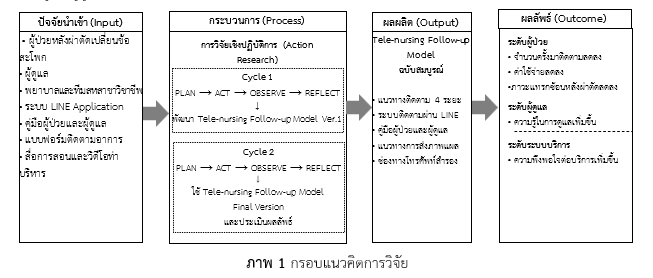
This action research aimed to develop and evaluate a tele-nursing care model for patients after hip replacement surgery at Kumphawapi Hospital, Udon Thani Province. The study followed the framework of Kemmis and McTaggart, consisting of planning, action, observation, and reflection, conducted in two cycles. In the first cycle, problems and needs related to post-operative follow-up care were explored, and a tele-nursing follow-up model was developed. Feedback and reflections from the first cycle were then used to improve and refine the model in the second cycle to ensure its suitability for the context of a community hospital. The study sample consisted of 15 patients who had undergone hip replacement surgery and their primary caregivers. Participants were selected using purposive sampling. Research instruments included a tele-nursing follow-up model using the LINE application, patient care manuals, follow-up record forms, and outcome evaluation tools. Data were analyzed using descriptive statistics, paired t-test, and content analysis.
The results showed that after implementing the tele-nursing model, the mean number of hospital visits significantly decreased from 4.20 to 2.13 times, and the average cost decreased from 1,200 to 620 baht (p < .001). Caregivers’ knowledge scores significantly increased from 6.28 to 8.70 (p < .001). Overall satisfaction was at a high level (mean = 4.71, SD = 0.47), and most patients had no complications (73.3%).
In conclusion, the tele-nursing care model effectively reduced healthcare utilization and costs, improved caregiver knowledge, and enhanced patient satisfaction. This model can be applied as a standard care approach for postoperative patients in community hospitals.
References
กรมการแพทย์, กระทรวงสาธารณสุข. (2564). แนวทางการดูแลรักษาผู้ป่วยกระดูกสะโพกหักในผู้สูงอายุ. กรุงเทพฯ: กรมการแพทย์, กระทรวงสาธารณสุข.
กองการพยาบาล, กระทรวงสาธารณสุข. (2563). มาตรฐานการพยาบาลผู้ใหญ่และผู้สูงอายุ. นนทบุรี: กองการพยาบาล, กระทรวงสาธารณสุข.
กิตติพล อยู่คง. (2566). ประสิทธิผลของโปรแกรมการสนับสนุนการจัดการตนเองร่วมกับการแพทย์ทางไกลต่อพฤติกรรมการจัดการตนเองและระดับความดันโลหิตในผู้ป่วยความดันโลหิตสูงชนิดไม่ทราบสาเหตุ อำเภอสวรรคโลก จังหวัดสุโขทัย [วิทยานิพนธ์ปริญญามหาบัณฑิต, มหาวิทยาลัยนเรศวร]. NU Intellectual Repository
งานผู้ป่วยนอก แผนกกระดูกและข้อ. (2567). เอกสารพัฒนาคุณภาพการดูแลผู้ป่วยแผนกกระดูกและข้อ ประจำปี 2567 [เอกสารภายในหน่วยงาน].
จินตนา ยูนิพันธ์ และคณะ. (2561). ผลของโปรแกรมการให้ความรู้ต่อความสามารถในการดูแลตนเองของผู้ป่วยผ่าตัดข้อสะโพกเทียม. วารสารพยาบาลศาสตร์, 36(2), 45-57.
ชญานิษฐ์ วัฒนวงศ์, กรรณิการ์ ศรีสวัสดิ์, และปวีณา นามวงศ์. (2563). ปัจจัยที่มีอิทธิพลต่อพฤติกรรมการตรวจสุขภาพของประชาชนกลุ่มเสี่ยงโรคเบาหวานและความดันโลหิตสูง. วารสารสาธารณสุขชุมชน, 16(3), 112-124.
ณัฐธิดา พรหมภัทร. (2560). การใช้ระบบ LINE ในการติดตามผู้ป่วยเรื้อรังเพื่อเพิ่มการยึดมั่นการรักษา. วารสารสาธารณสุขศาสตร์, 27(1), 85-96.
ดาราวรรณ รองเมือง และคณะ. (2566). การพัฒนารูปแบบระบบแพทย์ทางไกลเพื่อการดูแลรักษาผู้ป่วยล้างไตทางช่องท้อง: บทเรียนจากการระบาดของโควิด-19. วารสารสถาบันวิจัยระบบสาธารณสุข, 17(1), 108-127. https://kb.hsri.or.th/dspace/handle/11228/5857
ประเสริฐ บินตะคุ. (2566). การจัดบริการดูแลผู้ป่วยเบาหวานที่ควบคุมระดับน้ำตาลในเลือดได้ไม่ดีผ่านระบบการแพทย์ทางไกลของโรงพยาบาลส่งเสริมสุขภาพตำบล (Telemedicine NCDs on Cloud). วารสารวิจัยและพัฒนาระบบสุขภาพ, 16(3), 127-140.
เพ็ญศรี เลาสวัสดิ์ชัยกุล และบังอร ชาตริยานุโยค. (2554). การฟื้นฟูสภาพในผู้ป่วยที่ได้รับการผ่าตัดรักษากระดูกสะโพกหัก. วารสารพยาบาลศาสตร์, 29(3), 22-33.
รัชนี วงษ์คำ. (2568). ประสิทธิผลของการพัฒนาระบบบริการคลินิกโรคเรื้อรังในกลุ่มผู้สูงอายุด้วยระบบการแพทย์ทางไกลในโรงพยาบาลเกษตรวิสัย. วารสารการแพทย์โรงพยาบาลอุดรธานี, 33(3), 423-436.
วิภาพร ลีเลิศมงคลกุล, สุพร ดนัยดุษฎีกุล, วัลย์ลดา ฉันท์เรืองวณิชย์, และพัชรพล อุดมเกียรติ. (2556). ความสัมพันธ์ระหว่างดัชนีมวลกาย ความเจ็บปวด และการสนับสนุนทางสังคมกับการปฏิบัติกิจวัตรประจำวันในระยะฟื้นตัวของผู้ป่วยผ่าตัดเปลี่ยนข้อสะโพกเทียม. วารสารพยาบาลศาสตร์, 31(2), 26-37.
สุพัตรา เจนพาณิชพงศ์ และวิวัลญา อุดมเดชาเวทย์. (2566). การพัฒนารูปแบบบริการผู้ป่วยเบาหวานโดยใช้ระบบการแพทย์ทางไกล โรงพยาบาลท่าอุเทน จังหวัดนครพนม. วารสารสิ่งแวดล้อมศึกษา การแพทย์ และสุขภาพ, 9(4), 108-118. https://so06.tci-thaijo.org/index.php/hej/article/view/278667
อนุ อิสระพานิช และกิตติพร เนาว์สุวรรณ. (2564). การพัฒนารูปแบบการจัดการตนเองในผู้ป่วยเบาหวานและความดันโลหิตสูงที่มีภาวะแทรกซ้อนทางไตระยะที่ 4. วารสารวิชาการสาธารณสุข, 30(2), 123-135.
Bandura, A. (1977). Self-efficacy: Toward a unifying theory of behavioral change. Psychological Review, 84(2), 191-215. https://doi.org/10.1037/0033-295X.84.2.191
Buvik, A., Bugge, E., Knutsen, G., Småbrekke, A., & Wilsgaard, T. (2016). Quality of care for remote orthopaedic consultations using telemedicine: A randomised controlled trial. BMC Health Services Research, 16, 483. https://doi.org/10.1186/s12913-016-1717-7
Cheng, S. Y., Levy, A. R., Lefaivre, K. A., Guy, P., Kuramoto, L., & Sobolev, B. (2011). Geographic trends in incidence of hip fractures: A comprehensive literature review. Osteoporosis International, 22(10), 2575–2586. https://doi.org/10.1007/s00198-011-1596-z
Cohen, J. (1988). Statistical power analysis for the behavioral sciences (2nd ed.). Lawrence Erlbaum Associates.
Faul, F., Erdfelder, E., Lang, A.-G., & Buchner, A. (2007). G*Power 3: A flexible statistical power analysis program for the social, behavioral, and biomedical sciences. Behavior Research Methods, 39(2), 175-191. https://doi.org/10.3758/BF03193146
Kanfer, F. H., & Gaelick-Buys, L. (1991). Self-management methods. In F. H. Kanfer & A. P. Goldstein (Eds.), Helping people change: A textbook of methods (4th ed., pp. 305-360). Pergamon Press.
Kemmis, S., & McTaggart, R. (1988). The action research planner (3rd ed.). Deakin University Press.
Marques, A., Costa, N., Cantista, P., & Saraiva, F. (2015). Quality of life in elderly patients after hip fracture surgery: A comparative study. Acta Médica Portuguesa, 28(6), 660–668. https://doi.org/10.20344/amp.5262
Orem, D. E. (1985). Nursing: Concepts of practice (3rd ed.). McGraw-Hill.
Oudbier, S. J., Souget-Ruff, S. P., Chen, B. S. J., Ziesemer, K. A., Meij, H. J., & Smets, E. M. A. (2024). Implementation barriers and facilitators of remote monitoring, remote consultation and digital care platforms through the eyes of healthcare professionals: A review of reviews. BMJ Open, 14(6), e075833. https://doi.org/10.1136/bmjopen-2023-075833
Wallace, M., & Ellington, L. (2014). Promoting patient and family engagement: Understanding the nurse's role. Nursing Clinics of North America, 49(1), 45-58. https://doi.org/10.1016/j.cnur.2013.10.003
Downloads
Published
How to Cite
Issue
Section
License
Copyright (c) 2026 Journal of Health Promotion and Environmental Health Research Health Promotion Centre 8 Udon Thani

This work is licensed under a Creative Commons Attribution-NonCommercial-NoDerivatives 4.0 International License.
Articles in this journal are copyrighted by the published under the Creative Commons Attribution-NonCommercial-NoDerivatives 4.0 International (CC BY-NC-ND 4.0) license.
may be read and used for academic purposes, such as teaching, research, or citation, with proper credit given to the author and the journal.
use or modification of the articles is prohibited without permission.
statements expressed in the articles are solely the opinions of the authors.
authors are fully responsible for the content and accuracy of their articles.
other reuse or republication requires permission from the journal."



