
An Evaluation of the PBRI Healthy Way Project and the Community Health Center Model for Non-Communicable Diseases Management in Khao Khansong Subdistrict, Si Racha District, Chonburi Province
Keywords:
PBRI Healthy Way, NCDs Management, Program EvaluationAbstract
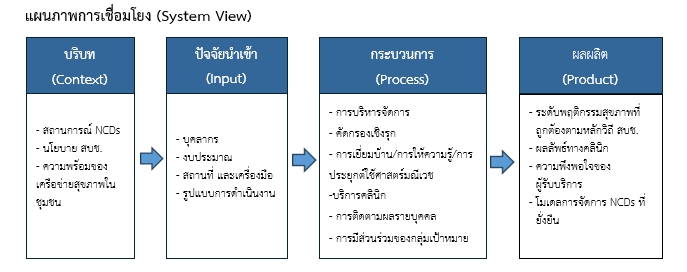
This mixed-methods evaluative research aimed to evaluate the implementation of the "PBRI Healthy Way" project and the Prototype Community Health Center for NCD management in Khao Khansong Subdistrict. The study focused on analyzing policies, support systems, and operational processes to formulate strategic recommendations. Data were collected from 125 participants and complemented by in-depth interviews with key stakeholders.
The results revealed that 1) Health Outcomes: Participants demonstrated significantly higher health behavior scores post-intervention (p < .05), particularly in emotional management. Clinical outcomes also improved, with high-risk groups and those with complications (orange and red zones) decreasing by 7.2%, while the proportion of the normal group by 11.2% 2) Policy and Support Systems: The PBRI Healthy Way policy was highly congruent with the area’s semi-industrial context. It effectively addressed accessibility constraints caused by geographic and transportation barriers. Integrated resource sharing between the Praboromarajchanok Institute (PBRI) and local health agencies was a primary success factor: however, though limitations remined regarding budget continuity and digital health database integration. 3) Operational Processes: The prototype center was efficiently driven by a tripartite collaboration among the local health promoting hospital, Boromarajonani College of Nursing Chonburi, and empowered Village Health Volunteers.
Conclusion and Recommendations: The project’s success was rooted in the effective translation of policy into practice through multisectoral collaboration. Key recommendations include accelerating IT systems development for long-term monitoring and establishing integrated budgeting mechanisms with Local Administrative Organizations (LAOs) to ensure the sustainable operation of community health centers.
References
กองโรคไม่ติดต่อ, กรมควบคุมโรค. (2567). รายงานประจำปี 2567 กองโรคไม่ติดต่อ กรมควบคุมโรค.
เกศินี มหาวงค์, วรวุฒิ ชมภูพาน, และสลักจิต นิลประเสริฐศักดิ์. (2563). ผลของโปรแกรมการปรับเปลี่ยนพฤติกรรมสุขภาพต่อระดับความดันโลหิตของผู้ที่มีภาวะเสี่ยงต่อโรคความดันโลหิตสูงในชุมชน. วารสารการพยาบาลและการส่งเสริมสุขภาพ, 2(2), 26–38.
นิตยา ชุดไธสง. (2569). การพัฒนาสถานีรักษ์สุขภาพ จังหวัดบุรีรัมย์. วารสารวิชาการสาธารณสุข, 35(1), 166-182.
วีระศักดิ์ เดชอรัญ. (2568). ประสิทธิภาพเชิงระบบของศูนย์ป้องกันโรคไม่ติดต่อในชุมชน: แนวทางลดโรคไม่ติดต่อเรื้อรังที่ยั่งยืน. วารสารสภาการสาธารณสุขชุมชน, 7(1), 1–18.
สถาบันพระบรมราชชนก. (2565). แนวทางการดำเนินงานโครงการสุขภาพดี วิถี สบช. และการพัฒนาศูนย์สุขภาพชุมชนต้นแบบเพื่อการจัดการโรคไม่ติดต่อเรื้อรัง.
สุรีย์ ธรรมิกพงษ์, จิราภรณ์ วงศ์ใหญ่, และนงนุช วงศ์สว่าง. (2563). ผลของโปรแกรมปรับเปลี่ยนพฤติกรรมสุขภาพต่อความรอบรู้ด้านสุขภาพและพฤติกรรมสุขภาพของกลุ่มเสี่ยงโรคไม่ติดต่อเรื้อรัง. วารสารการพยาบาลและการดูแลสุขภาพ, 38(4), 138–147.
องค์การบริหารส่วนจังหวัดชลบุรี. (2568). รายงานสถานการณ์โรคไม่ติดต่อเรื้อรังในเขตชุมชนกึ่งเมืองกึ่งอุตสาหกรรม จังหวัดชลบุรี ประจำปี 2568. กองสาธารณสุข.
Gibson, C. H. (1991). A concept analysis of empowerment. Journal of Advanced Nursing, 16(3), 354–361. https://doi.org/10.1111/j.1365-2648.1991.tb01660.x
Vichitkunakorn, P., Bunyanukul, W., Apiwan, K., Tanasanchonnakul, D., & Sittisombut, M. (2025). Prevalence of non-communicable disease risk factors and their association with economic status: Findings from the 2021 health behaviour of population survey in Thailand. Global Health Action, 18(1), Article 2485689. https://doi.org/10.1080/16549716.2025.2485689
The Nation Thailand. (2025, November 8). Rising non-communicable diseases: Thailand's major health crisis. The Nation Thailand
Stufflebeam, D. L., & Shinkfield, A. J. (2007). Evaluation theory, models, and applications. Jossey-Bass.
Wallerstein, N. (2006). What is the evidence on the effectiveness of empowerment to improve health? (Health Evidence Network Report No. 6). WHO Regional Office for Europe
Downloads
Published
How to Cite
Issue
Section
License
Copyright (c) 2026 Journal of Health Promotion and Environmental Health Research Health Promotion Centre 8 Udon Thani

This work is licensed under a Creative Commons Attribution-NonCommercial-NoDerivatives 4.0 International License.
Articles in this journal are copyrighted by the published under the Creative Commons Attribution-NonCommercial-NoDerivatives 4.0 International (CC BY-NC-ND 4.0) license.
may be read and used for academic purposes, such as teaching, research, or citation, with proper credit given to the author and the journal.
use or modification of the articles is prohibited without permission.
statements expressed in the articles are solely the opinions of the authors.
authors are fully responsible for the content and accuracy of their articles.
other reuse or republication requires permission from the journal."



