
Water supply management of local government organizations for accessibility clean water in Thailand
Keywords:
Local Water Supply, Water Quality, Water LiteracyAbstract
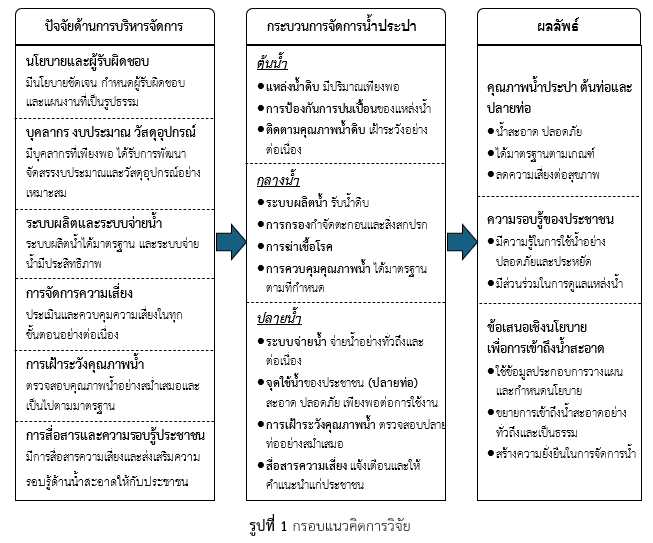
This study aimed to: 1) examine local water supply management and public water literacy, 2) evaluate water quality at system entry and point-of-use, and 3) synthesize policy recommendations to enhance local water supply management. A mixed-methods design was employed. Quantitative data were collected via surveys from 100 Environmental Health Accreditation (EHA) applicant local administrative organizations (LAOs) and face-to-face interviews with 420 local residents. Qualitative data were gathered through in-depth interviews and focus group discussions across 18 purposively selected study sites spanning 6 regions, combined with water quality analysis of 21 parameters (36 samples) against Department of Health 2020 Drinking Water Standards.
The results showed that 86.00% of LAOs managed their own water production, primarily utilizing surface water (47.00%). Average monthly revenue and expenditure were 284,971.12 THB and 232,865.94 THB, respectively. However, a major limitation was identified: only 34.70% possessed water quality monitoring tools or systems. Although most residents exhibited moderate-to-high water literacy (85.24%–96.90%), operational issues persisted, notably chlorine odor (35.48%) and turbidity (14.29%), incurring an average bottled water expense of 296.82 THB/household/month. Only 33.33% of water systems met all standard parameters. Microbiological risks were prominent, with Coliform bacteria (27.78%) and E. coli (11.11%) failing standards at both entry and end-points.
The results showed that 86.00% of LAOs managed their own water production, primarily utilizing surface water (47.00%). Average monthly revenue and expenditure were 284,971.12 THB and 232,865.94 THB, respectively. However, a major limitation was identified: only 34.70% possessed water quality monitoring tools or systems. Although most residents exhibited moderate-to-high water literacy (85.24%–96.90%), operational issues persisted, notably chlorine odor (35.48%) and turbidity (14.29%), incurring an average bottled water expense of 296.82 THB/household/month. Only 33.33% of water systems met all standard parameters. Microbiological risks were prominent, with Coliform bacteria (27.78%) and E. coli (11.11%) failing standards at both entry and end-points.
References
กรมอนามัย กระทรวงสาธารณสุข. (2563). เกณฑ์มาตรฐานคุณภาพน้ำประปาดื่มได้ กรมอนามัย พ.ศ. 2563. โรงพิมพ์ชุมนุมสหกรณ์การเกษตรแห่งประเทศไทย.
กรมส่งเสริมการปกครองท้องถิ่น. (2565). คู่มือหลักเกณฑ์และมาตรฐานคุณภาพระบบประปาหมู่บ้านขององค์กรปกครองส่วนท้องถิ่น. กรมส่งเสริมการปกครองท้องถิ่น.
มูลนิธิส่งเสริมเทคโนโลยี (ไทย-ญี่ปุ่น). (2532). คู่มือการปรับปรุงคุณภาพน้ำและการควบคุมระบบผลิตน้ำประปา. มูลนิธิส่งเสริมเทคโนโลยี (ไทย-ญี่ปุ่น).
ยิมรัตน์ ยิ้มรัตนบวร. (2555). การประเมินคุณภาพน้ำและระบบบริหารจัดการน้ำประปาหมู่บ้านในเขตภาคตะวันออกเฉียงเหนือ. สำนักบริหารโครงการวิจัยและพัฒนา มหาวิทยาลัยเทคโนโลยีสุรนารี.
ยุทธศิลป์ โยธาวุฒิ. (2560). การศึกษาสถานการณ์และรูปแบบการบริหารจัดการระบบประปาหมู่บ้านอย่างยั่งยืน. วารสารวิชาการสาธารณสุข, 26(3), 485–496.
อังศินันท์ อินทรกำแหง. (2560). ความรอบรู้ด้านสุขภาพ: การวัดและการพัฒนา. สถาบันวิจัยพฤติกรรมศาสตร์ มหาวิทยาลัยศรีนครินทรวิโรฒ.
Bartram, J., & Ballance, R. (Eds.). (1996). Water quality monitoring: A practical guide to the design and implementation of freshwater quality studies and monitoring programmes. E & FN Spon.
Dean, A. J., Fielding, K. S., & Newton, F. J. (2016). Community knowledge about water: Who has better knowledge and is this associated with water-related behaviors and support for water-related policies? PLOS ONE, 11(7), e0159063. https://doi.org/10.1371/journal.pone.0159063
Nutbeam, D. (2000). Health literacy as a public health goal: A challenge for contemporary health education and communication strategies into the 21st century. Health Promotion International, 15(3), 259–267. https://doi.org/10.1093/heapro/15.3.259
Otaki, Y., Sakura, O., & Otaki, M. (2015). Advocating water literacy. Mahasarakham International Journal of Engineering Technology, 1(1), 36–40. https://doi.org/10.14456/mijet.2015.8
Rahmanian, N., Ali, S. H. B., Homayoonfard, M., Ali, N. J., Rehan, M., Sadef, Y., & Nizami, A. S. (2015). Analysis of physiochemical parameters to evaluate the drinking water quality in the State of Perak, Malaysia. Journal of Chemistry, 2015, Article 716125. https://doi.org/10.1155/2015/716125
Silva, G. M. e., Campos, D. F., Brasil, J. A. T., Tremblay, M., Mendiondo, E. M., & Ghiglieno, F. (2022). Advances in technological research for online and in situ water quality monitoring—A review. Sustainability, 14(9), 5059. https://doi.org/10.3390/su14095059
Tian, K., Wang, H., & Wang, Y. (2021). Investigation and evaluation of water literacy of urban residents in China based on data correction method. Water Policy, 23(1), 77–95. https://doi.org/10.2166/wp.2021.160
World Health Organization. (2009). Water safety plan manual: Step-by-step risk management for drinking-water suppliers. World Health Organization.
World Health Organization. (2011). Guidelines for drinking-water quality (4th ed.). World Health Organization. https://www.who.int/publications-detail-redirect/9789241548151
Downloads
Published
How to Cite
Issue
Section
License
Copyright (c) 2026 Journal of Health Promotion and Environmental Health Research Health Promotion Centre 8 Udon Thani

This work is licensed under a Creative Commons Attribution-NonCommercial-NoDerivatives 4.0 International License.
Articles in this journal are copyrighted by the published under the Creative Commons Attribution-NonCommercial-NoDerivatives 4.0 International (CC BY-NC-ND 4.0) license.
may be read and used for academic purposes, such as teaching, research, or citation, with proper credit given to the author and the journal.
use or modification of the articles is prohibited without permission.
statements expressed in the articles are solely the opinions of the authors.
authors are fully responsible for the content and accuracy of their articles.
other reuse or republication requires permission from the journal."



