
Development of a Community-Based Participatory Oral Health Promotion Model for Preschool Children in Early Childhood Development Centers, Sam Phrao Subdistrict, Udon Thani Province, Thailand
Keywords:
Preschool children, Oral health promotion, Research and development, Community participation, Early childhood development center, 4M–C ModelAbstract
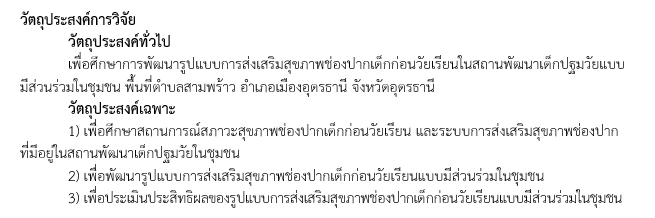
Dental caries among preschool children remains a significant public health problem. This study aimed to: (1) examine the oral health status and oral health promotion system in early childhood development centers; (2) develop a community-participatory oral health promotion model for preschool children; and (3) evaluate the effectiveness of the developed model. This research and development (R&D) study was conducted in early childhood development centers in Sam Phrao Subdistrict, Mueang Udon Thani District, Udon Thani Province, Thailand, from May to October 2025. The study comprised four phases: situational analysis, model development, model implementation, and evaluation. The target participants included preschool children, parents or caregivers, childcare teachers, and community stakeholders. Data were collected through oral health examinations, focus group discussions, and questionnaires. Data were analyzed using descriptive and inferential statistics.
Results: Among 93 preschool children who underwent oral health examinations, 17.20% had dental caries, 30.11% had early carious lesions (white spot lesions), and 35.48% had dental plaque. The existing oral health promotion system showed gaps in parental participation, risk-group screening, and information linkage among relevant sectors. Consequently, the researchers developed the 4M–C Model, comprising four components: Motivation (M1), Monitoring and Screening (M2), Maintenance of Oral Health Behaviors (M3), and Management (M4). Community Participation (C) served as the linking mechanism among these components, while Continuous Improvement was incorporated to support ongoing development and refinement of the model.
Among 52 parents or caregivers with complete pre- and post-intervention data, perception scores increased significantly (p < 0.001; effect size r = 0.84–0.90). Knowledge scores increased from 11.04 ± 2.37 to 12.15 ± 1.72 (mean difference = 1.12; 95% CI: 0.61–1.62; p < 0.001). Overall oral health care behavior scores also increased significantly, from 34.60 ± 5.73 to 35.73 ± 5.62 (p = 0.034). In addition, the prevalence of dental plaque among children decreased from 45.60% to 1.50% (p < 0.001), while the prevalence of early carious lesions decreased from 44.10% to 22.10% (p = 0.001). The mean decayed, missing, and filled teeth (dmft) index did not change significantly (p = 0.339).
Conclusions: The 4M–C Model enhanced oral health promotion practices by transforming fragmented activities into a more integrated and coordinated approach. The model improved parents’ or caregivers’ knowledge and oral health care behaviors and was associated with significant reductions in dental plaque and early carious lesions among preschool children. The model may therefore be applicable to other settings with similar contexts.
References
สำนักทันตสาธารณสุข. (2567). รายงานผลการสำรวจสภาวะสุขภาพช่องปากแห่งชาติ ครั้งที่ 9 ประเทศไทย พ.ศ. 2566. กรมอนามัย.
สุมัทนา กลางคาร, และ วรพจน์ พรหมสัตยพรต. (2553). หลักการวิจัยทางวิทยาศาสตร์สุขภาพ (พิมพ์ครั้งที่ 6). สารคามการพิมพ์-สารคามเปเปอร์.
สุเทพ ภูติประวรรณ. (2566). กิจกรรมส่งเสริมสุขภาพช่องปากและสภาวะสุขภาพช่องปากเด็กในศูนย์พัฒนาเด็กเล็ก จังหวัดชุมพร. วารสารวิชาการสาธารณสุข, 32(2), 288–298.
วนิดา วาดีเจริญ, รังสรรค์ เลิศในสัตย์, และ สมบัติ ทีฆทรัพย์. (2560). ระเบียบวิธีวิจัย จากแนวคิด ทฤษฎี สู่ภาคปฏิบัติ. ซีเอ็ดยูเคชั่น.
Alzahrani, A. Y., El Meligy, O., Bahdila, D., Aljawi, R., Bamashmous, N. O., & Almushayt, A. (2024). The influence of parental oral health literacy on children's oral health: A scoping review. Journal of Clinical Pediatric Dentistry, 48(4), 16–25. https://doi.org/10.22514/jocpd.2024.074
Bandura, A. (1986). Social foundations of thought and action: A social cognitive theory. Prentice-Hall.
Boonyawong, M., Auychai, P., & Duangthip, D. (2022). Risk factors of dental caries in preschool children in Thailand: A cross-sectional study. Healthcare, 10(5), Article 794. https://doi.org/10.3390/healthcare10050794
Fejerskov, O., Nyvad, B., & Kidd, E. (2015). Dental caries: The disease and its clinical management (3rd ed.). Wiley-Blackwell.
Green, L. W., & Kreuter, M. W. (2005). Health program planning: An educational and ecological approach (4th ed.). McGraw-Hill.
Harris, R., Nicoll, A. D., Adair, P. M., & Pine, C. M. (2004). Risk factors for dental caries in young children: A systematic review. Community Dental Health, 21(Suppl. 1), 71–85.
Ho, P. S., Lin, Y. C., Huang, S. T., Yen, C. W., Huang, Y. K., Shieh, T. M., Chi, W. H., & Yao, W. L. (2023). Comparing individual-, family-, and community-level effects on the oral health of preschool children: A multilevel analysis of national survey data. BMC Oral Health, 23, 353. https://doi.org/10.1186/s12903-023-03077-w
Hooley, M., Skouteris, H., Boganin, C., Satur, J., & Kilpatrick, N. (2012). Parental influence and the development of dental caries in children aged 0–6 years: A systematic review. Journal of Dentistry, 40(11), 873–885. https://doi.org/10.1016/j.jdent.2012.07.013
Ispas, D. (2024). Understanding the link between health literacy and oral health outcomes: Promoting oral health equity and raising awareness. BDJ Student, 31, 58–59. https://doi.org/10.1038/s41406-024-1381-z
Jiang, H. F., Shi, A. T., Li, J., Zhang, Y. H., & Yang, J. (2024). Effectiveness of risk-based caries management among Chinese preschool children: A randomized controlled single-blind trial. BMC Oral Health, 24, 673. https://doi.org/10.1186/s12903-024-04442-z
Natapov, L., Dekel, D., Pikovsky, V., & Zusman, S. P. (2021). Dental health of preschool children after two years of a supervised tooth-brushing program in southern Israel. Israel Journal of Health Policy Research, 10(1), 42. https://doi.org/10.1186/s13584-021-00479-5
Petersen, P. E. (2003). The World Oral Health Report 2003: Continuous improvement of oral health in the 21st century–the approach of the WHO Global Oral Health Programme. Community Dentistry and Oral Epidemiology, 31(Suppl. 1), 3–24. https://doi.org/10.1046/j.2003.com122.x
Pitts, N. B., Zero, D. T., Marsh, P. D., Ekstrand, K., Weintraub, J. A., Ramos-Gomez, F., Tagami, J., Twetman, S., Tsakos, G., & Ismail, A. (2017). Dental caries. Nature Reviews Disease Primers, 3, Article 17030. https://doi.org/10.1038/nrdp.2017.30
Plutzer, K., & Spencer, A. J. (2008). Efficacy of an oral health promotion intervention in the prevention of early childhood caries. Community Dentistry and Oral Epidemiology, 36(4), 335–346. https://doi.org/10.1111/j.1600-0528.2007.00414.x
Shan, Z., Liao, C., Lu, J., Yeung, C. P. W., Li, K. Y., Gu, M., Chu, C. H., & Yang, Y. (2023). Improvement of parents' oral health knowledge by a school-based oral health promotion for parents of preschool children: A prospective observational study. BMC Oral Health, 23, 890. https://doi.org/10.1186/s12903-023-03567-x
Weinstein, P., Harrison, R., & Benton, T. (2004). Motivating mothers to prevent caries: Confirming the beneficial effect of counseling. The Journal of the American Dental Association, 135(6), 731–738. https://doi.org/10.14219/jada.archive.2004.0271
World Health Organization. (2024). Global strategy and action plan on oral health 2023–2030. https://www.who.int/publications/i/item/9789240090538
World Health Organization. (2025). Report of the WHO Global Oral Health Meeting, Bangkok, Thailand. https://www.who.int/publications/
Yu, K. F., Wen, W., Liu, P., Gao, X., Lo, E. C. M., & Wong, M. C. M. (2022). Effectiveness of family-centered oral health promotion on toddler oral health in Hong Kong. Journal of Dental Research, 101(3), 286–294. https://doi.org/10.1177/00220345211045339
Downloads
Published
How to Cite
Issue
Section
License
Copyright (c) 2026 Journal of Health Promotion and Environmental Health Research Health Promotion Centre 8 Udon Thani

This work is licensed under a Creative Commons Attribution-NonCommercial-NoDerivatives 4.0 International License.
Articles in this journal are copyrighted by the published under the Creative Commons Attribution-NonCommercial-NoDerivatives 4.0 International (CC BY-NC-ND 4.0) license.
may be read and used for academic purposes, such as teaching, research, or citation, with proper credit given to the author and the journal.
use or modification of the articles is prohibited without permission.
statements expressed in the articles are solely the opinions of the authors.
authors are fully responsible for the content and accuracy of their articles.
other reuse or republication requires permission from the journal."



