
The Development of Model for Post-operative Care in Recovery room at Kumphawapi Hospital, Udonthani
Keywords:
Development , Post-operative Care in Recovery roomAbstract
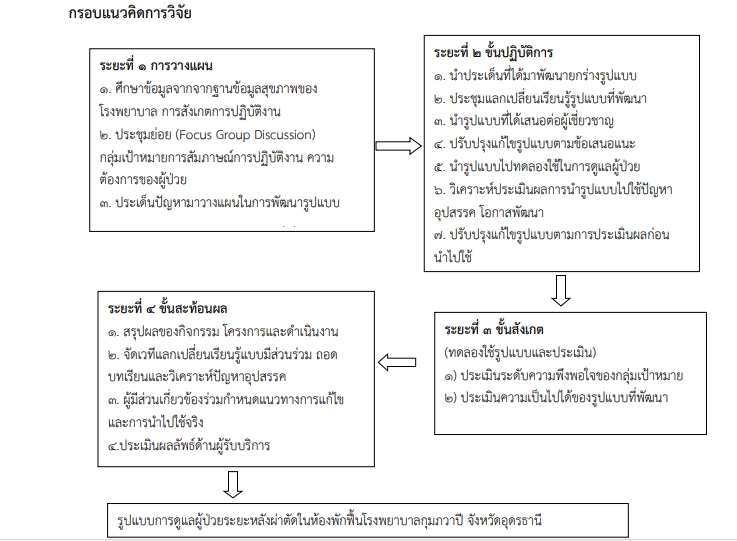
The purposes of research were to create the development of Model for Post-operative Care in Recovery room at Kumphawapi Hospital, Udonthani. The study consisted of 4 phases: 1) Plan 2) Action 3) Observation and 4) reflection. A simple random was used to selected the multidisciplinary teams target group consisting of Anesthesiologist, Nurse Anesthetist and Nurse Aide. The questionnaires were examined for the validity by the expert. The Cranbach’s alpha coefficient was employed for verifying the reliability and it was 0.88 The data collection included both qualitative and quantitative data. The quantitative data were analyzed by descriptive data: frequency, percentage mean, and standard deviation. Results of this study were as follows:
Phase 1 Situation of Post-operative Care in Recovery at Kumphawapi Hospital, Udonthani. found that not comprehensive implementation of practice. lack of Assessment and monitoring, Symptom management, Record and Discharge.
Phase 2 The development model consisted of 4 components. (1 ) Assessment and monitoring (2 ) Symptom management (3 ) Nursing Documentation and (4) Discharge to ward
Phase 3 and 4 The evaluation of the Model for Post-operative Care in Recovery room at Kumphawapi Hospital, Udonthani. revealed that in the overall average of appropriate and possibility were at the high level ( = 4.58) and all items were at the high level. The assessment of satisfaction the multidisciplinary team was satisfied with the high level ( = 4.80) and the satisfaction of patients and care givers toward the system was also at the high level. It was agreed that the Model for Post-operative Care in Recovery room was appropriate for using in the organization.
Downloads
Published
How to Cite
Issue
Section
License
Copyright (c) 2023 Journal of Health Promotion and Environmental Health ResearchArticles in this journal are copyrighted by the published under the Creative Commons Attribution-NonCommercial-NoDerivatives 4.0 International (CC BY-NC-ND 4.0) license.
may be read and used for academic purposes, such as teaching, research, or citation, with proper credit given to the author and the journal.
use or modification of the articles is prohibited without permission.
statements expressed in the articles are solely the opinions of the authors.
authors are fully responsible for the content and accuracy of their articles.
other reuse or republication requires permission from the journal."



