
Effects of Stroke Prevention Program among Elderly Hypertension
Keywords:
elderly, prevention, HypertensionAbstract
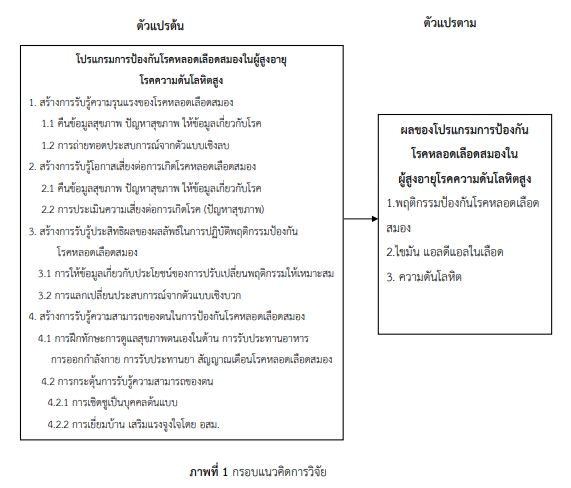
Quasi-experimental research with one group measuring results before and after the experiment. The objective is to study the results of stroke prevention program in the elderly on blood pressure and blood lipids. The sample consisted of 34 elderly people diagnosed with high blood pressure in a sub-district health promotion hospital. The sample was selected according to the specified characteristics using simple random sampling. A questionnaire was used as a tool to collect general information and stroke prevention behaviors. The following areas: diet, exercise, and medication were examined for validity and reliability. Cronbrach's alpha coefficient was 0.92, and 0.88, 0.73, and 0.73, respectively. The results of the study found that after using the program, the sample group had a higher mean total score for stroke prevention behavior than before using the program, at a statistical significance of .05. And it was found that the sample group's mean systolic and diastolic blood pressure and LDL blood lipid levels decreased at a statistical significance of .05. Therefore, the program should be used as a guideline for behavioral modification to prevent stroke and be applied to populations with chronic diseases that have similar characteristics.
Downloads
Published
How to Cite
Issue
Section
License
Copyright (c) 2024 Journal of Health Promotion and Environmental Health ResearchArticles in this journal are copyrighted by the published under the Creative Commons Attribution-NonCommercial-NoDerivatives 4.0 International (CC BY-NC-ND 4.0) license.
may be read and used for academic purposes, such as teaching, research, or citation, with proper credit given to the author and the journal.
use or modification of the articles is prohibited without permission.
statements expressed in the articles are solely the opinions of the authors.
authors are fully responsible for the content and accuracy of their articles.
other reuse or republication requires permission from the journal."



