A study of knowledge and behavior of raw food consumption among people in Bangjakreng Amphur mueng, Samut Song Khram Province
Article Sidebar
Main Article Content
Abstract
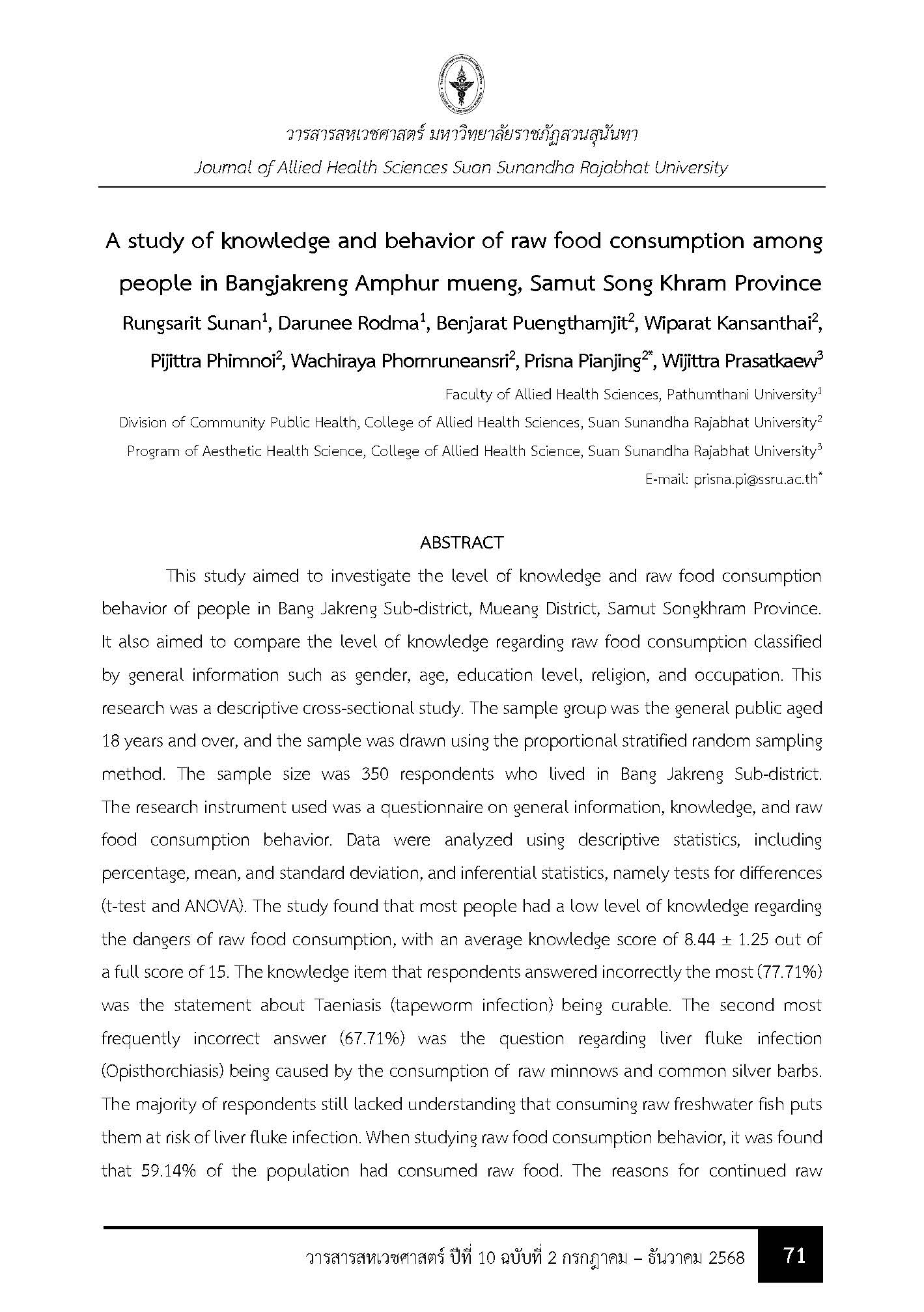
This study aimed to investigate the level of knowledge and raw food consumption behavior of people in Bang Jakreng Sub-district, Mueang District, Samut Songkhram Province.
It also aimed to compare the level of knowledge regarding raw food consumption classified
by general information such as gender, age, education level, religion, and occupation. This research was a descriptive cross-sectional study. The sample group was the general public aged 18 years and over, and the sample was drawn using the proportional stratified random sampling method. The sample size was 350 respondents who lived in Bang Jakreng Sub-district. The research instrument used was a questionnaire on general information, knowledge, and raw food consumption behavior. Data were analyzed using descriptive statistics, including percentage, mean, and standard deviation, and inferential statistics, namely tests for differences (t-test and ANOVA). The study found that most people had a low level of knowledge regarding the dangers of raw food consumption, with an average knowledge score of 8.44 ± 1.25 out of a full score of 15. The knowledge item that respondents answered incorrectly the most (77.71%) was the statement about Taeniasis (tapeworm infection) being curable. The second most frequently incorrect answer (67.71%) was the question regarding liver fluke infection (Opisthorchiasis) being caused by the consumption of raw minnows and common silver barbs. The majority of respondents still lacked understanding that consuming raw freshwater fish puts them at risk of liver fluke infection. When studying raw food consumption behavior, it was found that 59.14% of the population had consumed raw food. The reasons for continued raw consumption were enjoyment of the taste (44.93%), social/family/friend influencing (32.86 %), influencing from social media (14.00 %), and the least reason found was familiarity (8.21 %). Consumption behavior of raw food categorized by food ingredients showed that the percentage of respondents who do not consume raw pork/beef ranged between 85.99% and 90.82%. Among the group who did consume it (7.73%-11.59%), the most frequent consumption was
1-2 times per year, and the lowest frequency was 0.48% who reported consuming it daily. Regarding the consumption of raw freshwater aquatic animals such as fish, shrimp, shellfish, and crabs, the majority (89.86%) did not consume them. The most frequent consumption among the group that did consume raw freshwater aquatic animals was Kung Ten (raw shrimp with seasoning and herb), with 19.32% consuming it 1-2 times per year, while the least frequent consumption of raw freshwater aquatic animals was daily consumption. For raw seafood consumption, such as fermented shellfish, raw sea shrimp, and oysters, the group that had never consumed them was 72.46%. It was found that 28.99% of respondents consume fermented mussels with a frequency of 1-2 times per year. This research indicates that the consumption frequency of raw seafood (such as fermented sea shrimp, fermented sea crab, and fermented shellfish) is higher than that of raw meat and raw freshwater aquatic animals. The results comparing demographic factors to consumption knowledge indicated that differences in gender, age, education, occupation, and religion led to differences in knowledge. These findings demonstrate the necessity of providing education and campaigning to reduce raw food consumption in the community to prevent foodborne infectious diseases such as Streptococcus suis infection or cholera, liver fluke disease, and other gastrointestinal diseases.
Article Details
References
กรมควบคุมโรค. การป้องกันโรคและภัยคุกคามที่เกิดในช่วงฤดูร้อนของประเทศไทย: บทความ [อินเทอร์เน็ต]. กรุงเทพฯ: กรมควบคุมโรค กระทรวงสาธารณสุข; 2568 [เข้าถึงเมื่อ 1 ตุลาคม 2568]. เข้าถึงได้จาก: https://ddc.moph.go.th/uploads/publish/1686320250311080656.pdf.
วิภาวี หมื่นไวย์. ประเมินความเสี่ยงโรคไข้หูดับ (Streptococcus suis): บทความ [อินเทอร์เน็ต]. นครราชสีมา: สำนักงานป้องกันควบคุมโรคที่ 9 จังหวัดนครราชสีมา; 2567 [เข้าถึงเมื่อ 1 ตุลาคม 2568]. เข้าถึงได้จาก: https://odpc9.ddc.moph.go.th/EOC/Content/RRA%20_17final.pdf.
เตือนใจ คำมูล, เกศรา แสนศิริทวีสุข และ ภูมิพัฒน์ นริษทิ์ภูวพงษ์. ปัจจัยที่มีความสัมพันธ์กับพฤติกรรมบริโภคปลาดิบหรือสุก ๆ ดิบ ๆ ของประชาชนในเขตสุขภาพที่ 10 จังหวัดอุบลราชธานี ปี พ.ศ. 2564: รายงานการวิจัย [อินเทอร์เน็ต]. อุบลราชธานี: สำนักงานป้องกันควบคุมโรคที่ 10 กรมควบคุมโรค กระทรวงสาธารณสุข; 2564 [เข้าถึงเมื่อ 10 ตุลาคม 2568]. เข้าถึงได้จาก: https://odpc5ratchaburi.com/news/uploads/other/file_6k9eg0h2d431ws7ju8fryt5.pdf.
Tidman R, Kanankege K, Bangert M, Abela-Ridder B. Global prevalence of four neglected foodborne trematodes targeted for control by WHO: A scoping review to highlight the gaps. PLOS Negl Trop Dis 2023;17(2):e0011073.
Canh H, Loi C, Tuan N, et al. Prevalence and risk factors of fish-borne zoonotic trematode infections in a rural community: A cross-sectional study in the Red River Delta of Vietnam. J Public Health Res 2025;14(2):1-9.
European Centre for Disease Prevention and Control. Increased risk of Vibrio infections throughout the summer season. [Internet]. 2025 [cited 2025 Oct 29]. Available from: https://www.ecdc.europa.eu/en/news-events/increased-risk-vibrio-infections-throughout-summer-season.
กลุ่มสารสนเทศ กองระบาดวิทยา. ข้อมูลรายงานเฝ้าระวังทางระบาดวิทยาประจำสัปดาห์ที่ 28 ปี พ.ศ. 2567. วารสารรายงานการเฝ้าระวังทางระบาดวิทยาประจำสัปดาห์ 2564;55(1):1-5.
กรมควบคุมโรค. อหิวาตกโรค. [อินเทอร์เน็ต]. 2562. เข้าถึงได้จาก: https://www.ddc.moph.go.th/disease_detail.php?d=74.
กันตภณ ธรรมสา. ปัจจัยที่มีความสัมพันธ์กับพฤติกรรมการบริโภคปลาดิบของประชาชนในตำบลแก้งไก่ อำเภอสังคม จังหวัดหนองคาย. วารสารวิชาการสำนักงานป้องกันควบคุมโรคที่ 8 จังหวัดอุดรธานี 2567;2(3):1-15.
ศักดิ์ชัย ศรีกลาง และ พิษณุ อุตตมะเวทิน. ความสัมพันธ์ระหว่างพฤติกรรมการบริโภคปลาดิบของผู้กำหนดอาหาร และการบริโภคปลาดิบของสมาชิกในครัวเรือน ตำบลสะแก จังหวัดบุรีรัมย์. วารสารวิจัยสาธารณสุขศาสตร์ มหาวิทยาลัยขอนแก่น 2562;12(3):31–39.
สุรพงษ์ โสธนเสถียร. การสื่อสารกับสังคม. พิมพ์ครั้งที่ 1. กรุงเทพฯ: โรงพิมพ์จุฬาลงกรณ์มหาวิทยาลัย; 2533.
Krejcie RV, Morgan DW. Determining sample size for research activities. Educ Psychol Meas 1970;30(3):607-610.
บุญชม ศรีสะอาด. การวิจัยเบื้องต้น. พิมพ์ครั้งที่ 10. กรุงเทพฯ: สุวีริยาสาส์น; 2560.
ดลชย เลิศวิจิตรอนันต์, ลัญจกร เสวตะ, กัญญนัทธิ์ แสงศรี และ สมคิด พันธ์แก่น. ความรู้ ทัศนคติ กับพฤติกรรมการบริโภคอาหารของประชาชน ตำบลน้ำผุด อำเภอระโนด จังหวัดสตูล. วารสารวิชาการเฉลิมกาญจนา 2561;5(1):80-91.
Bloom B, Engelhart M, Furst E, Hill W, Krathwohl D. Taxonomy of Educational Objectives: Handbook I – The Cognitive Domain. New York: David McKay Co Inc; 1956.
รัฐพล ประดับเวทย์. แนวทางการจัดกิจกรรมการเรียนรู้ด้วยเทคโนโลยีตามแนวคิดอนุกรมวิธานของบลูม. Veridian E-Journal, Silpakorn University 2560;10(3):1051-1065.
รัตนา จันทร์เทาว์ และ เชิดชัย อุดมพันธ์. ชื่ออาหารท้องถิ่นอีสานและภาคใต้: มุมมองด้านอรรถศาสตร์ชาติพันธุ์. วารสารศิลปศาสตร์ มหาวิทยาลัยสงขลานครินทร์ วิทยาเขตหาดใหญ่ 2560;9(1):63-89.
ฉวีวรรณ สุวรรณาภา, อรอนงค์ วูวงค์ และ เสริมศิลป์ สุภเมธีสกุล. อาหารพื้นบ้าน: กระบวนการจัดการเพื่อพัฒนาคุณภาพชีวิตและจริยธรรมทางสังคมในชุมชน. [อินเทอร์เน็ต]. แพร่: รายงานวิจัยฉบับสมบูรณ์ ทุนวิจัยมหาวิทยาลัยมหาจุฬาลงกรณราชวิทยาลัย วิทยาเขตแพร่; 2560 [เข้าถึงเมื่อ 18 พฤศจิกายน 2568]. เข้าถึงได้จาก: http://mcuir.mcu.ac.th:8080/jspui/bitstream/123456789/761/1/2560-017.pdf.
อมรรัตน์ นธะสนธิ์, อัญชลี รุ่งศรี และ รัตนาพร บัวทอง. ความรู้ทางโภชนาการ ทัศนคติเกี่ยวกับอาหาร พฤติกรรมการรับประทานอาหารและภาวะโภชนาการในชุมชนกึ่งชนบทจังหวัดอุบลราชธานี. Ramathibodi Nurs J 2560;23(3):345-357.
ศิษฏ์ เกตุเอี่ยม และ รุจน์ เลาหภักดี. ความรู้ ทัศนคติ และพฤติกรรมการบริโภคอาหารของนักเรียนระดับมัธยมศึกษาในกรุงเทพมหานคร. วารสารวิทยาศาสตร์การกีฬาและสุขภาพ 2565;23(3):119-131.
