
Evaluation of Miraculous Subdistrict of 1,000 days Plus to 2,500 days in Health Region 8
Keywords:
การประเมินผล, ตำบลมหัศจรรย์ 1,000 วัน Plus สู่ 2,500 วัน, เขตสุขภาพที่ 8Abstract
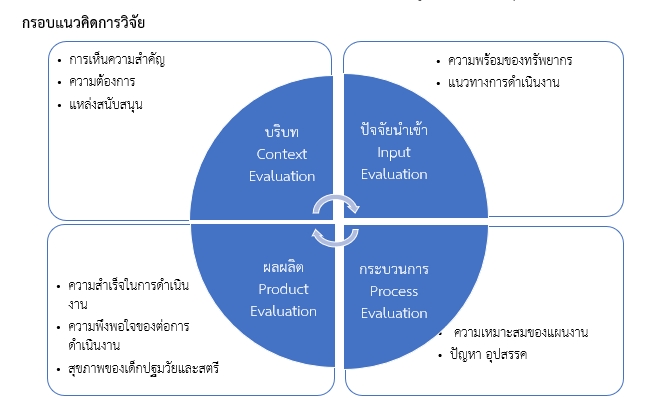
This study employed a mixed-methods approach, integrating both quantitative and qualitative methods, to evaluate the implementation of the 1,000 Days Plus to 2,500 Days Miracle Sub-district project in Health Region 8 of Thailand. The evaluation was conducted using Stufflebeam’s CIPP Model, which comprises four components: Context, Input, Process, and Product. Data were collected from seven sub-districts that implemented the project in 2023, with one sub-district selected per province using purposive sampling. Data collection took place between August and September 2024. A semi-structured interview guide was developed based on the national 1,000 Days Project evaluation tools. Quantitative data were analyzed using descriptive statistics, including frequency, percentage, mean, and standard deviation, while qualitative data were analyzed using content analysis.
The results showed that the majority of participants were female (89.29%), with an average age of 47.89 years (SD = 9.51), and most held a bachelor’s degree (50.00%). The most common role in the project was early childhood development caregiver (21.43%). Key findings by CIPP components were as follows 1) Context: The project successfully engaged a wide range of community stakeholders, fostering local ownership and active support for target groups, consistent with national health promotion goals. 2) Input: Personnel, equipment, and budgetary support were generally sufficient across implementation sites. Clear operational guidelines were in place. 3) Process: The implementation process was appropriate and aligned with national policies. However, challenges included limited budgets, lack of annual integrated plans, inconsistent home visit practices by CFT (Child and Family Team), and incomplete data monitoring systems. 4)Product: Key success factors included strong local partnerships particularly Village Health Volunteers who effectively reached target populations. Health outcomes for pregnant women and young children showed improvement in many areas, especially child development in 0–5 years and exclusive breastfeeding in the first six months. Overall, satisfaction with the project implementation was at the highest level (Mean = 4.69, SD = 0.12). The aspect with the highest satisfaction score was collaborative support among stakeholders (Mean = 4.89, SD = 0.31), followed by overall project implementation (Mean = 4.82, SD = 0.39). Recommendations: Future efforts should include ongoing health outcome evaluations for pregnant women and young children, documentation of best practices for model replication, and continuous monitoring and support in the project’s expansion areas.
References
กองยุทธศาสตร์และแผนงาน สำนักงานปลัดกระทรวงสาธารณสุข. (2561). แผนยุทธศาสตร์ชาติ ระยะ 20 ปี ด้านสาธารณสุข (พ.ศ. 2560–2579). สืบค้นเมื่อ 8 พฤศจิกายน 2567 จาก http://www.spd.moph.go.th
คณะกรรมการนโยบายการพัฒนาเด็กปฐมวัย. (2564). แผนพัฒนาเด็กปฐมวัย พ.ศ. 2564–2570 (Vol. 1). บริษัทพริกหวานกราฟฟิค จำกัด.
พิสิษฐ์ บุญถนอม และปริญญา หรุ่นโพธิ์. (2564). แนวทางการดำเนินงานเพื่อความสำเร็จในการทำงานร่วมกันระหว่างผู้นำชุมชนกับองค์กรปกครองส่วนท้องถิ่น: กรณีศึกษา องค์การบริหารส่วนตำบลบางสะแก อำเภอบางคนที จังหวัดสมุทรสงคราม. Research and Development Journal Suan Sunandha Rajabhat University, 13(2), 249–266. จาก https://doi.org/10.53848/irdssru.v13i2.
ยูนิเซฟ ประเทศไทย, กรมอนามัย, & มหาวิทยาลัยมหิดล. (2565). Formative evaluation of the 1000 days programme TH. สืบค้นเมื่อ 11 พฤศจิกายน 2567 จาก http://nscr.nesdb.go.th/wp-content/uploads/2019/10/National-Strategy-Eng-Final-25-OCT-2019.pdf
ศูนย์วิจัยและสนับสนุนเป้าหมายการพัฒนาที่ยั่งยืน. (2567). เป้าหมายการพัฒนาที่ยั่งยืน (Sustainable Development Goals: SDGs). สืบค้นเมื่อ 25 ตุลาคม 2567 จาก https://www.sdgmove.com/intro-to-sdgs/
สำนักเลขาธิการคณะรัฐมนตรี. (2561). ยุทธศาสตร์ชาติ (พ.ศ. 2561–2580). สืบค้นเมื่อ 10 ตุลาคม 2567 จาก https://www.ratchakitcha.soc.go.th
สำนักงานสถิติแห่งชาติ. (2566). การสำรวจสถานการณ์เด็กและสตรีในประเทศไทย พ.ศ. 2565 [ออนไลน์]. สืบค้นเมื่อ 17 ตุลาคม 2567 จาก https://www.unicef.org/thailand/th/reports/
อุดมศักดิ์ แก้วบังเกิด และกมลกาญจน์ คุ้มชู. (2566). การประเมินโครงการมหัศจรรย์ 1,000 วันแรกแห่งชีวิตในสถานีอนามัยเฉลิมพระเกียรติ 60 พรรษานวมินทราชินี เขตสุขภาพที่ 3. Journal of Health Science of Thailand, 32(Supplement 2), S275–S287.
Health Data Center. (2567). กลุ่มรายงานมาตรฐาน [ออนไลน์]. สืบค้นเมื่อ 2 ตุลาคม 2567 จาก https://hdcservice.moph.go.th/hdc/main/index_pk.php
Stufflebeam, D. L. (2000). The CIPP model for evaluation. In D. L. Stufflebeam, G. F. Madaus, & T. Kellaghan (Eds.), Evaluation models: Viewpoints on educational and human services evaluation (pp. 279–317). Springer Science+Business Media. https://doi.org/10.1007/0-306-47559-6
Downloads
Published
How to Cite
Issue
Section
License
Copyright (c) 2025 Journal of Health Promotion and Environmental Health Research Health Promotion Centre 8 Udon Thani

This work is licensed under a Creative Commons Attribution-NonCommercial-NoDerivatives 4.0 International License.
Articles in this journal are copyrighted by the published under the Creative Commons Attribution-NonCommercial-NoDerivatives 4.0 International (CC BY-NC-ND 4.0) license.
may be read and used for academic purposes, such as teaching, research, or citation, with proper credit given to the author and the journal.
use or modification of the articles is prohibited without permission.
statements expressed in the articles are solely the opinions of the authors.
authors are fully responsible for the content and accuracy of their articles.
other reuse or republication requires permission from the journal."



