
The Effects of Discharge Planning Program on Anxiety and Self-Care Ability of Patients Undergoing Cataract Surgery at Uthai Thani Hospital
Keywords:
Discharge planning program, Anxiety, Self-care ability, Cataract surgeryAbstract
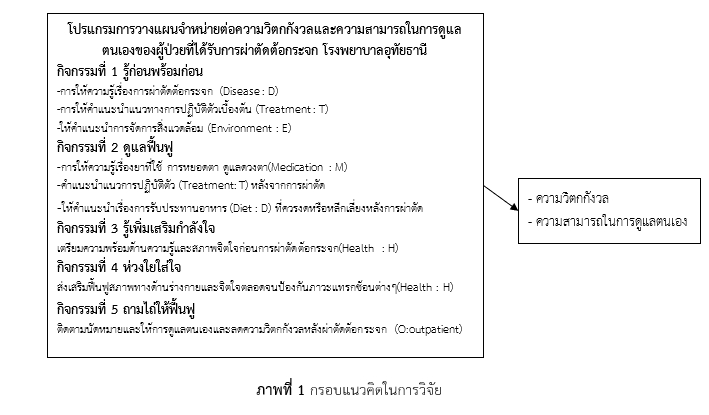
This quasi-experimental study aimed to examine the effects of a discharge planning program on anxiety and self-care ability among patients undergoing cataract surgery at Uthai Thani Hospital. The sample consisted of 78 cataract surgery patients who met the inclusion and exclusion criteria. Participants were randomly assigned by simple randomization (drawing lots) into an experimental group and a control group, with 39 participants in each group. The control group received routine nursing care, while the experimental group received a discharge planning program designed to reduce anxiety and enhance self-care ability, developed based on the D-METHOD principles, consisting of five activities. The research instruments included the discharge planning program, an anxiety assessment questionnaire, and a self-care ability assessment questionnaire for post–cataract surgery patients. Data were analyzed using descriptive statistics, including frequency, percentage, and mean. Differences within groups before and after the intervention were analyzed using paired t-tests, and differences between the experimental and control groups were analyzed using independent t-tests. Statistical significance was set at the .01 level.
The results showed that, after receiving the discharge planning program, the experimental group demonstrated a statistically significant decrease in mean anxiety scores and a significant increase in mean self-care ability scores at the .01 level. When compared between groups, the experimental group exhibited a significantly greater reduction in anxiety and a significantly higher increase in self-care ability than the control group at the .01 level.
In conclusion, the discharge planning program developed based on the D-METHOD effectively reduced anxiety and enhanced self-care ability among patients undergoing cataract surgery. The program should be expanded to outpatient surgical units to reduce anxiety, improve quality of life, and prevent potential postoperative eye infections.
References
กนกพร อริยภูวงศ์, ศุภพร ไพรอุดม, และทานตะวัน สลีวงศ์. (2562). ผลของการพยาบาลระบบสนับสนุนและให้ความรู้ต่อพฤติกรรมการดูแลตนเองของผู้ป่วยผ่าตัดต้อกระจกโรงพยาบาลสุโขทัย. วารสารวิทยาลัยพยาบาลพระจอมเกล้า จังหวัดเพชรบุรี, 2(3), 17–30.
เกษรา ทวีแสง. (2564). ผลของโปรแกรมการลดความวิตกกังวลของผู้ป่วยที่ได้รับการผ่าตัดต้อกระจกในโรงพยาบาลร้อยเอ็ด. วารสารวิจัยและพัฒนานวัตกรรมทางสุขภาพ, 2(1), 163–174.
จิรัชยา เจียวก๊ก, สุภาวี หมัดอะด้ำ, และเขมริฐศา เข็มมะลวน. (2558). ความรู้ความสามารถของครอบครัวในการดูแลผู้สูงอายุหลังผ่าตัดต้อกระจก. วารสารหาดใหญ่วิชาการ, 13(1), 35–45.
พาภรณ์ เยาว์วัฒนานุกุล. (2560). ผลของการใช้โปรแกรมการเตรียมความพร้อมต่อความวิตกกังวลและความรู้เกี่ยวกับการปฏิบัติตัวของผู้ป่วยที่ได้รับการผ่าตัดสลายต้อกระจกในโรงพยาบาลชลบุรี. วารสารโรงพยาบาลสิงห์บุรี, 26(1), 31–44.
ทิพาภัทร เอกวงษา. (2564). ประสิทธิผลการใช้โปรแกรมวางแผนจำหน่ายแบบผู้ป่วยนอกต่อความวิตกกังวลและความสามารถในการดูแลตนเองของผู้ป่วยที่ได้รับการผ่าตัดต้อกระจก. วารสารวิจัยและพัฒนานวัตกรรมทางสุขภาพ, 2(1), 71–78.
นงพิมล นิมิตอานันท์. (2560). การเตรียมจำหน่ายออกจากโรงพยาบาล: แนวคิดและแนวปฏิบัติทางการพยาบาล. วารสารมหาวิทยาลัยคริสเตียน, 23(3), 501–510.
นงลักษณ์ วิรัชชัย. (2555). การกำหนดขนาดตัวอย่างในการทดสอบสมมุติฐานวิจัย. สืบค้นเมื่อ 2 มีนาคม 2568, จาก https://lllskill.com/web/files/GPower.pdf
เพ็ญศรี ปัญโญ, อรพิน มโนรส, มะลิ การปักษ์, และอัญชลี แนวณรงค์. (2566). ผลของโปรแกรมการวางแผนจำหน่ายร่วมกับการใช้แอปพลิเคชันในการให้ความรู้ต่อความรู้และความสามารถในการดูแลตนเองของผู้ป่วยโรคต้อกระจกที่เข้ารับการรักษาในหอผู้ป่วยจักษุ โสต ศอ นาสิก โรงพยาบาลแพร่. PMJCS, 31(2), 1–16.
ยุพาวดี สกุลวรรณรักษ์, และธนสร เธียรธไนศวรรย. (2564). ประสิทธิผลการวางแผนจำหน่ายผู้ป่วยต้อหินที่รักษาด้วยวิธีการผ่าตัด โรงพยาบาลอุดรธานี. วารสารการแพทย์โรงพยาบาลอุดรธานี, 29(1), 127–138.
โรงพยาบาลกรุงเทพ. (2568). ต้อกระจกอย่านิ่งนอนใจ รีบรักษาก่อนต้อสุก. สืบค้นเมื่อ 15 กุมภาพันธ์ 2568, จาก https://www.bangkokhospital.com/th/bangkok/content/cataract-should-not-be-overlooked
เลิศศิลป์ เอี่ยมพงษ์, และพฤกษ์ ไชยกิจ. (2561). ผลของโปรแกรมการเตรียมความพร้อมก่อนผ่าตัดต่อความวิตกกังวลและการฟื้นฟูสภาพหลังผ่าตัดของผู้ป่วยที่ได้รับการผ่าตัดเปลี่ยนข้อเข่าเทียม. วชิรสารการพยาบาล, 20(2), 33–41.
ศิริพร ลวณะสกล. (2564). ประสิทธิผลของโปรแกรมการวางแผนจำหน่ายต่อความสามารถในการดูแลตนเองของผู้ป่วยหลังทำผ่าตัดจอประสาทตาและน้ำวุ้นตา หอผู้ป่วยตาหูคอจมูก โรงพยาบาลสุราษฎร์ธานี. วารสารมหาจุฬานาครทรรศน์, 8(11), 272–285.
อังคนา อัศวบุญญาเดช, ดุจดาว ศุภจิตกุลชัย, และวริศนันท์ ปุรณะวิทย์. (2565). ผลการสอนสุขศึกษาโดยใช้สื่อวีดิทัศน์เรื่องการปฏิบัติตัวหลังทำผ่าตัดต้อกระจกให้กับผู้ป่วยผ่าตัดต้อกระจก. Burapha Journal of Medicine, 9(1), 13–27.
อัจฉรา โพธิ. (2566). ประสิทธิผลของโปรแกรมการวางแผนจำหน่ายต่อความสามารถในการดูแลตนเองของผู้ป่วยหลังผ่าตัดต้อกระจก โรงพยาบาลพระอาจารย์แบน ธนากโร จังหวัดสกลนคร. วารสารอนามัยสิ่งแวดล้อมและสุขภาพชุมชน, 8(3), 989–999.
Healthkpi. (2568). KPI กระทรวงสาธารณสุข. สืบค้นเมื่อ 29 พฤษภาคม 2568, จาก https://healthkpi.moph.go.th/kpi2/kpi-list/view/?id=50
Bloom, B. S., Madaus, G. F., & Hastings, J. T. (1971). Handbook on formative and summative evaluation of student learning. New York, NY: McGraw-Hill.
Burton, M. J., et al. (2021). The Lancet Global Health Commission on Global Eye Health: Vision beyond 2020. The Lancet Global Health, 9(4), e489–e551. from
https://doi.org/10.1016/S2214-109X(20)30488-5
Edmonds, W. A., & Kennedy, T. D. (2017). An applied reference guide to research designs: Quantitative, qualitative, and mixed methods. Thousand Oaks, CA: SAGE Publications.
Lumpkin, S., Kratzke, I., Duke, K., & Chaumont, N. (2024). Twelve tips for preparing a surgical discharge summary: Enabling a safe discharge. MedEdPublish, 13, 39, 1–12. from https://doi.org/10.15694/mep.2024.000039.1
Obuchowska, I., & Konopinska, J. (2021). Fear and anxiety associated with cataract surgery under local anesthesia in adults: A systematic review. Psychology Research and Behavior Management, 14, 781–793. https://doi.org/10.2147/PRBM.S308313
Orem, D. E., Taylor, S. G., & Renpenning, K. M. (2001). Nursing: Concepts of practice (6th ed.). St. Louis, MO: Mosby.
Oymaagaclıo, K., & Ates, S. (2019). Identifying factors affecting anxiety levels in the patients planned for cataract surgery: A cross-sectional study. International Journal of Caring Sciences, 12(2), 639–648.
Rorden, J. W., & Taft, E. (1990). Discharge planning guide for nurses. Philadelphia, PA: W.B. Saunders.
Sakunsuk, S., Luangubol, J., & Promarak, T. (2025). Factors influencing self-care among patients after cataract surgery with intraocular lens implantation during home recovery: A multivariate analysis. Veredas do Direito, 22(3), e223308, 1–23. from
https://doi.org/10.18623/rvd.v22i3.23308
Spielberger, C. D. (1966). Anxiety and behavior. New York, NY: Academic Press.
Tavakol, M., & Dennick, R. (2011). Making sense of Cronbach’s alpha. International Journal of Medical Education, 2, 53–55. from https://doi.org/10.5116/ijme.4dfb.8dfd
Wang, X., et al. (2024). The association between cataract surgery and mental health in older adults: A review. International Journal of Surgery, 110(4), 2300–2312. https://doi.org/10.1016/j.ijsu.2024.2300
World Health Organization. (2023). Blindness and vision impairment. Retrieved June 28, 2025, from https://who.int/news-room/fact-sheets/detail/blindness-and-visual-impairment
Downloads
Published
How to Cite
Issue
Section
License
Copyright (c) 2026 Journal of Health Promotion and Environmental Health Research Health Promotion Centre 8 Udon Thani

This work is licensed under a Creative Commons Attribution-NonCommercial-NoDerivatives 4.0 International License.
Articles in this journal are copyrighted by the published under the Creative Commons Attribution-NonCommercial-NoDerivatives 4.0 International (CC BY-NC-ND 4.0) license.
may be read and used for academic purposes, such as teaching, research, or citation, with proper credit given to the author and the journal.
use or modification of the articles is prohibited without permission.
statements expressed in the articles are solely the opinions of the authors.
authors are fully responsible for the content and accuracy of their articles.
other reuse or republication requires permission from the journal."



