
The effectiveness of THAI program on enhancing autistic children’s development Case study of Thabo Crown Prince Hospital
Keywords:
autistic, THAI Model ,Social emotional developmental stimulation, THAI modelAbstract
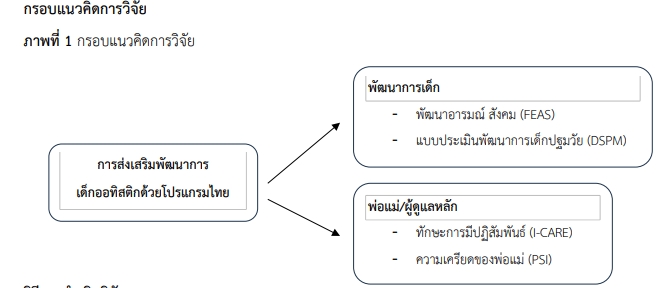
This quasi-experimental study was single group with pretest - posttest design. Objective: The effectiveness of THAI program on enhancing autistic children’s development by comparing the changes in Functional Emotional Assessment Scale (FEAS) , Early Childhood Development Assessments (DSPM), Parenting Stress Index Short Form (PSI-SF) and Parent-Child interaction (I-CARE) before and after using the Thai program. Method: Five families selected by purposive sampling. The THAI Model program is consisting of 1) Parental classroom, 2) Clinic visits by promoting child development and coaching caregivers in the clinic and 3) Home based program to promote home development by caregivers. Data were collected consisting of 1) the questionnaires of demographic 2) the Functional Emotional Assessment Scale (FEAS), 3) Early Childhood Development Assessments (DSPM) 4) the Parenting Stress Index (PSI-SF) and 5) the Parent-Child interaction (I-CARE). Data were analyzed using descriptive statistics and Wilcoxon Signed Rank Test.
Results: Findings Post-program participation significant changes in children had higher mean scores for the functional Emotional Assessment Scale (FEAS) (Z = -1.214, p = 0.225). However, Caregiver’s stress had decreased scores (Z = -0.674, p = 0.500) and Parent- Child interaction (I-CARE) had increased scores (Z = -2.032, p = 0.042) were not statistically significant .
Conclusion: THAI Program improve Parent - Child interaction with autistic children significantly. It can increased scores for social emotion development and reduce Caregiver’s stress but not statistically significant.
Downloads
Published
How to Cite
Issue
Section
License
Copyright (c) 2024 Journal of Health Promotion and Environmental Health ResearchArticles in this journal are copyrighted by the published under the Creative Commons Attribution-NonCommercial-NoDerivatives 4.0 International (CC BY-NC-ND 4.0) license.
may be read and used for academic purposes, such as teaching, research, or citation, with proper credit given to the author and the journal.
use or modification of the articles is prohibited without permission.
statements expressed in the articles are solely the opinions of the authors.
authors are fully responsible for the content and accuracy of their articles.
other reuse or republication requires permission from the journal."



