
The Effectiveness of a Behavioral Promoting Program of Prevention Noise Induce Hearing Loss of Knowledge Health Belief Model and Behavioral Prevention of Noise Induce Hearing Loss among Surin Hospital Personnel
Keywords:
knowledge , health belief model, Behavioral prevention of noise induce hearing loss, noise induce hearing loss, Surin Hospital PersonnelAbstract
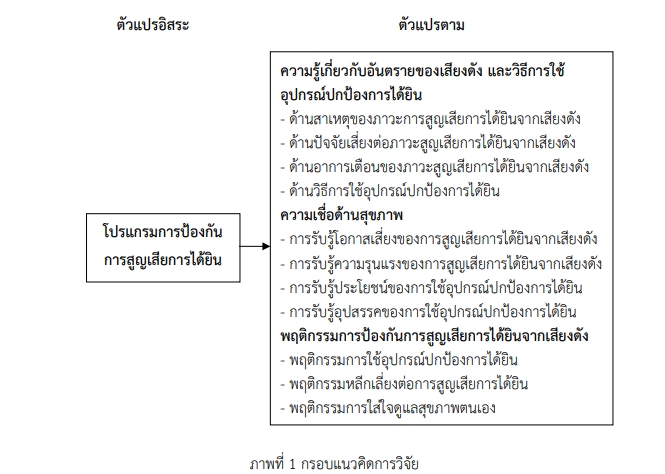
This quasi-experimental study the objective was to study the effects of hearing loss prevention programs. The study population was Surin Hospital personnel working in units exposed to loud noises. The questionnaire passed a content straightness check from 3 experts, all questions had a conformity index (IOC) greater than 0.50 and the alpha coefficient of Cronbach was analyzed with precisions of 0.83, 0.81, 0.81, respectively. Data were collected between November 1 and December 29, 2023. The statistics used in the data analysis were descriptive statistics and paired sample t-test, with a statistical significance level of 0.05.
The results of the study showed that the average score of knowledge about the dangers of loud noises and how to use hearing protection devices. The average of health beliefs scores and the average of preventive behavior scores. Hearing loss from loud noises before and after the implementation there was a statistically significant increase at the level of 0.05. Supervisors/work groups participate in discussions and opinions on how to choose the best protection method that is best suited to the operator. To achieve sustainable solutions in the future. Therefore, this project can be applied to promote protective behaviors. Hearing loss for personnel working with loud noises in other hospitals with similar problems.
Downloads
Published
How to Cite
Issue
Section
License
Copyright (c) 2024 Journal of Health Promotion and Environmental Health ResearchArticles in this journal are copyrighted by the published under the Creative Commons Attribution-NonCommercial-NoDerivatives 4.0 International (CC BY-NC-ND 4.0) license.
may be read and used for academic purposes, such as teaching, research, or citation, with proper credit given to the author and the journal.
use or modification of the articles is prohibited without permission.
statements expressed in the articles are solely the opinions of the authors.
authors are fully responsible for the content and accuracy of their articles.
other reuse or republication requires permission from the journal."



