Mutation Patterns of Isoniazid and Second-Line Drug Resistance in Mycobacterium tuberculosis Complex Using Xpert MTB/XDR in Health Region 12, Thailand
Keywords:
Tuberculosis, Isoniazid resistance, Xpert MTB/XDR assayAbstract
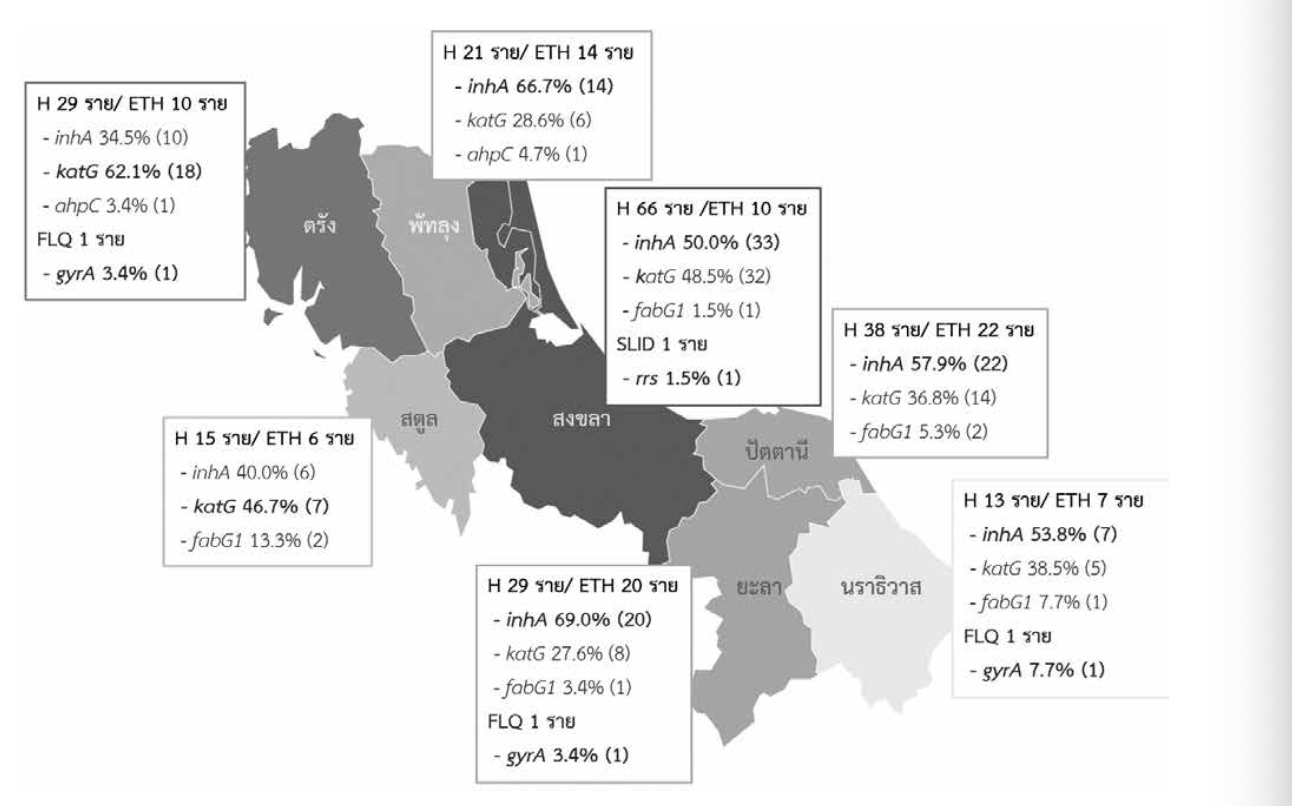
Isoniazid-resistant tuberculosis (Hr-TB) is a major public health problem affecting the efficacy of standard anti-tuberculosis treatment regimens. This study aimed to investigate the mutation patterns of genes associated with resistance to Isoniazid (H) and second-line drug (SLD) in Mycobacterium tuberculosis complex (MTBC) using the Xpert MTB/XDR technique in Health Region 12 at the Tuberculosis Laboratory, TB Center 12, Yala, from October 2022 to September 2024. This retrospective descriptive study identified 211 Hr-TB patients. Most patients were male (male-to-female ratio 3:1), with a median age of 49.0 years (IQR 35–59 years). Newly diagnosed and previously treated cases accounted for 53.6% (n=113) and 46.4% (n=98), respectively. Among mutations associated with H resistance, inhA mutations were most common (53.1%), associated with low-level H resistance and cross-resistance to ethionamide (ETH), followed by katG mutations (42.7%), associated with high-level H resistance. fabG1 and oxyR-ahpC mutations were less frequently detected (3.3% and 0.9%, respectively). Regarding SLD resistance, fluoroquinolone (FLQ) resistance was detected in three cases (1.4%) due to gyrA mutations, and second-line injectable drug (SLID) resistance was identified in one case (0.5%) due to an rrs mutation. All SLD-resistant cases occurred in previously treated patients. In conclusion, the Xpert MTB/XDR assay is a rapid and effective tool for detecting drug resistance. The predominance of inhA over katG mutations reflects an area-specific pattern of H resistance and has important implications for treatment planning. The occurrence of SLD resistance exclusively among previously treated patients highlights the importance of comprehensive drug resistance testing at the initiation of retreatment. Further studies with larger sample sizes and whole-genome sequencing are recommended to monitor transmission dynamics and emerging drug resistance in this setting.
References
World Health Organization. TB incidence [Internet]. Geneva: World Health Organization; 2024 [cited 2025 June 29]. Available from: https://www.who.int/teams/global-programme-on-tuberculosis-and-lung-health/tb-reports/global-tuberculosis-report-2024/tb-disease-burden/1-1-tb-incidence
World Health Organization. Drug resistant TB [Internet]. Geneva: World Health Organization; 2024 [cited 2025 June 29]. Available from: https://www.who.int/teams/global-programme-on-tuberculosis-and-lung-health/tb-reports/global-tuberculosis-report-2024/tb-disease-burden/1-3-drug-resistant-tb
World Health Organization. Country, regional and global profiles [Internet]. Geneva: World Health Organization; 2024 [cited 2025 June 29]. Available from: https://worldhealthorg.shinyapps.io/tb_profiles/?_inputs_&tab=%22tables%22&lan=%22EN%22&iso2=%22TH%22&entity_type=%22country%22
World Health Organization. WHO consolidated guidelines on tuberculosis: Module 1: prevention – tuberculosis preventive treatment. Geneva: World Health Organization; 2020. p. 18. License: CC BY-NC-SA 3.0 IGO
Dean AS, Zignol M, Cabibbe AM, Falzon D, Glaziou P, Cirillo DM, et al. Prevalence and genetic profiles of isoniazid resistance in tuberculosis patients: A multicountry analysis of cross-sectional data. PLoS Med 2020;17:e1003008. doi: 10.1371/journal.pmed.1003008.
กองวัณโรค กรมควบคุมโรค กระทรวงสาธารณสุข. แนวทางการบริหารจัดการผู้ป่วยวัณโรคดื้อยา พ.ศ.2567. พิมพ์ครั้งที่ 1. กรุงเทพมหานคร: สำนักพิมพ์อักษรกราฟฟิคแอนด์ดีไซน์; 2567.
Seifert M, Catanzaro D, Catanzaro A, Rodwell TC. Genetic Mutations Associated with Isoniazid Resistance in Mycobacterium tuberculosis: A Systematic Review. PLoS One. 2015;10(3):e0119628. doi: 10.1371/journal.pone.0119628
Rudeeaneksin J, Phetsuksiri B, Nakajima C, Fukushima Y, Suthachai W, Tipkrua N, et al. Molecular characterization of mutations in isoniazid- and rifampicin-resistant Mycobacterium tuberculosis isolated in Thailand. Jpn J Infect Dis. 2023;76(1):39–45. doi:10.7883/yoken.JJID.2022.055
Harrison GA, Wang ER, Cho K, Mreyoud Y, Sarkar S, Almqvist F, Patti GJ, Stallings CL. Inducing vulnerability to InhA inhibition restores isoniazid susceptibility in drug-resistant Mycobacterium tuberculosis. mBio. 2024 Mar 13;15(3):e0296823. doi:10.1128/mbio.02968-23.
Unissa AN, Subbian S, Hanna LE, Selvakumar N. Overview on mechanisms of isoniazid action and resistance in Mycobacterium tuberculosis. Infect Genet Evol. 2016 Nov;45 :474–92. doi: 10.1016/j.meegid.2016.09.004.
Faïon L, Djaout K, Pintiala C, Piveteau C, Leroux F, Biela A, et al. Exploring the Antitubercular Activity of Anthranilic Acid Derivatives: From MabA (FabG1) Inhibition to Intrabacterial Acidification. Pharmaceuticals (Basel). 2023 Feb 22;16(3):335. doi: 10.3390/ph16030335.
Zhang Y, Dhandayuthapani S, Deretic V. Molecular basis for the exquisite sensitivity of Mycobacterium tuberculosis to isoniazid. Proc Natl Acad Sci U S A. 1996 Nov 26;93(24):13212-6. doi:10.1073/pnas.93.24.13212.
World Health Organization. WHO treatment guidelines for isoniazid-resistant tuberculosis: supplement to the WHO treatment guidelines for drug-resistant tuberculosis. Geneva: World Health Organization; 2018.
World Health Organization. Technical report on critical concentrations for drug susceptibility testing of medicines used in the treatment of drug-resistant tuberculosis. Geneva: WHO; 2018 Mar. Available from: https://www.who.int/publications/i/item/WHO-CDS-TB-2018.5
World Health Organization. WHO consolidated guidelines on tuberculosis: module 3: diagnosis – rapid diagnostics for tuberculosis detection, 3rd ed. Geneva: WHO; Mar 20 2024. Available from: https://www.who.int/publications/i/item/9789240089488
World Health Organization. WHO consolidated guidelines on tuberculosis. Module 3: Diagnosis – Rapid diagnostics for tuberculosis detection 2021 update. Geneva: World Health Organization; 2021. License: CC BY-NC-SA 3.0 IGO
Pillay S, Steingart KR, Davies GR, Chaplin M, De Vos M, Schumacher SG, et al.
Xpert MTB/XDR for detection of pulmonary tuberculosis and resistance to isoniazid, fluoroquinolones, ethionamide, and amikacin. Cochrane Database Syst Rev. 2022 May 18;5(5):CD014841. doi:10.1002/14651858.CD014841.pub2.
Georghiou SB, Schumacher SG, Chakravorty S, Plisova T, Kim EY, Denkinger CM, et al.
Analytical performance of the Xpert MTB/XDR assay for the detection of mutations associated with resistance to isoniazid, fluoroquinolones, and second-line injectable drugs. J Clin Microbiol. 2021 Jul;59(7):e00159-21. doi:10.1128/JCM.00159-21.
World Health Organization. Global Tuberculosis Report 2024. Geneva: World Health Organization; 2024.
Kamolwat P, Nateniyom S, Chaiprasert A, Disratthakit A, Mahasirimongkol S, Yamada N, Smithtikarn S. Prevalence and associated risk factors of drug-resistant tuberculosis in Thailand: results from the fifth national anti-tuberculosis drug resistance survey. Trop Med Int Health. 2020 Nov;26(1):45–53.
กรมควบคุมโรค. สถานการณ์และผลการดำเนินการควบคุมวัณโรคของประเทศไทย ปี พ.ศ.2562-2566. กรุงเทพฯ: กระทรวงสาธารณสุข; 2566.
สุภาพร ทันตา, ธีรศักดิ์ พาจันทร์, สุทิน ชนะบุญ, กฤษณ์ ขุนลึก. ความชุกและปัจจัยที่มีความสัมพันธ์กับวัณโรคดื้อยาหลายขนานของผู้ป่วยวัณโรค เขตสุขภาพที่ 7. วารสารสำนักงานป้องกันควบคุมโรคที่ 7 ขอนแก่น. 2567;31(1):67–78.
Van Deun A, Maug AKJ, Salim MAH, Das PK, Sarker MR, Daru P, et al. Short, highly effective, and inexpensive standardized treatment of multidrug-resistant tuberculosis. Am J Respir Crit Care Med. 2010;182(5):684–92.
Acosta CD, Dadu A, Cegielski JP, Palmero D, Ködmön C, D'Ambrosio L, et al. Transmission of drug-resistant tuberculosis: a systematic review and meta-analysis. Eur Respir J. 2020;55(4):1901541.
Zhang Y, Yew WW. Mechanisms of drug resistance in Mycobacterium tuberculosis. Int J Tuberc Lung Dis. 2009;13(11):1320–30.
Dokrungkoon T, Tulyaprawat O, Suwannakarn K, Ngamskulrungroj P. In vitro modeling of isoniazid resistance mechanisms in Mycobacterium tuberculosis H37Rv. Front Microbiol. 2023;14:1171861. doi:10.3389/fmicb.2023.1171861
Hazbon MH, Brimacombe M, Bobadilla del Valle M, et al. Population genetics study of isoniazid resistance mutations and evolution of multidrug resistant Mycobacterium tuberculosis. Antimicrob Agents Chemother. 2006 Aug;50(8):2640–2649. doi:10.1128/AAC.00112-06
Vilchèze C, Jacobs WR Jr. Resistance to isoniazid and ethionamide in Mycobacterium tuberculosis: genes, mutations, and causalities. Microbiol Spectr. 2014;2(4). doi:10.1128/microbiolspec.MGM2-0014-2013
Wang J, Yu C, Xu Y, Chen Z, Qiu W, Chen S, Pei H, Zhong Y. Analysis of drug-resistance characteristics and genetic diversity of multidrug-resistant tuberculosis based on whole-genome sequencing on the Hainan Island, China. Infect Drug Resist. 2023;16:4523–4534. doi:10.2147/IDR.S424243
Torres JN, Paul LV, Rodwell TC, Victor TC, Amallraja AM, Elghraoui A, et al. Novel katG mutations causing isoniazid resistance in clinical M. tuberculosis isolates. Emerg Microbes Infect. 2015;4(10):e42. doi:10.1038/emi.2015.42
Bollela VR, Namburete EI, Feliciano CS, Macheque D, Harrison LH, Caminero JA. Detection of katG and inhA mutations to guide isoniazid and ethionamide use for drug-resistant tuberculosis. Int J Tuberc Lung Dis. 2016 Aug;20(8):1099-104. doi: 10.5588/ijtld.15.0864.
Isakova J, Sovkhozova N, Vinnikov D, Goncharova Z, Talaibekova E, Aldasheva N, et al. Mutations of rpoB, katG, inhA and ahp genes in rifampicin and isoniazid-resistant Mycobacterium tuberculosis in Kyrgyz Republic. BMC Microbiol. 2018 Mar 22;18(1):22. doi: 10.1186/s12866-018-1168-x.
Solo ES, Nakajima C, Kaile T, Bwalya P, Mbulo G, Fukushima Y, et al. Mutations in rpoB and katG genes and the inhA operon in multidrug-resistant Mycobacterium tuberculosis isolates from Zambia. J Glob Antimicrob Resist. 2020 Sep;22:302-307. doi: 10.1016/j.jgar.2020.02.026.
Nono VN, Nantia EA, Mutshembele A, Teagho SN, Simo YWK, Takong BS, et al. Prevalence of katG and inhA mutations associated with isoniazid resistance in Mycobacterium tuberculosis clinical isolates in Cameroon. BMC Microbiol. 2025 Mar 10;25(1):127. doi: 10.1186/s12866-025-03816-9.
Tseng ST, Tai CH, Li CR, Lin CF, Shi ZY. The mutations of katG and inhA genes of isoniazid-resistant Mycobacterium tuberculosis isolates in Taiwan. J Microbiol Immunol Infect. 2015 Jun;48(3):249-55. doi: 10.1016/j.jmii.2013.08.018.
Charan AS, Gupta N, Dixit R, Arora P, Patni T, Antony K, et al. Pattern of InhA and KatG mutations in isoniazid monoresistant Mycobacterium tuberculosis isolates. Lung India. 2020 May-Jun;37(3):227-231. doi: 10.4103/lungindia.lungindia_204_19.
Jaksuwan R, Tharavichikul P, Patumanond J, Chuchottaworn C, Chanwong S, Smithtikarn S, et al. Genotypic distribution of multidrug-resistant and extensively drug-resistant tuberculosis in northern Thailand. Infect Drug Resist. 2017 Jul 3;10:201-209. doi: 10.2147/IDR.S130203.
Karaipoom P, Saengsawang P, Bromnavej A, Sangsong S, Waseewiwat P, Bunsanong B, et al. Occurrence of multidrug-resistant Mycobacterium tuberculosis in upper Southern Thailand. Vet World. 2024 Jun;17(6):1405-1412. doi: 10.14202/vetworld.2024.1405-1412.
Müller B, Borrell S, Rose G, Gagneux S. The heterogeneous evolution of multidrug-resistant Mycobacterium tuberculosis. Trends Genet. 2013 Mar;29(3):160-9. doi: 10.1016/j.tig.2012.11.005.
Fenner L, Egger M, Bodmer T, Altpeter E, Zwahlen M, Jaton K, et al. Effect of Mycobacterium tuberculosis lineage on drug resistance and clinical manifestations. J Clin Microbiol. 2012 Mar;50(3):822-6. doi: 10.1128/JCM.05613-11.
World Health Organization. Catalogue of mutations in Mycobacterium tuberculosis complex and their association with drug resistance. Geneva: World Health Organization; 2021. p. 20.
Chien JY, Chiu WY, Chien ST, Chiang CJ, Yu CJ, Hsueh PR. Mutations in gyrA and gyrB among Fluoroquinolone- and Multidrug-Resistant Mycobacterium tuberculosis Isolates. Antimicrob Agents Chemother. 2016;60(4):2090-6. doi: 10.1128/AAC.01049-15.
Farhat MR, Jacobson KR, Franke MF, Kaur D, Sloutsky A, Mitnick CD, et al. Gyrase mutations are associated with variable levels of fluoroquinolone resistance in Mycobacterium tuberculosis. J Clin Microbiol. 2016;54(3):727–33. doi: 10.1128/JCM.02775-15.
Uddin MKM, Ather MF, Nasrin R, et al. Correlation of gyr Mutations with the Minimum Inhibitory Concentrations of Fluoroquinolones among Multidrug-Resistant Mycobacterium tuberculosis Isolates in Bangladesh. Pathogens. 2021;10(11):1422. doi:10.3390/pathogens10111422.
Du Q, Dai G, Long Q, et al. Mycobacterium tuberculosis rrs A1401G mutation correlates with high-level resistance to kanamycin, amikacin, and capreomycin in clinical isolates from mainland China. Diagn Microbiol Infect Dis. 2013;77(2):138-142. doi:10.1016/j.diagmicrobio.2013.06.031.
Malik S, Willby M, Sikes D, Tsodikov OV, Posey JE. New insights into fluoroquinolone resistance in Mycobacterium tuberculosis: functional genetic analysis of gyrA and gyrB mutations. PLoS One. 2012;7(6):e39754. doi:10.1371/journal.pone.0039754
Downloads
Published
How to Cite
Issue
Section
License
Copyright (c) 2026 Journal of the Office of DPC 12 Songkhla

This work is licensed under a Creative Commons Attribution-NonCommercial-NoDerivatives 4.0 International License.
วารสาร TCI อยู่ภายใต้การอนุญาต Creative Commons Attribution-NonCommercial-NoDerivatives 4.0 International (CC BY-NC-ND 4.0) เว้นแต่จะระบุไว้เป็นอย่างอื่น โปรดอ่านหน้านโยบายของเราสำหรับข้อมูลเพิ่มเติมเกี่ยวกับการเข้าถึงแบบเปิดลิขสิทธิ์ และการอนุญาต

