Evaluation of Long Term Sub-District Dengue Management activity in Thailand, 2022
Keywords:
Dengue, management evaluation, disease control, subdistrict health managementAbstract
Dengue fever is a mosquito-borne disease and a major public health problem in Thailand. Effective dengue management plays a crucial role in significantly reducing disease transmission. Therefore, evaluating the key components of dengue management is essential for assessing the readiness of local areas and guiding appropriate response strategies. This study aimed to evaluate the implementation of the Sustainable Subdistrict Dengue Management Program, identify key strengths and limitations, and propose approaches for improving dengue management systems at the subdistrict level.
This study was conducted using an evaluation approach with an assessment tool developed from literature review and dengue management guidelines. The tool covered six domains: disease surveillance, vector surveillance, outbreak control, diagnosis and treatment, risk communication, and stakeholder participation. The assessment tool was piloted and refined before being implemented in an online format. A total of 97 subdistricts from 18 provinces conducted self-assessment with supporting evidence after one year of implementation. Subsequently, a central committee reviewed the evidence and assigned scores based on predefined criteria. Data were analyzed using descriptive statistics, including frequency and percentage, and key strengths and limitations were examined by comparing the performance among subdistrict groups at different assessment levels.
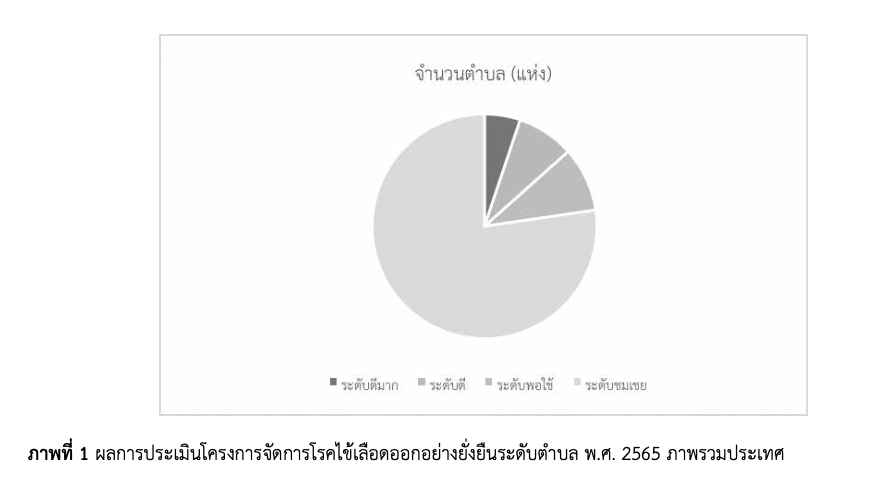
The results showed that 5 subdistricts (5.2%) achieved an excellent level, 8 (8.2%) a good level, 9 (9.3%) a fair level, and 75 (77.3%) as basic level, which requires further development. Subdistricts with excellent and good performance shared several key strengths, including systematic analysis of dengue situation data, maintaining larval indices within recommended thresholds, effective surveillance and outbreak control systems, establishment of Dengue Corners and clear referral pathways, comprehensive risk communication, and active stakeholder engagement. In contrast, common limitations across subdistricts included inadequate data recording and reporting systems, larval indices exceeding standard thresholds, and limited stakeholder participation. Based on these findings, strengthening systematic surveillance, prevention, and control systems is recommended. Standardized reporting and continuous monitoring mechanisms should be established, along with policy support from relevant sectors at all administrative levels. In addition, enhancing stakeholder participation is essential to improve the effectiveness and sustainability of dengue management at the subdistrict level.
References
กองระบาดวิทยา กรมควบคุมโรค. รายงานการเฝ้าระวังโรคทางระบาดวิทยา (506) ณ วันที่ 1 มกราคม 2568. นนทบุรี: กรมควบคุมโรค; 2568.
Runge-Ranzinger S, McCall PJ, Kroeger A, Horstick O. Dengue disease surveillance: an updated systematic literature review. Trop Med Int Health. 2014;19(9):1116-1160.
Nirattisai P. Evaluation of dengue haemorrhagic fever disease surveillance system, Lampang Hospital Center. J Health Sci Scholarsh. 2017;4(2):1-13.
Phonghan A, Ratioran S. รูปแบบการพัฒนาระบบจัดการควบคุมป้องกันการระบาดของโรคไข้เลือดออกแบบมีส่วนร่วมในพื้นที่อำเภอจอมบึง จังหวัดราชบุรี. J MCU Nakhondhat. 2024;11(11):126-135.
กองโรคติดต่อนำโดยแมลง กรมควบคุมโรค. แบบประเมินตำบลจัดการโรคไข้เลือดออกอย่างยั่งยืน (พ.ศ. 2565-2567). นนทบุรี: กรมควบคุมโรค; 2565.
สุนทร หงษ์ทอง. การติดตามประเมินผลการดำเนินงานป้องกันควบคุมโรคไข้เลือดออกของอำเภอเมือง จังหวัดกาญจนบุรี [วิทยานิพนธ์สาธารณสุขศาสตรมหาบัณฑิต]. ชลบุรี: มหาวิทยาลัยบูรพา; 2560.
Somsingjai C, Sirinual S. The development of dengue hemorrhagic fever preventive and control measures by community-based participation, Pafaek Subdistrict, Maechai District, Phayao Province. J Health Sci Community Public Health. 2023;6(2):1-15.
กรมควบคุมโรค. รายงานการประชุมพิจารณาผลการประเมินตำบลจัดการโรคไข้เลือดออกอย่างยั่งยืน ปี พ.ศ. 2565 วันที่ 19 ธันวาคม 2566 ณ ห้องประชุมสมบัติ ชัยเพ็ชร ชั้น 6 อาคาร 4. นนทบุรี: กรมควบคุมโรค; 2566.
Downloads
Published
How to Cite
Issue
Section
License
Copyright (c) 2026 Journal of the Office of DPC 12 Songkhla

This work is licensed under a Creative Commons Attribution-NonCommercial-NoDerivatives 4.0 International License.
วารสาร TCI อยู่ภายใต้การอนุญาต Creative Commons Attribution-NonCommercial-NoDerivatives 4.0 International (CC BY-NC-ND 4.0) เว้นแต่จะระบุไว้เป็นอย่างอื่น โปรดอ่านหน้านโยบายของเราสำหรับข้อมูลเพิ่มเติมเกี่ยวกับการเข้าถึงแบบเปิดลิขสิทธิ์ และการอนุญาต

