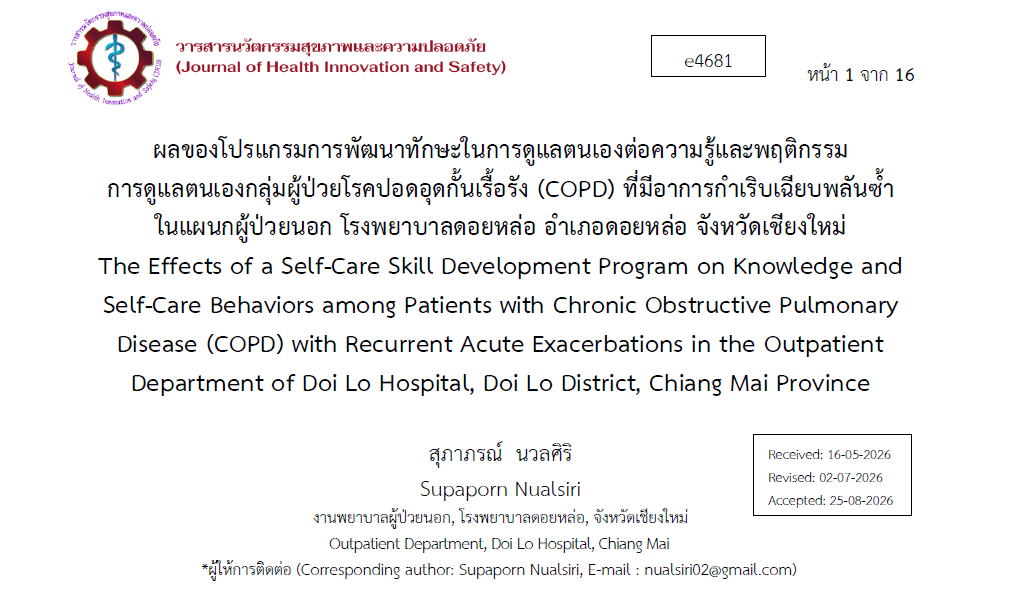
The Effects of a Self-Care Skill Development Program on Knowledge and Self-Care Behaviors among Patients with Chronic Obstructive Pulmonary Disease (COPD) with Recurrent Acute Exacerbations in the Outpatient Department of Doi Lo Hospital, Doi Lo District, Chiang Mai Province
Keywords:
Self-care skill development program, chronic obstructive pulmonary disease (COPD), recurrent acute exacerbations, self-care behaviorsAbstract
This quasi-experimental research, utilizing a one-group pretest–posttest design aimed to examine the effects of a Self-care skill development program on knowledge and Self - care behaviors of 33 patients with chronic obstructive pulmonary disease (COPD) experiencing recurrent acute exacerbations at Doi Lo Hospital, Chiang Mai Province Research instruments consisted of a 6-week Self-care skill development program, a demographic questionnaire, the COPD Assessment Test™ (CAT), a COPD knowledge questionnaire, and a self-care behavior assessment form. Data were collected before and after participation in the program. Descriptive statistics were used to analyze demographic data, while paired t-tests were employed to compare mean scores of knowledge, self-care behaviors, and CAT scores before and after the intervention. Statistical significance was set at p < 0.05.
The results revealed that, after participation in the program, the mean knowledge score significantly increased to a good level (M = 8.58, SD = 0.94, t = -15.34, df = 32, p < .001). The mean self-care behavior score also significantly increased to a good level (M = 51.27, SD = 2.95, t = 5.20, p < .001). Practical training effectively rehabilitated lung function, enabling patients to better control dyspnea and manage initial symptoms. Consequently, the mean recurrent acute exacerbation score significantly decreased (M = 0.70, SD = 0.77, t = 6.12, df = 32, p < .001). Regarding the impact of the disease on quality of life, the CAT assessment showed a significant decrease in the mean score (M = 2.30, SD = 2.08, t = 5.20, df = 32, p < .001).
In conclusion, the 6-week self-care skill development program effectively enhanced patients' abilities to adapt their self-care behaviors appropriately to their specific situations. Therefore, it is a highly suitable and effective approach for preventing recurrent acute exacerbations, minimizing disease impact, and promoting the quality of life among COPD patients at the outpatient department of Doi Lo Hospital
References
ธณิกานต์ ฉายอรุณ และพัชรินทร์ เยาว์ธานี. (2568). ผลของโปรแกรมการจัดการตนเองต่อค่าสมรรถภาพปอดของผู้ป่วยโรคปอดอุดกั้นเรื้อรัง โรงพยาบาลเวียงแก่น จังหวัดเชียงราย. วารสารสำนักงานสาธารณสุขจังหวัดเชียงราย, 1(3), 11–23.
ธีระพันธ์ โต้หนองแปน. (2566). ผลของโปรแกรมสนับสนุนการจัดการตนเองในผู้ป่วยโรคปอดอุดกั้นเรื้อรัง โรงพยาบาลกมลาไสย จังหวัดกาฬสินธุ์. วารสารวิชาการทางการพยาบาลและวิทยาศาสตร์สุขภาพ, 3(1), 6–16. https://he04.tci-thaijo.org/index.php/AJNHS/article/view/152
ฐิติกร นาปัน. (2566). ความสัมพันธ์ของฝุ่นละอองขนาดไม่เกิน 2.5 ไมครอนกับอาการกำเริบเฉียบพลันของโรคปอดอุดกั้นเรื้อรังในอำเภอไชยปราการ จังหวัดเชียงใหม่. วารสารการยศาสตร์ไทย, 6(1), 52–64.
พรทิพย์ อุ่นจิตร, สุภาภรณ์ ด้วงแพง, เขมารดี มาสิงบุญ, อภิชาต ชิงนวรรณ. (2565). ประสิทธิผลของโปรแกรมการส่งเสริมความสามารถในการจัดการภาวะหายใจลำบากเรื้อรังด้วยตนเองต่อผลลัพธ์การจัดการด้วยตนเองในผู้ที่เป็นโรคปอดอุดกั้นเรื้อรัง. วารสารคณะพยาบาลศาสตร์ มหาวิทยาลัยบูรพา 14(1).
ราเชนร์ สุโท, & สุนิดา ปรีชาวงษ์. (2566). ผลของโปรแกรมการจัดการตนเองแบบ 5A ต่ออาการหายใจลำบากและพฤติกรรมการจัดการอาการในผู้ป่วยโรคปอดอุดกั้นเรื้อรัง. วารสารพยาบาลศาสตร์, 41(2), 88–102
สราญรัตน์ ส่งข่าว, เขมารดี มาสิงบุญ, ชุติมา ฉันทมิตรโอภาส, และ ปณิชา พลพินิจ. (2565). ปัจจัยที่มีอิทธิพลต่อการป้องกันการเกิดอาการกำเริบเฉียบพลันในผู้ป่วยโรคปอดอุดกั้นเรื้อรัง. วารสารไทยเภสัชศาสตร์และวิทยาการสุขภาพ, 17(4), 335-343.
สมาคมอุรเวชช์แห่งประเทศไทย ในพระบรมราชูปถัมภ์. (2565). แนวทางการวินิจฉัยและรักษาโรคปอดอุดกั้นเรื้อรัง พ.ศ. 2565. ภาพพิมพ์.
สุรางค์รัตน์ สุรงคบพิตร, ปุลวิชช์ ทองแตง, จีรามัย สมตา. (2567). ผลของโปรแกรมการจัดการตนเองและการมีส่วนร่วมของครอบครัวในผู้ป่วยโรคปอดอุดกั้นเรื้อรัง โรงพยาบาลดอยสะเก็ด จังหวัดเชียงใหม่. สำนักงานสาธารณสุขจังหวัดเชียงใหม่
สำนักงานสาธารณสุขจังหวัดราชบุรี. (2560). แนวทางการดูแลผู้ป่วยโรคปอดอุดกั้นเรื้อรัง COPD : Chronic obstructive pulmonary disease). จังหวัดราชบุรี
โรงพยาบาลดอยหล่อ. (2564). แบบประเมินการเกิดอาการกำเริบซ้ำ. แผนกผู้ป่วยนอก รพ.ดอยหล่อ. อุทัยชนินทร์ จันทร์แก้ว, จิราพร เกศพิชญวัฒนา. ผลของโปรแกรมการพัฒนาทักษะโดยการให้ความรู้และสร้างแรงจูงใจต่ออาการหายใจลำบากของผู้สูงอายุโรคปอดอุดกั้นเรื้อรัง. วารสารวิจัยสุขภาพและการพยาบาล, 36(1), 84–97
Agusti, A., & Vogelmeier, C. F. (2023). GOLD 2024: a brief overview of key changes. Jornal brasileiro de pneumologia; publicacao oficial da Sociedade Brasileira de Pneumologia e Tisilogia, 49(6), e20230369. https://doi.org/10.36416/1806- 3756/e20230369
Global Initiative for Chronic Obstructive Lung Disease. (2024). Global strategy for the diagnosis, management, and prevention of chronic obstructive pulmonary disease. GOLD.
Global Initiative for Chronic Obstructive Lung Disease. (2019). Global strategy for the iagnosis, management, and prevention of chronic obstructive pulmonary disease; 2019.
Miller WR. Rollnick S. (2013). Motivational interviewing: Help people change. 3rd ed. New York.
Orem, D. E. (2001). Nursing: Concepts of practice (6th ed.). Mosby.
Singkam, W., Sinnarong, N., Autchariyapanitkul, K., Sitthisuntikul, K., & Pongpiachan, S. (2024). Effects of PM2.5 and meteorological parameters on the incidence rates of chronic obstructive pulmonary disease (COPD) in the upper northern region of Thailand. National Institute of Development Administration. NIDA Research Article
World Health Organization. (2023). Chronic obstructive pulmonary disease (COPD). https://www.who.int/news-room/fact-sheets/detail/chronic-obstructive-pulmonary-disease-(copd).
Health Data Center. (2025). รายงานอัตราป่วยสูงเป็นอันกับหนึ่งของประเทศไทยในเขตภาคเหนือตอนบน. กระทรวงสาธารณสุข
Downloads
Published
How to Cite
Issue
Section
License
Copyright (c) 2026 Journal of Health Innovation and Safety (JHIS)

This work is licensed under a Creative Commons Attribution-NonCommercial-NoDerivatives 4.0 International License.
1. บทความหรือข้อคิดเห็นใด ๆ ที่ปรากฏในวารสารนวัตกรรมสุขภาพและความปลอดภัย ที่เป็นวรรณกรรมของผู้เขียน บรรณาธิการ ไม่จำเป็นต้องเห็นด้วย
2. บทความที่ได้รับการตีพิมพ์ถือเป็นลิขสิทธิ์ของ วารสารนวัตกรรมสุขภาพและความปลอดภัย