
The Effects of a Competency and Attitude Promotion Program on Infection Prevention Among Nurses in Inpatient Units
Keywords:
infection prevention and control, attitude of health personnel, nurses, competence, inpatientsAbstract
Objectives: To compare the mean scores of infection prevention competency and attitude in inpatient units among registered nurses before and after participating in the competency and attitude promotion program.
Methods: A quasi-experimental study with one-group pretest–posttest design was conducted. The sample comprised 30 registered nurses working in inpatient units at Somdej Phra Sangkharat Ong Thi 19 Hospital, selected by purposive sampling. Data were collected using questionnaires assessing infection prevention and control competency, infection surveillance competency, and attitude toward infection prevention. Data were analyzed using the Wilcoxon signed-rank test and the paired t-test.
Results: After participating in the program, registered nurses had a statistically significant increase in mean infection prevention competency scores (posttest 4.25±0.58 vs. pretest 3.88±0.51; p=0.031) and a significant improvement in attitude toward infection prevention (4.25±0.35 vs. 3.97±0.48; p=0.017). Infection surveillance competency scores increased, but the difference was not statistically significant (4.00±0.66 vs. 3.80±0.48; p=0.170).
Conclusions: Hospitals or service units may apply this program to train and develop personnel including infection control ward nurses (ICWNs), registered nurses, and related staff to strengthen infection prevention systems. However, infection surveillance activities and long-term follow-up should be further emphasized and developed.
References
World Health Organization. (2022, May 6). WHO launches first ever global report on infection prevention and control. https://www.who.int/news/item/06-05-2022-who-launches- first-ever-global-report-on-infection-prevention-and-control
สุจินดา ศรีบัวโรย. สมรรถนะของพยาบาลด้านการควบคุมและการเฝ้าระวังการติดเชื้อ สถาบันบำราศนราดูร. วารสารสถาบันบำราศนราดูร. 2567;18(1):1–12.
สุชาญวัชร สมสอน. ผลการเฝ้าระวังการติดเชื้อในโรงพยาบาลเขตสุขภาพที่ 4 ปี 2565. วารสารวิทยาศาสตร์และเทคโนโลยีสู่ชุมชน. 2022;1(5):45–56. doi: 10.57260/stc.2023.636
Bandura A. Self-efficacy: toward a unifying theory of behavioral change. Psychol Rev. 1977;84(2):191–215. doi: 10.1037/0033-295X.84.2.191
ประภาวดี เวชพันธ์, อรอุมา โชติมโนธรรม, สิริพงษ์ แทนไธสง, สุภาพรณ์ ตัณฑ์สุระ. ผลของโปรแกรมการพัฒนาสมรรถนะพยาบาลวิชาชีพเพื่อป้องกันและควบคุมการติดเชื้อดื้อยาต้านจุลชีพโรงพยาบาล ตติยภูมิแห่งหนึ่งในภาคตะวันออกเฉียงเหนือ. วารสารวิชาการทางการพยาบาลและวิทยาศาสตร์สุขภาพ. 2566;3(2):76–87.
กัลยพัทธ์ นิยมวิทย์, กัญญดา ประจุศิลปะ. สมรรถนะพยาบาลวิชาชีพควบคุมการติดเชื้อประจำหอผู้ป่วย. วารสารพยาบาลตำรวจ. 2558;7(1):153–65.
สมาคมพยาบาลด้านการป้องกันและควบคุมโรคติดเชื้อ. คู่มือสมรรถนะในงานด้านการป้องกันและควบคุมการติดเชื้อสำหรับพยาบาลควบคุมการติดเชื้อ. กรุงเทพฯ: สำนักพิมพ์อักษรกราฟฟิคแอนด์ดีไซน์; 2567.
Lee MH, Yi YM, Noh EY, Park YH. Effects of establishing infection control program with core components of World Health Organization on reducing the risk of residents' infections and improving staff infection control competency in a nursing home. Antimicrob Resist Infect Control. 2024;13(1):136.doi: 10.1186/s13756-024-01492-4
นิศาชล สำแดงเดช. ประสิทธิผลของโปรแกรมสุขศึกษาต่อความรู้ของผู้ดูแลผู้ป่วยโรคหลอดเลือดสมอง หอผู้ป่วยอายุรกรรมหญิง โรงพยาบาลมะการักษ์. วารสารวิชาการและการพยาบาล วิทยาลัยพยาบาลบรมราชชนนี จักรีรัช. 2568;5(1):e2466.
อรุณี นาประดิษฐ์. ความรู้ ทัศนคติ การปฏิบัติงานตามหลักการแพร่กระจายเชื้อของบุคลากร. วารสารศูนย์การศึกษาแพทยศาสตร์คลินิก โรงพยาบาลพระปกเกล้า. 2559;33(1):6–19.
นันท์ธิภา วัฒนเขื่อนขันธ์. ความรู้ ทัศนคติ และพฤติกรรมเกี่ยวกับการควบคุมและป้องกันการติดเชื้อในโรงพยาบาลของพยาบาลวิชาชีพอำเภอแสวงหา จังหวัดอ่างทอง [อินเทอร์เน็ต]. 2567. [เข้าถึงเมื่อ 13 ก.ค. 2568]. เข้าถึงได้จาก: https://sci.rmutsb.ac.th/2024/11/25/ความรู้-ทัศนคติ-และพฤติกรรมเกี่ยวกับการควบคุมและป้องกันการติดเชื้อ/
Tangeraas Hansen MJ, Storm M, Syre H, Dalen I, Husebø AML. Attitudes and self-efficacy towards infection prevention and control and antibiotic stewardship among nurses: A mixed-methods study. J Clin Nurs. 2023;32(17-18):6268–86.doi:10.1111/jocn.16657
Hyeon YH, Moon KJ. Development of an infection control competency scale for clinical nurses: an instrument design study. BMC Nurs. 2024;23(1):250.doi: 10.1186/s12912-024-01904-1
สมพร สังข์แก้ว, ธีรนุช ห้านิรัติศัย, บุญใจ ศรีสถิตย์นรากูร. สมรรถนะพยาบาลวิชาชีพด้านการพยาบาลผู้ป่วยโรคติดต่ออุบัติใหม่. วารสารสภาการพยาบาล. 2563;35(3):69–86.
Ajzen I. The theory of planned behavior. Organ Behav Hum Decis Process. 1991;50(2):179–211. doi: 10.1016/0749-5978(91)90020-T
ธวัชชัย ยืนยาว, ไวยพร พรมวงค์, กัลยา รัตนคาดสนิท. ความรู้ ทัศนคติ และพฤติกรรมการป้องกัน การติดเชื้อไวรัสโคโรนาสายพันธุ์ใหม่ 2019 (COVID-19) ของนักศึกษาพยาบาลในเครือข่ายวิทยาลัยพยาบาลภาคตะวันออกเฉียงเหนือ. วารสารการแพทย์โรงพยาบาลอุดรธานี. 2564;29(2):204–13.
Ayed A, Malak MZ, Ayed M, Allayed R, Shouli M. Knowledge, attitudes, and practices toward infection control precautions among nurses in Palestinian hospitals. Int J Nurs Educ Scholarsh. 2024;21(1):20230117. doi: 10.1515/ijnes-2023-0117
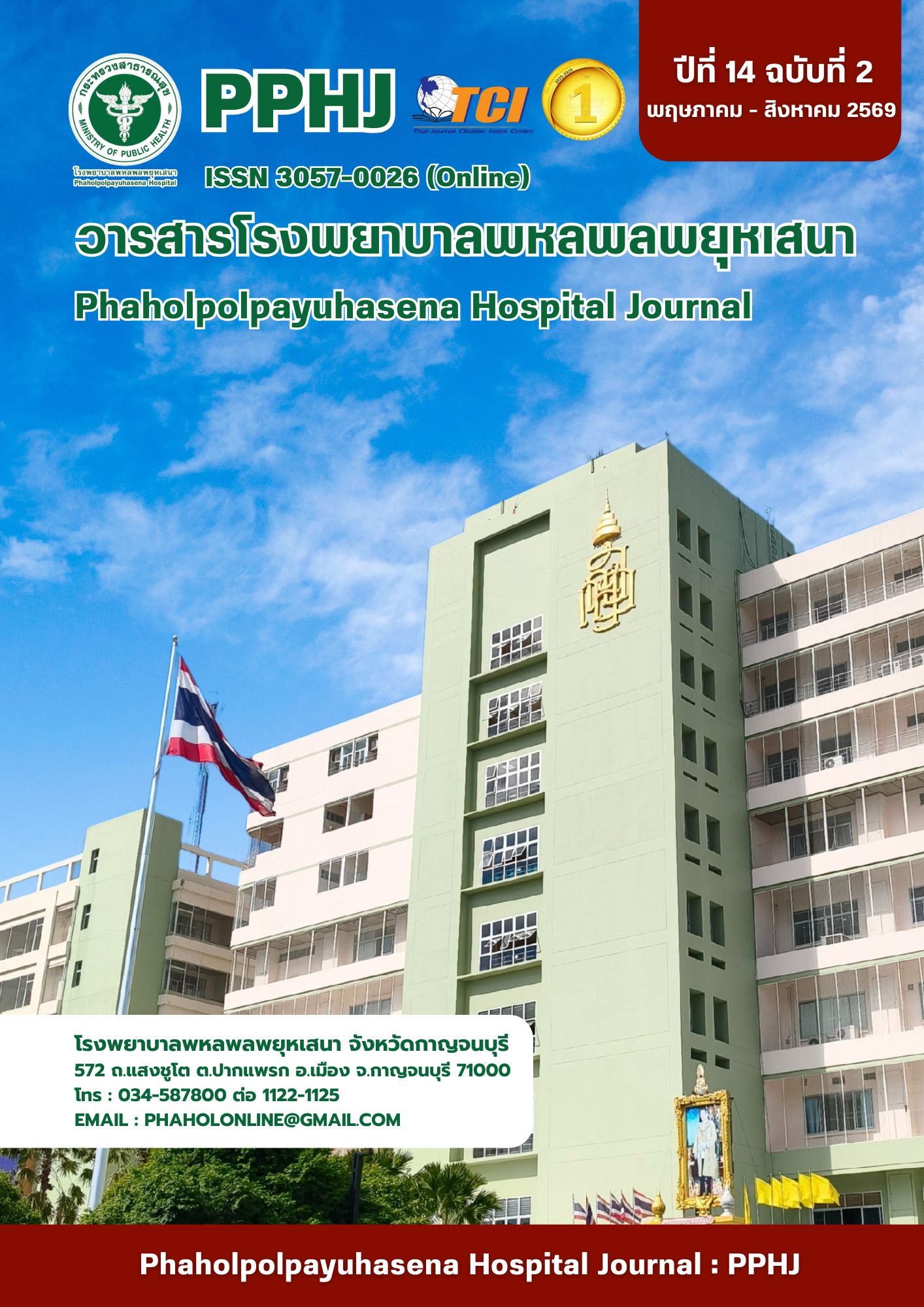
Downloads
Published
How to Cite
Issue
Section
License
Copyright (c) 2026 Phaholpolpayuhasena Hospital

This work is licensed under a Creative Commons Attribution-NonCommercial-NoDerivatives 4.0 International License.
บทความที่ได้รับการตีพิมพ์เป็นลิขสิทธิ์ของโรงพยาบาลพหลพลพยุหเสนา
ข้อความที่ปรากฏในบทความแต่ละเรื่องในวารสารวิชาการเล่มนี้เป็นความคิดเห็นส่วนตัวของผู้เขียนแต่ละท่านไม่เกี่ยวข้องกับโรงพยาบาลพหลพลพยุหเสนาและบุคลากรท่านอื่น ๆ ในโรงพยาบาลฯ แต่อย่างใด ความรับผิดชอบองค์ประกอบทั้งหมดของบทความแต่ละเรื่องเป็นของผู้เขียนแต่ละท่าน หากมีความผิดพลาดใด ๆ ผู้เขียนแต่ละท่านจะรับผิดชอบบทความของตนเอง

 Phaholpolpayuhasena Hospital
